The Fenomeno Takes Red Dot’s Top Prize for ‘Hyper-Elegant’ Design
Lamborghini’s Fenomeno, the 29-unit few-off hypercar built on the Revuelto’s architecture, has earned the Red Dot: Best of the Best 2026 award in the Product Design category. The distinction is the jury’s highest tier, reserved for work the organization considers a new benchmark in quality, creativity, and vision. The formal ceremony takes place July 7 at the Aalto Theater in Essen, Germany.
What makes this win worth examining closely is the reason behind it. The Fenomeno is the vehicle Lamborghini chose to debut what Design Director Mitja Borkert calls a “hyper-elegant” design language, a deliberate pivot from the layered, angular complexity that defined the Aventador lineage and, to a lesser extent, the Revuelto. Borkert described the car as a project that “expands our design language once again in an unexpected way” while “continuing the bloodline of our successful few-off cars in an athletic and elegant way.” The Red Dot jury, in effect, validated that pivot on a global stage.
For a brand whose visual identity has been synonymous with sharp aggression for decades, earning a top design award specifically for restraint is a meaningful signal. It suggests Lamborghini’s next chapter of production cars could look quite different from the ones filling current showrooms.
What ‘Hyper-Elegant’ Actually Means When You Look at the Car
Strip away the marketing vocabulary and the Fenomeno’s design philosophy boils down to a specific idea: reduce the number of visual elements and make the ones that remain do more work. Lamborghini says the concept combines formal purity with functional effectiveness, and the studio images bear that out.
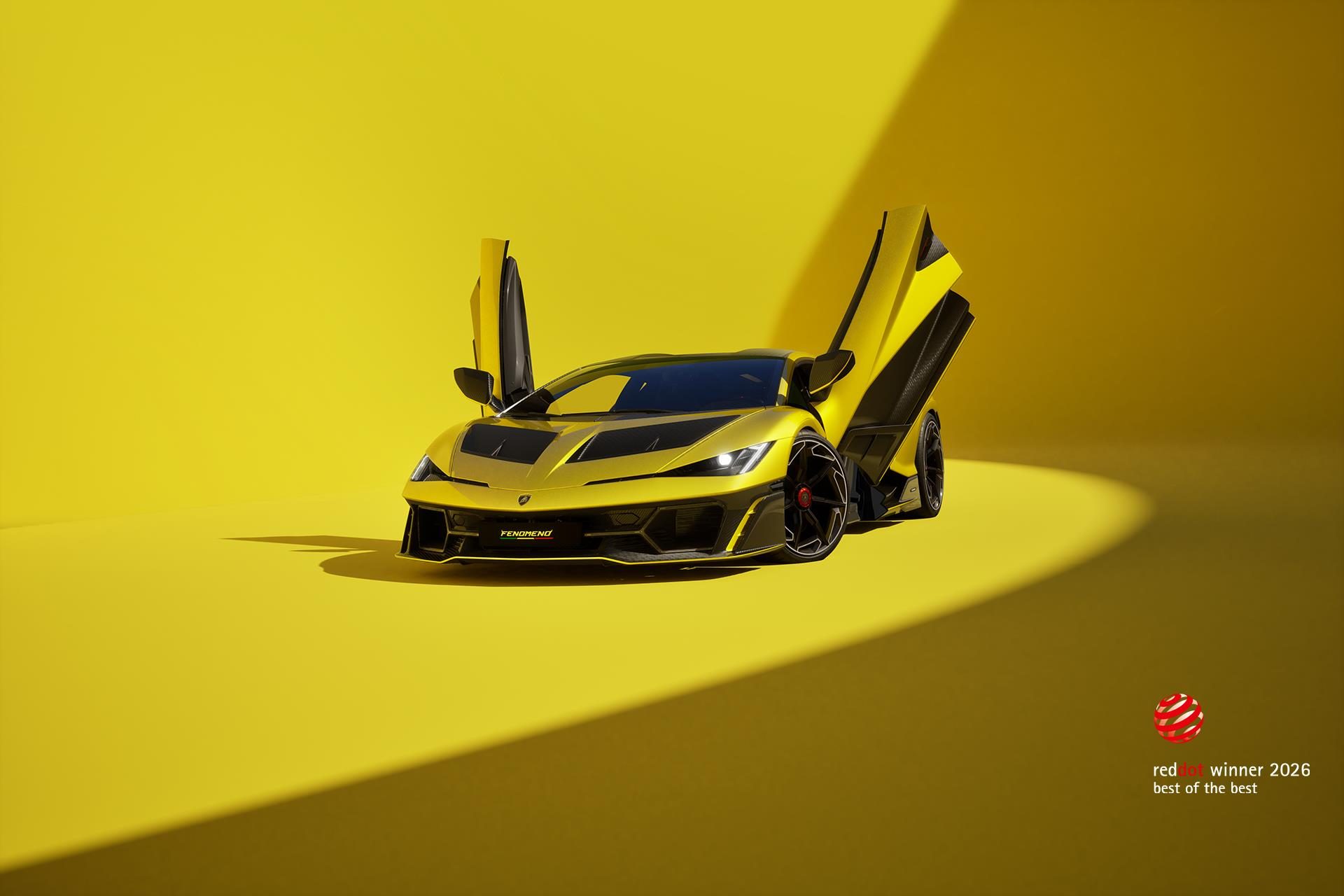
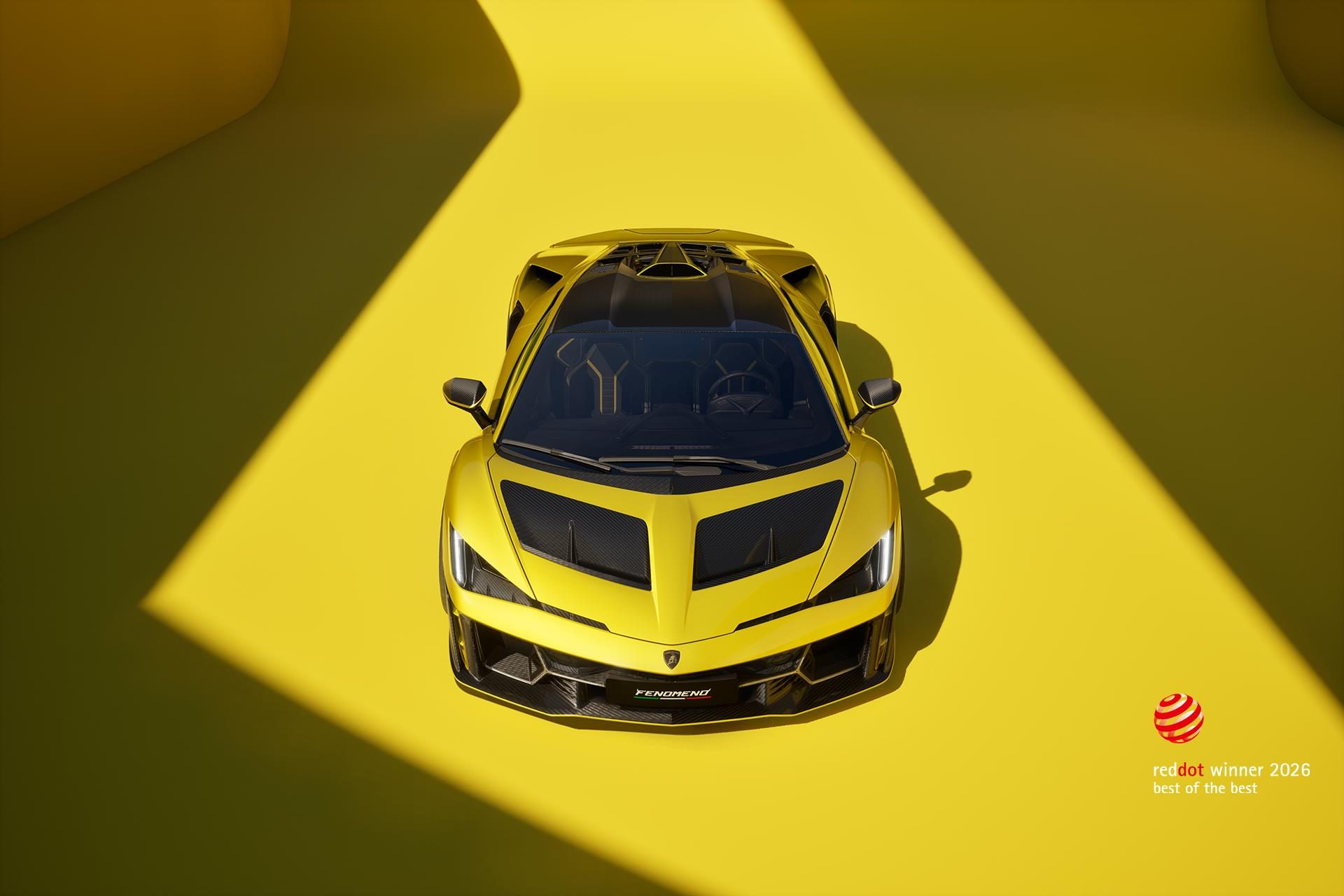
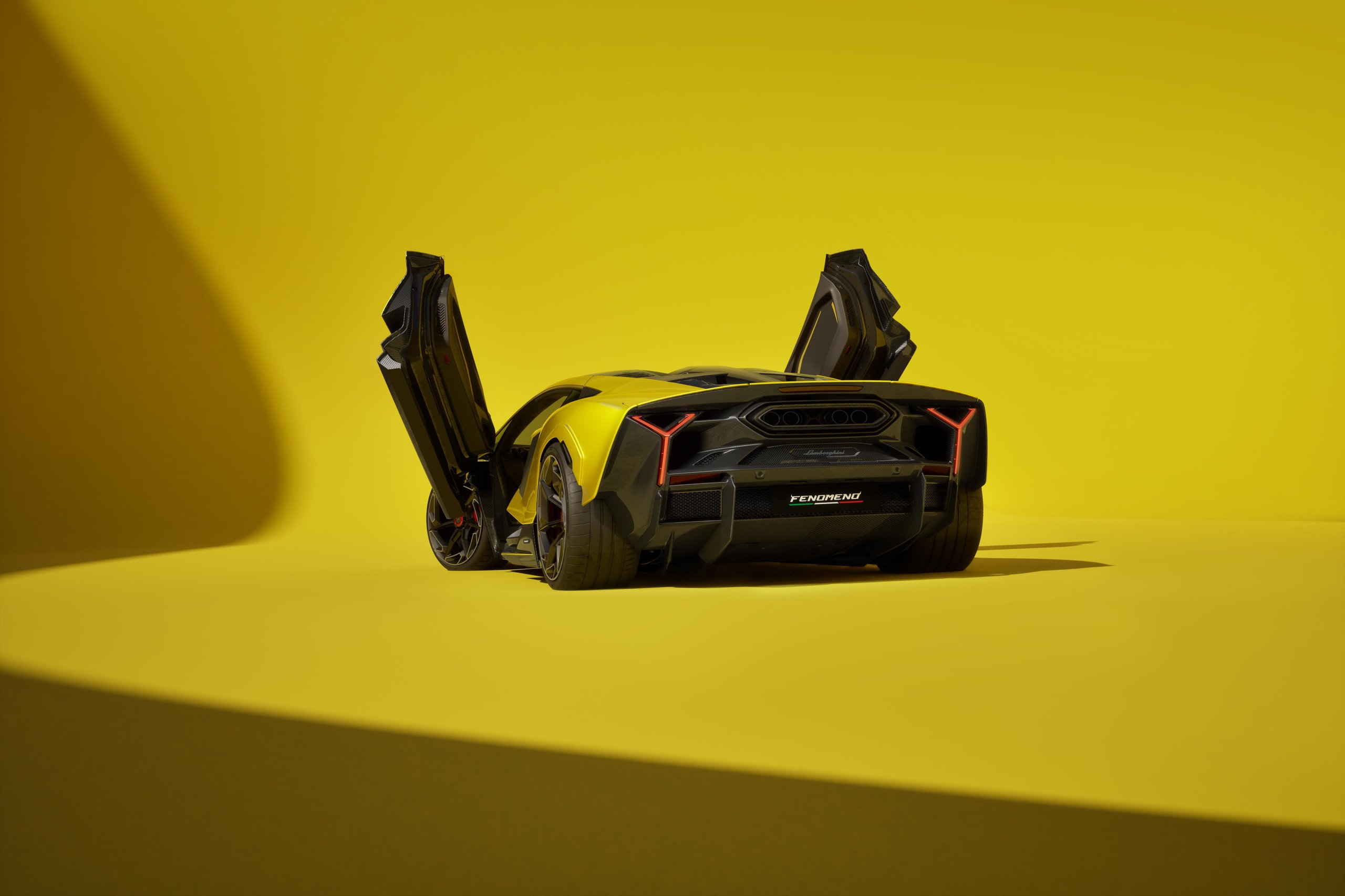
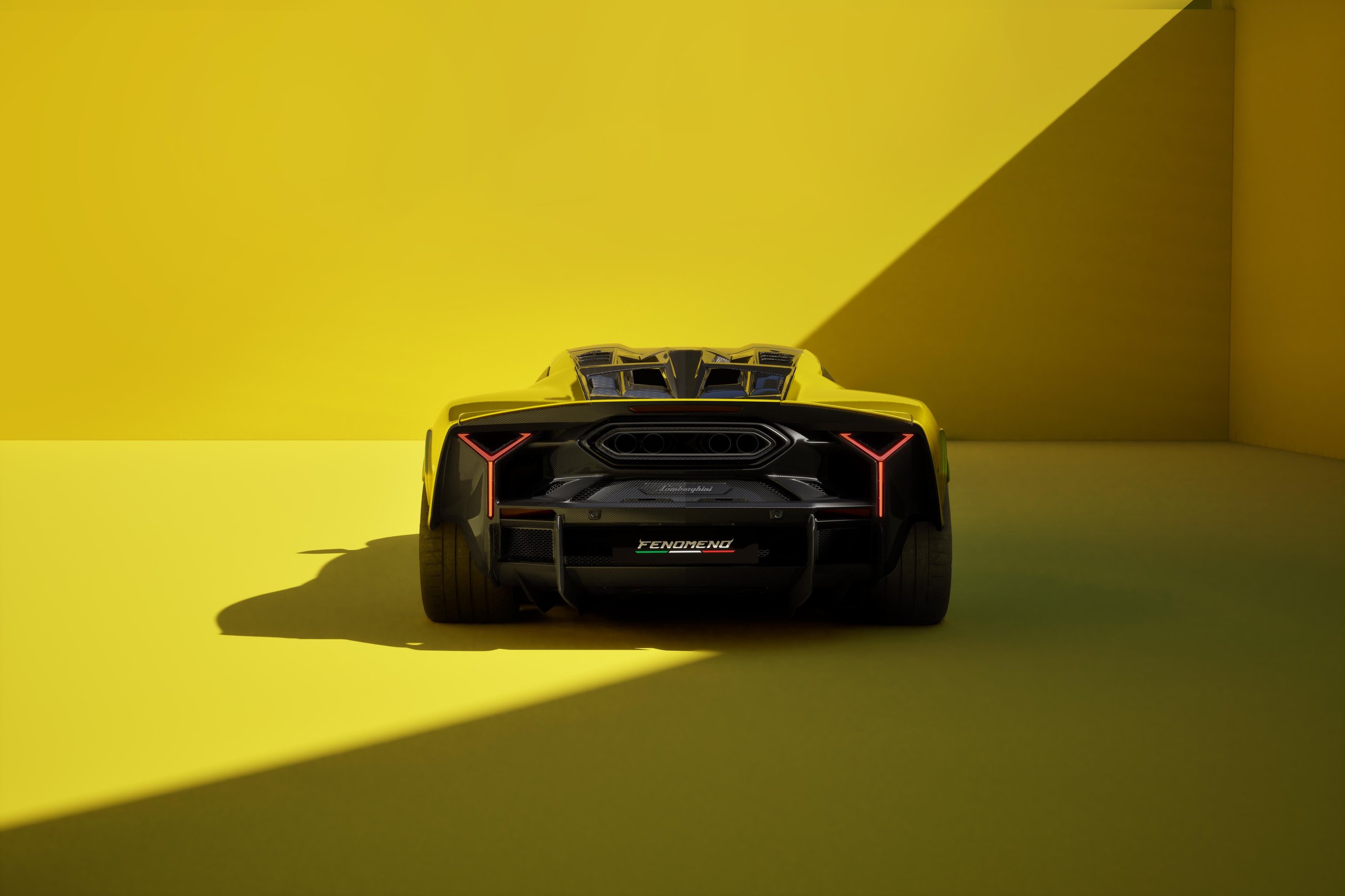
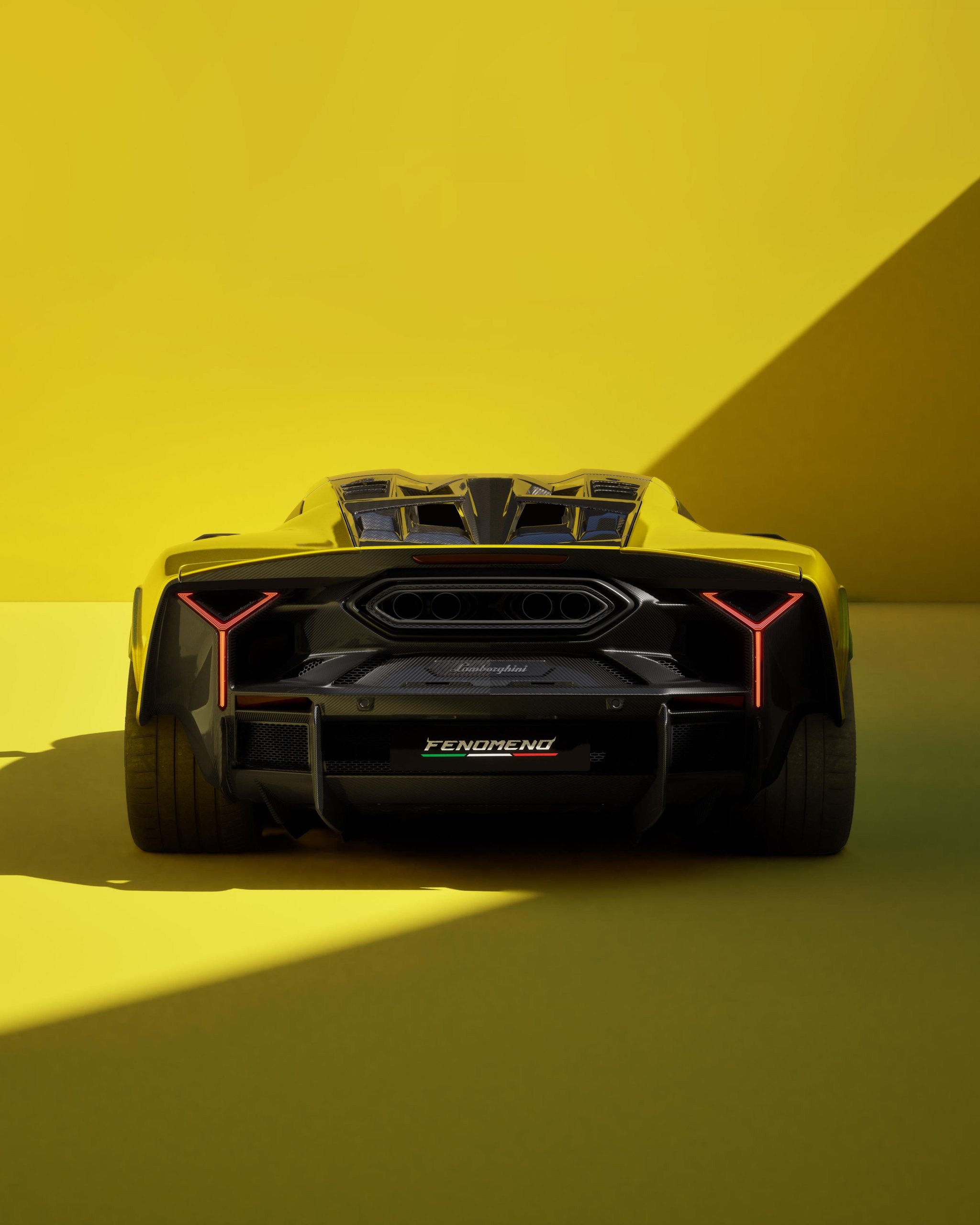
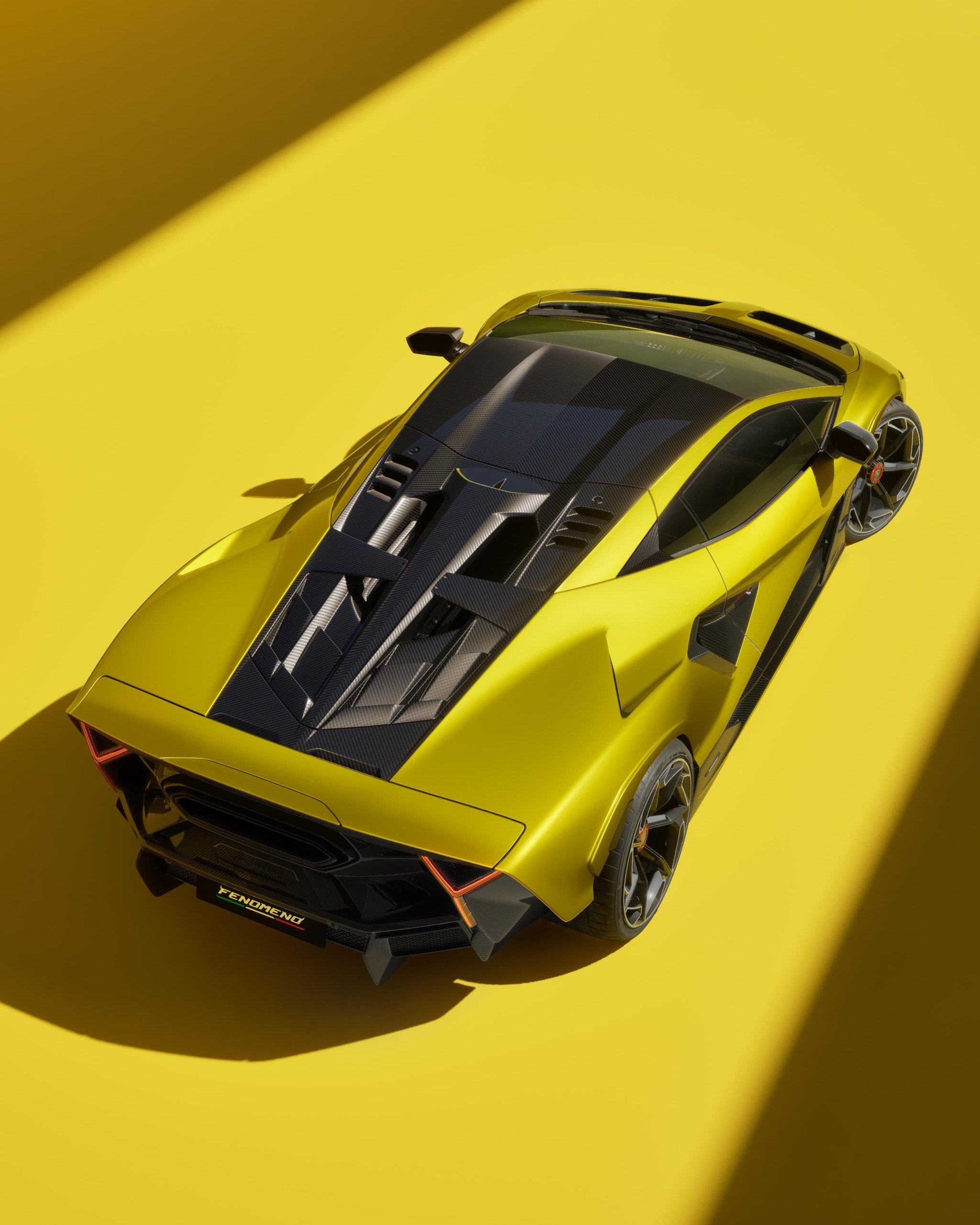
The side profile runs on a single continuous character line from nose to tail, a deliberate echo of the Essenza SCV12‘s long-tail proportions. Compared to the Revuelto’s busier flanks, the Fenomeno reads as a single, unbroken gesture. Up front, the daytime running light signature references the horn from the Lamborghini shield logo, while Y-shaped graphics link the carbon fiber splitter to the headlights. At the rear, that Y-motif carries into the LED taillights, framed by hexagonal exhaust outlets and an aggressive diffuser wrapped in exposed carbon fiber weave.
The Giallo Crius launch livery amplifies the two-tone strategy: glossy yellow paint dominates the upper body, while matte black carbon fiber elements handle the lower aerodynamic surfaces. The effect separates the car visually into a sculpted upper volume and a functional lower platform, making the body appear lighter and more athletic than the Revuelto from which it descends.
This is not surface styling divorced from engineering. One report notes the Fenomeno’s doors were redesigned to channel air toward side-mounted intakes, reportedly improving cooling by 30 percent. Another source describes an S-duct in the front end, a feature borrowed from GT3 race car aerodynamics. Together they suggest Centro Stile and Lamborghini’s aero team worked in closer concert than on previous few-offs, where visual drama sometimes led the conversation.

The Lamborghini Fenomeno concept car's side profile reveals its extreme aerodynamic design and flowing lines. Image: Automobili Lamborghini.
Centro Stile at Twenty: The Fenomeno as a Design Manifesto
The timing of this award is not accidental. The Fenomeno was conceived to mark the 20th anniversary of Lamborghini’s Centro Stile, the in-house design center that opened in 2005 at the Sant’Agata Bolognese campus. Under Borkert’s direction since 2016, Centro Stile produced the Sian, the reborn Countach LPI 800-4, and the Essenza SCV12. Each of those few-offs explored a different facet of the brand’s heritage, but none attempted to redefine the underlying visual grammar the way the Fenomeno does.
Previous limited cars leaned heavily on nostalgia (the Countach) or track-only extremism (the Essenza). The Fenomeno occupies new territory: a road-legal hypercar that tries to look sophisticated rather than ferocious. Whether that direction will filter into the next generation of series-production Lamborghinis is the question enthusiasts should be watching. If Borkert’s team can apply this reduction philosophy to a future Urus refresh or the next model cycle after the Temerario, the entire brand could shift its visual register within a few years.
As Road & Track reported in an interview with Lamborghini CTO Rouven Mohr, the Fenomeno represents a new type of few-off for the company, one that goes beyond simply rebodying a series-production platform. That distinction matters because it positions the Fenomeno not as a collector’s novelty but as a genuine engineering and design testbed, the kind of project whose lessons feed directly into future production cars.
1,080 Horsepower and the Fastest Lamborghini Claim
The design story would ring hollow without the mechanical substance to support it, and the Fenomeno delivers on that front. Lamborghini says the car pairs its most powerful naturally aspirated V12 to date with three electric motors for a combined 1,080 horsepower. The V12 alone reportedly produces 835 CV at 9,250 rpm, according to one report, while two electric motors sit on the front axle and a third integrates above the eight-speed dual-clutch gearbox. Claimed performance figures include 0 to 100 km/h in 2.4 seconds, 0 to 200 km/h in 6.7 seconds, and a top speed exceeding 350 km/h. A weight-to-power ratio of 1.64 kg/CV sets a new internal benchmark.
Those numbers make the Fenomeno the fastest Lamborghini ever built, per the company’s own claims. Context helps: the Revuelto, which shares the basic platform, produces 1,015 CV and hits 100 km/h in 2.5 seconds. The Fenomeno’s gains come from extracting more from the V12, shedding weight through additional carbon fiber, and refining the aero package. One source mentions CCM-R Plus carbon-ceramic brakes adapted from Lamborghini’s SC63 endurance race car, along with race-derived firm dampers, suggesting the chassis tuning skews considerably harder than the Revuelto’s road-biased setup.
For the 29 buyers who secured their cars before the public reveal, this is the closest thing to an SC63 experience with license plates. Lamborghini has not disclosed pricing, and no delivery timeline has been confirmed. All 29 allocations are spoken for.

Intricate details of the Lamborghini Fenomeno's rear reveal its Y-shaped LED taillights and carbon fiber elements. Image: Automobili Lamborghini.
Where the Fenomeno Sits Against Rival Hypercars
Lamborghini’s few-off strategy occupies a distinct lane in the hypercar market. Ferrari’s limited-production approach with cars like the SF90 XX Stradale leans on turbocharged mid-engine architecture and active aerodynamics; McLaren’s recent limited models have emphasized lightweight carbon construction and driver engagement above outright power. The Fenomeno’s differentiator is its insistence on a naturally aspirated V12 as the centerpiece, supplemented rather than replaced by electrification. No other current hypercar manufacturer builds a road car around a high-revving, atmospheric twelve-cylinder engine with electric assist arranged this way.
The “hyper-elegant” design angle carves out competitive space, too. Ferrari’s limited cars tend toward aggressive visual complexity; McLaren favors technical minimalism but with a clinical, almost industrial aesthetic. Lamborghini is attempting something in between: dramatic proportions with cleaner surfaces. Whether the Red Dot jury’s endorsement translates into broader design influence remains to be seen, but the award gives Lamborghini a credible external validation that competitors in the few-off space rarely pursue.
Online discussion around the Fenomeno has been predictably divided. Multiple enthusiast forums reflect a split between those who find the design a compelling evolution and those who see it as too restrained for a brand built on visual shock. Some forum members have questioned whether a rebodied Revuelto justifies the few-off price premium, while others appreciate that Lamborghini continues to build cars around a naturally aspirated V12 when the industry trend points firmly toward downsized turbo engines.

The Lamborghini Fenomeno concept car makes a bold statement with its open scissor doors and aggressive front design. Image: Automobili Lamborghini.
What the Fenomeno Signals for Lamborghini’s Next Production Cars
Few-off models have always served a dual purpose at Sant’Agata: they reward top collectors with exclusivity, and they let the design team test ideas that would be too risky for a volume car. The Reventon previewed the Aventador’s angular language. The Sian introduced the brand’s first hybrid V12 architecture. If the pattern holds, the Fenomeno’s hyper-elegant vocabulary is a preview of what Lamborghini’s production lineup could look like in the next design cycle.
Borkert’s team now has a Red Dot Best of the Best trophy validating the direction, which gives internal advocates for the cleaner aesthetic real ammunition in future product-planning meetings. For prospective buyers waiting on the next Revuelto update or watching the Temerario evolve, the practical takeaway is straightforward: expect Lamborghini’s surfaces to get simpler, its character lines fewer, and its visual identity to rely more on proportion and sculptural confidence than on the layered aggression of the Aventador era.
Whether that shift excites or concerns you probably depends on how you feel about the brand’s recent trajectory. The V12 remains. The scissor doors remain. The performance keeps escalating. What changes is the suit the car wears, and the Fenomeno suggests the next one will be cut with considerably more discipline.
Gallery