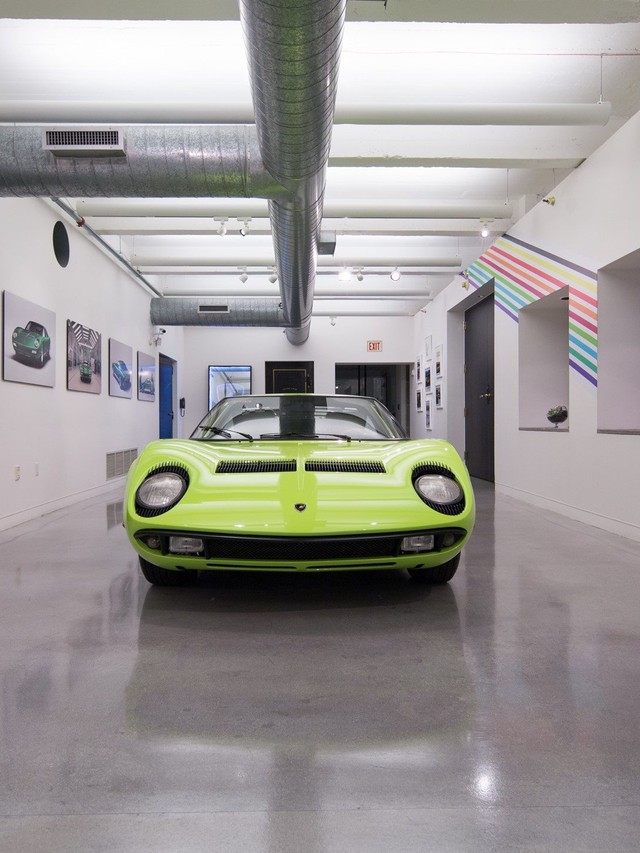
A Miura in a Museum: Lamborghini’s Art Basel Gambit
During Art Basel Miami Beach 2019, Lamborghini installed a 1968 Miura on the second floor of The Wolfsonian-FIU museum in Miami’s Art Deco district, converting the gallery into an immersive 1960s installation titled “A Dreamscape of Italian Design.” The private VIP gathering placed the lime green Miura alongside period archival photographs sourced from the company’s archives in Sant’Agata Bolognese, all within a broader celebration of Italian leaders in design, architecture, and fashion.
The venue itself carried the argument. The Wolfsonian-FIU is a serious design and propaganda museum, not a convention center or a hotel lobby. Positioning a car inside it, surrounded by framed period images on gallery walls and bathed in the kind of lighting reserved for sculpture, sent a deliberate message: this object belongs in the same conversation as the furniture, typography, and industrial design the museum normally collects. Cristiano Musillo, Consul General of Italy in Miami, reinforced that framing at the event, describing Lamborghini as “the perfect symbol of the beautiful and well-crafted Made in Italy, ‘il Bello e il Ben Fatto italiano.'”
Gandini’s Masterwork: Why the Miura Earns Gallery Walls
Plenty of classic cars look beautiful. Fewer fundamentally changed what a car could be. Produced between 1966 and 1973, the Miura was the first supercar with a rear-mid-engine, two-seat layout to make a genuine international impact. Marcello Gandini designed its body during his tenure at Bertone, reportedly going from initial sketch to prototype in roughly three months. The result was a car whose proportions were dictated by engineering rather than decoration: the transversely mounted V12 sat behind the cabin, pulling mass inward and freeing up the front end to taper into that impossibly long, sharply pointed bonnet.
Gandini treated the Miura as a complete object where mechanics and style were inseparable. The surfaces are nearly flat, curving only slightly, with sharp edges and almost no superfluous ornamentation. The cabin sat just 110 centimeters above the ground. Every element served the car’s aerodynamic and structural purpose while simultaneously creating a silhouette that looked like nothing else on the road.
The irony, well documented in design histories, is that Gandini himself reportedly viewed the Miura as a “compromise” and a “transition line” in his early career. He considered it a blend of aggression and a certain softness that still nodded to 1950s sports car tradition; his later Countach would push further into radical, angular territory. For collectors and design scholars, that tension between restraint and revolution is precisely what makes the Miura so enduring. It occupies a pivot point in automotive aesthetics, the moment the supercar template crystallized. Placing it inside a museum dedicated to the power of design objects was, in that light, less a marketing stunt than a statement of fact.
Heritage as Strategy: What Lamborghini Was Really Selling
Lamborghini did not bring a current production car to Art Basel. No Aventador SVJ, no Urus, no configurator kiosk. Leading with a model more than 50 years old rather than anything from the current lineup told you exactly what the company was selling: heritage, cultural legitimacy, and the idea that Lamborghini’s contribution to Italian design transcends the automotive industry.
The audience made the strategy legible. Art Basel Miami Beach attracts collectors, gallerists, architects, and the broader ultra-high-net-worth community that overlaps significantly with Lamborghini’s buyer base but does not necessarily walk into dealerships. A Miura in a museum context says “we belong here” in a way that parking an Aventador outside a cocktail party never could. It also reinforces Lamborghini’s Polo Storico program, the company’s heritage division dedicated to certifying, restoring, and preserving classic models, as a serious custodial effort rather than a marketing afterthought.
Lamborghini returned to Art Basel Miami Beach in subsequent years. One report indicates the brand celebrated its 60th anniversary at the event in 2023 with a Revuelto “Opera Unica,” suggesting this was not a one-off experiment but a recurring pillar of the company’s cultural positioning strategy. The through line from the 2019 Miura exhibit to a bespoke Revuelto four years later is consistent: Lamborghini keeps choosing art-world stages to make its case for design permanence.
A Different Lane from Ferrari and McLaren
Ferrari maintains its own museum complex in Maranello and regularly lends cars to design exhibitions globally, but its cultural strategy tends to emphasize motorsport heritage and the Prancing Horse as a lifestyle brand through restaurants, branded experiences, and fashion collaborations. Porsche operates a well-regarded museum in Stuttgart and sponsors design awards, leaning into its engineering narrative. McLaren has occasionally placed cars in design contexts, though its brand identity skews more toward technology and Formula 1 than Italian artisanship.
Lamborghini’s Art Basel approach occupies different ground. By embedding a single historic car inside an independent museum’s curated installation, alongside non-automotive Italian design masterpieces, the company positioned itself as a peer of those disciplines rather than a guest. The Miura was not displayed as a car at an art fair. It was displayed as Italian design that happens to have an engine.
For Lamborghini enthusiasts, this distinction carries real weight. The brand’s identity was forged by Ferruccio Lamborghini’s desire to build grand touring cars that could rival Ferrari in refinement and beauty, not just speed. Choosing the Miura for this context, rather than the more aggressive Countach or Diablo, signals that Lamborghini understands which of its icons best embodies that original aspiration. The Miura remains the purest expression of the idea that a Lamborghini should be, above all, a beautiful object.
What the Miura Still Teaches Lamborghini
Owners and prospective buyers should note what this kind of cultural investment signals about Lamborghini’s direction. As the brand navigates hybridization and electrification across its lineup, anchoring its public identity to a model universally regarded as one of the most beautiful cars ever designed is a way of promising that aesthetic ambition will survive the powertrain transition. Whether Centro Stile, Lamborghini’s in-house design studio, can deliver on that promise with future models remains the open question, but the intent is clear.
Miura values in the collector market reflect the car’s dual status as both a performance milestone and a design icon. Lamborghini has not disclosed pricing or provenance details for the specific 1968 example shown at The Wolfsonian-FIU, but the model’s broader market trajectory speaks for itself: clean examples routinely command attention at major auction houses, and the car’s presence at events like Pebble Beach and the Bologna Fair (where a Miura P400 appeared as recently as October 2025) confirms its continued relevance in the collector world.
The exhibit at The Wolfsonian-FIU ran through December 9, 2019. For anyone who missed it, the takeaway is less about one evening in Miami and more about what Lamborghini chose to say when it had a museum’s walls at its disposal. It said the Miura is art. Given what Gandini accomplished with a three-month design sprint and a transverse V12 in 1966, that claim is difficult to argue with.
Gallery


