10,112 Cars, €723 Million in Profit, and a Margin Most Luxury Houses Would Kill For
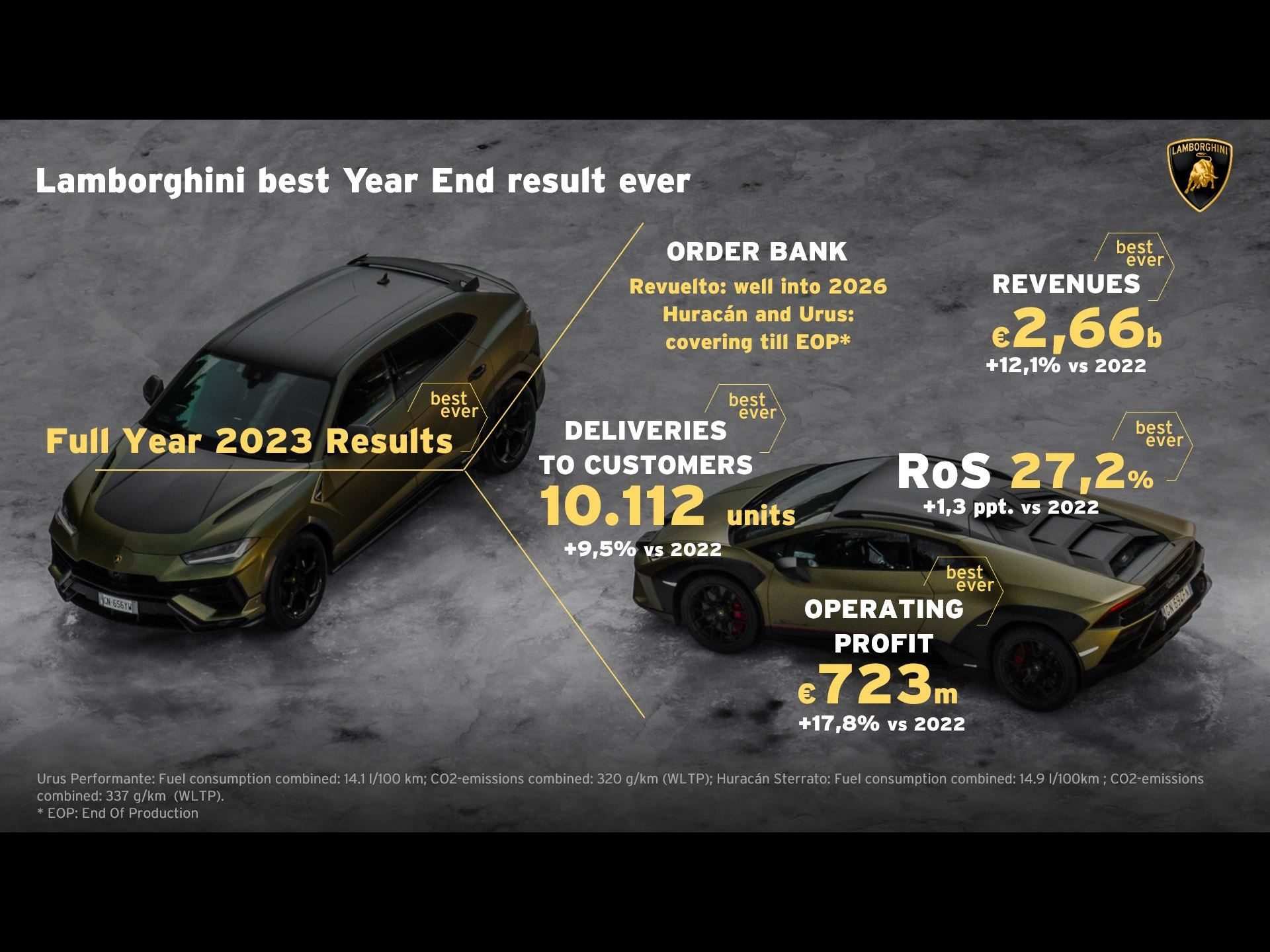
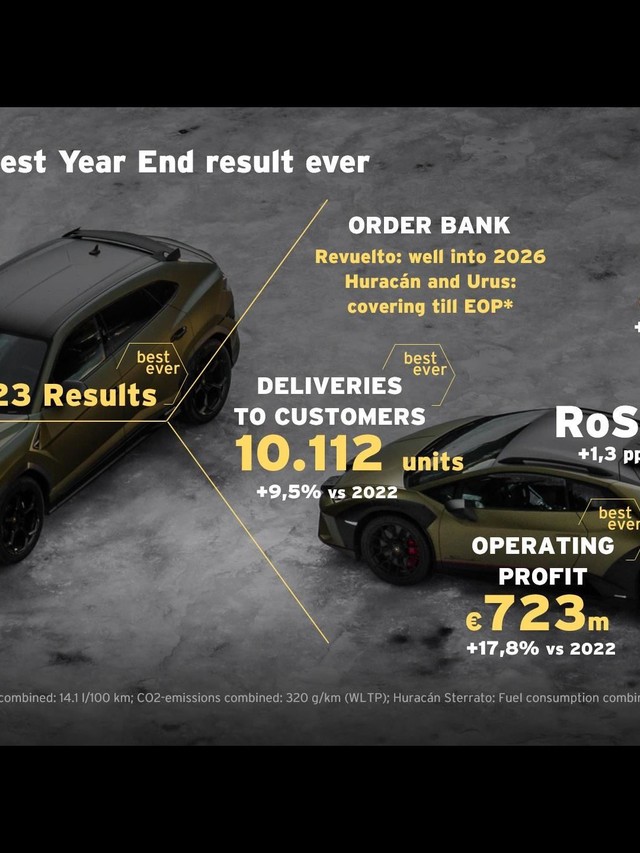
Lamborghini crossed the 10,000-delivery threshold for the first time in 2023, moving 10,112 cars globally while posting revenues of €2.66 billion, a 12.1% jump over 2022. The operating result cleared €700 million for the first time, landing at €723 million, up 17.8% year over year. But the figure that anchors everything else in this story sits at the very top of the income statement: a 27.2% operating margin.
That number positions Lamborghini among the most profitable luxury goods companies on the planet, not just within the automotive sector. The operating margin grew steadily every year from 2017 onward, meaning this is not a one-off spike driven by pandemic-era pricing games. It reflects a compounding strategy of controlling volume, enriching the product mix, and letting the order bank do the pricing work.
Perhaps the most telling detail: these results arrived without a single Revuelto delivery. The V12 hybrid flagship’s contribution begins in 2024, meaning the outgoing Huracán and Urus carried the entire commercial load. Existing orders for both models extend through the end of their respective production runs, and the broader order bank covers more than two years of output. That kind of backlog gives Sant’Agata something money alone cannot buy: time to execute a generational product transition without panic. And it is precisely that financial cushion that makes the next chapter possible.
Direzione Cor Tauri: Where the Money Goes
Record profits are satisfying on a spreadsheet. What makes them consequential is where they flow next. Lamborghini’s electrification roadmap, branded Direzione Cor Tauri, represents the largest capital investment in the company’s history. One report indicates the total commitment exceeds €1.9 billion, up from an initial announcement of more than €1.5 billion over four years. The Italian Ministry of Enterprises and Made in Italy reportedly approved additional government funding exceeding €100 million through a development contract administered by Invitalia.
The practical output of that spending is already visible. Lamborghini confirmed that the new Urus PHEV and the Huracán successor would both be presented in 2024, completing the hybridization of the entire lineup alongside the Revuelto. CFO Paolo Poma framed the strategy explicitly:
“Our objective with the Direzione Cor Tauri strategy is to increase profitability by following a sustainable path both in environmental and financial terms, in order to create value for all of our stakeholders.”
A company generating this level of cash from operations can self-fund much of its hybrid R&D without diluting exclusivity through volume increases. Lamborghini emphasized that a portion of its recent investments were self-financed, particularly following the commercial success of the Urus. The discipline of keeping annual production below demand, rather than chasing higher unit counts, protects residual values and keeps the order pipeline pressurized. In other words, the 27.2% margin is not just a trophy; it is the engine that powers the entire transition.

Two Lamborghini Revuelto models, in vibrant orange and pristine white, await completion in the advanced manufacturing facility. Image: Automobili Lamborghini.
The SC63 and Lamborghini’s Endurance Racing Gamble
The hybrid investment does not stop at road cars. CEO Stephan Winkelmann positioned the SC63 endurance racing program alongside the hybrid model launches as a defining milestone for 2024. Lamborghini confirmed the SC63 as a hybrid prototype that would mark the brand’s debut in the world’s most important endurance championships.
This is not a customer-racing exercise like the Super Trofeo series. The SC63 represents a factory commitment to prototype-class competition, the kind of program that demands sustained engineering investment and carries genuine reputational risk. For a brand that built its modern motorsport identity through GT3 customer cars, the jump to endurance racing signals a willingness to compete directly against Porsche, Ferrari, and other manufacturers who treat Le Mans as a proving ground for hybrid technology.
The financial connection is direct. Programs of this scale require the kind of cash flow that a 27.2% margin and €723 million operating result can sustain without jeopardizing road-car development timelines. The SC63 also provides a real-world laboratory for hybrid powertrain integration under extreme conditions, technology that feeds back into the production cars Lamborghini owners actually drive. Without the profit engine running at full capacity, a factory prototype program of this ambition would be difficult to justify.

The Lamborghini SC63 race car gleams on the track, ready for competition as the sun rises or sets. Image: Automobili Lamborghini.
Volume Control as Competitive Advantage
Lamborghini’s decision to celebrate 10,112 deliveries rather than chase 15,000 tells you everything about how Sant’Agata views the exclusivity equation. Ferrari delivered roughly 13,663 cars in 2023 and posted a 26.8% EBIT margin in its most recent annual filing, a figure Lamborghini now edges past. The comparison is imperfect (Ferrari’s corporate structure and revenue streams differ significantly), but the directional message matters: Lamborghini generates comparable profitability per unit while producing fewer cars.
For the enthusiast community, this tension between growth and scarcity is the perennial concern. Discussion on Lamborghini-Talk forums reflects a mix of pride in the financial results and wariness about what corporate parent Volkswagen Group might demand. Some forum members worry that strong margins invite pressure from Audi’s leadership to push volume higher, potentially diluting the brand’s exclusivity. Lamborghini’s public position, reinforced by the two-year order bank and end-of-run sell-out on the Huracán and Urus, suggests the company intends to manage the transition conservatively.
The practical buyer takeaway: if you are waiting for a Urus SE or Huracán successor allocation, the financial health of the company means those programs are fully funded and on schedule. The risk of delays driven by cash constraints is essentially zero. What remains unknown is how Lamborghini will price the new hybrid models, and whether personalization options like Ad Personam configurations and limited editions will expand to capture even more revenue per unit.

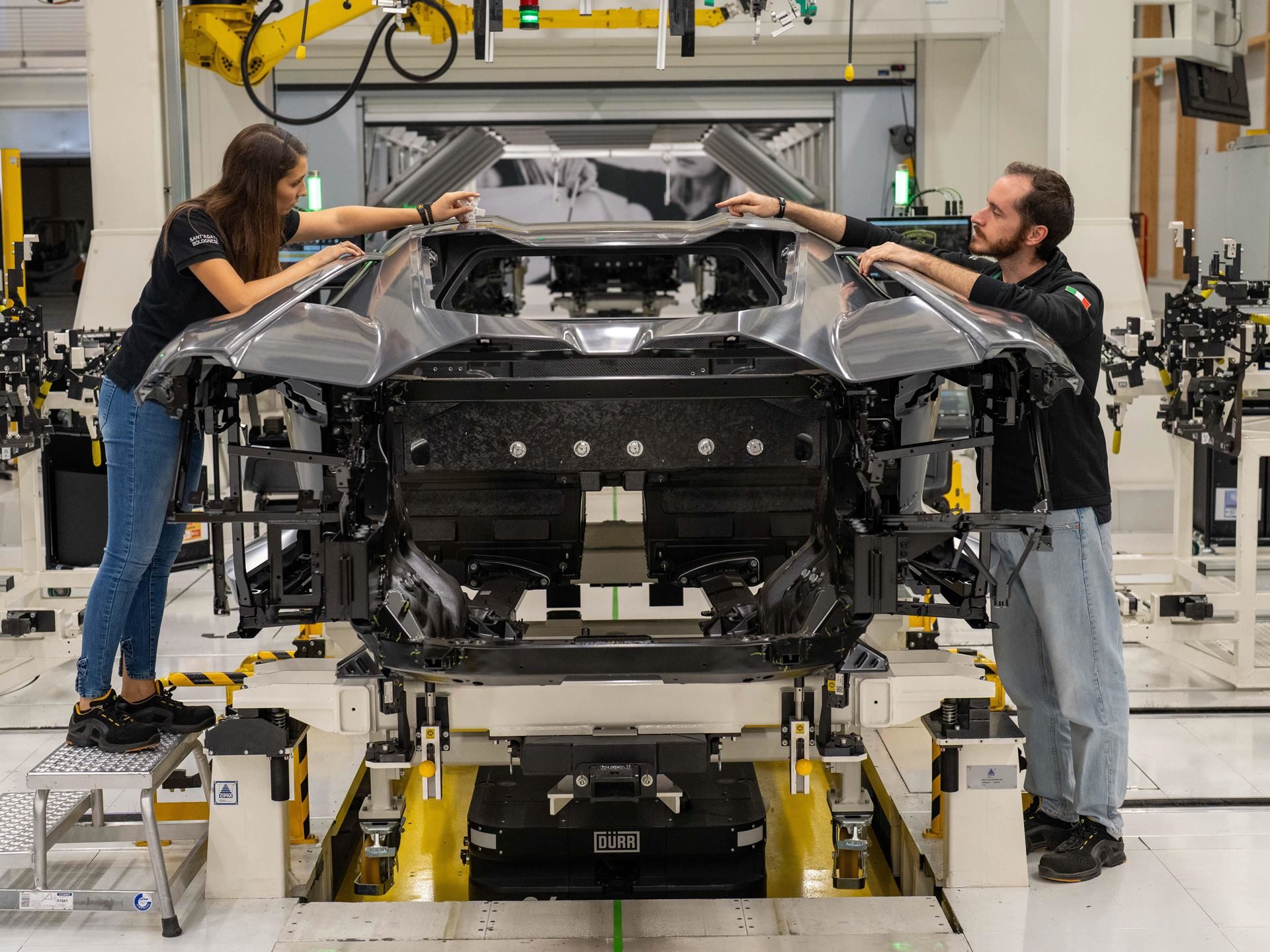
Skilled technicians meticulously assemble a powerful Lamborghini V12 engine, a masterpiece of engineering. Image: Automobili Lamborghini.
What 2024 Needs to Prove
The 2023 numbers establish a financial baseline that Lamborghini will struggle to repeat through sheer momentum. The Huracán and Urus are ending production, and the Revuelto, Urus SE, and Huracán successor all need to ramp simultaneously. Transition years in the automotive industry almost always produce a temporary dip in deliveries, even when the order book is full, because production lines need retooling and suppliers need to qualify new components.
Winkelmann’s framing of 2024 as “a year of important changes and innovations” is corporate-speak for a period of managed disruption. The order bank provides a cushion, but the real test is whether the new hybrid lineup can sustain or improve the margin profile that the outgoing naturally aspirated and conventionally powered models established. Hybrid powertrains carry higher component costs. Battery packs, electric motors, and power electronics add complexity and expense that must be offset through pricing power and mix management.
For LamboCars readers, the 2023 results represent proof of concept: Lamborghini can generate the capital to fund its hybrid future, compete in prototype endurance racing, and maintain exclusivity without external financing pressure. The margin is the message. Whether the next chapter delivers cars worthy of the investment is the question that only driving them will answer.

The iconic Lamborghini factory stands proudly under a vibrant sunset, a testament to automotive excellence. Image: Automobili Lamborghini.
Gallery