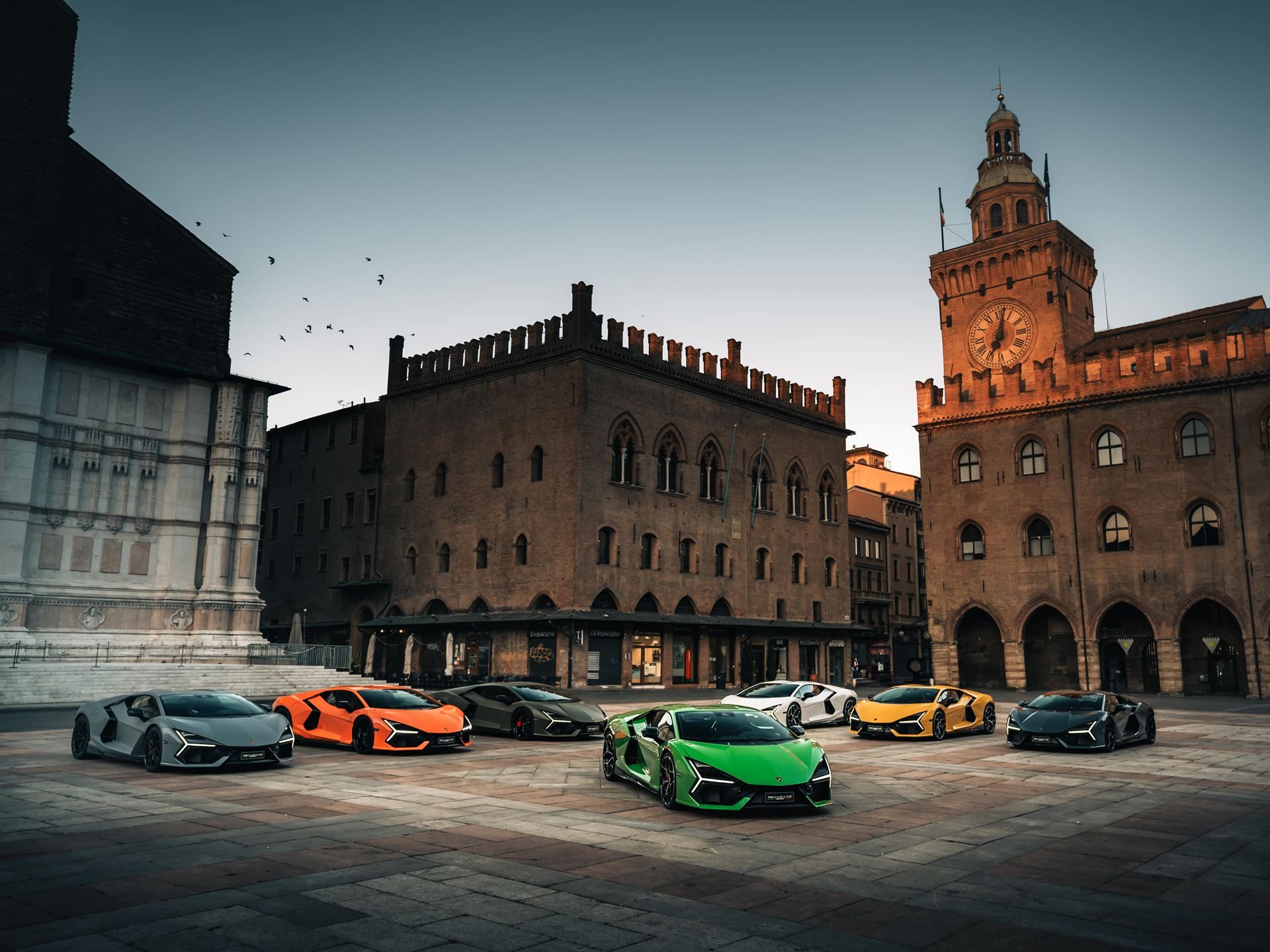
More Than 400 Shades, and Every One Tells a Story
Most supercar manufacturers offer a color palette. Lamborghini offers a mythology. The Ad Personam personalization program, launched in 2011 at Sant’Agata Bolognese, now encompasses more than 400 unique paint shades. Lamborghini says each one carries a deliberate narrative: a nod to a Greek deity, a tribute to an anniversary, a reference to the Emilia-Romagna landscape, or a technical process involving actual diamond dust.
That commitment to storytelling through color is not a boutique exercise for a handful of collectors. Lamborghini states that over 94% of all cars it produces include at least one Ad Personam feature, with color consistently the most requested element. The Ad Personam team and Centro Stile do not simply assign alphanumeric codes. They assign stories, and those stories become inseparable from the cars that wear them.

Gods, Constellations, and a Queen of Crete
Lamborghini’s naming conventions draw heavily from Greek and Latin epics, astronomy, and classical mythology. According to the company, these are deliberate choices designed to link each car to humanity’s symbolic heritage.
Nero Nemesis evokes the goddess of divine justice and the black of a judge’s gown. Arancio Apodis takes its name from the constellation of the Bird of Paradise, whose principal stars astronomers classify as “orange giants.” Viola Pasifae references Pasiphae, queen of Crete and mother of the Minotaur, a figure whose story is equal parts beauty and menace. An apt association for a purple Lamborghini.
Blu Cepheus honors the constellation Cepheus, the Ethiopian king of Greek mythology, husband of Cassiopeia, father of Andromeda. Lamborghini notes this northern constellation is visible from Italy during autumn, creating a direct bridge between sky and earth. Grigio Telesto designates both a moon of Saturn discovered in 1980 and a mythological figure. Lamborghini leans into the ambiguity, treating the mystery itself as part of the color’s character.
For enthusiasts who spec their cars carefully, the name on the build sheet matters. It becomes part of the car’s provenance at concours events and owners’ gatherings. A Viola Pasifae Revuelto tells a different story than a generic “purple metallic,” and Lamborghini clearly understands that distinction.

The Dress, the Diablo, and a Month Called May
Mythology is only one thread. Several Ad Personam colors are anchored to specific moments in Lamborghini’s own history.
Verde Scandal is the most famous example. Lamborghini’s account places the origin in the late 1960s: a customer wanted a shade of green not in the range and pointed to the dress she was wearing as her reference. When a representative asked for a physical sample to match, she reportedly removed the dress on the spot. Whether perfectly accurate or slightly embellished by decades of retelling, the story captures something essential about the Lamborghini customer relationship. These buyers do not accept “close enough.”
Viola 30th marks Lamborghini’s 30th anniversary in 1993 and debuted on the Diablo. Pairing a commemorative purple with the Diablo’s razor-edged bodywork was a statement that anniversary editions would not be subtle affairs. Giallo Maggio arrived for Lamborghini’s 50th anniversary, introduced on the Aventador 50° Anniversario in 2013. The name honors May 1963, the company’s founding month. According to Lamborghini, the color achieves its intense brilliance through a layer of highly reflective transparent particles that make the bodywork visibly glow under direct sunlight. Yellow, alongside orange and green, remains one of Lamborghini’s most popular color families, a tradition stretching back to the Miura era.
Each of these shades functions as a chapter in the company’s autobiography, encoded directly into the paint catalog.

Rooted in Emilia-Romagna
Some Ad Personam colors skip the classical references entirely and look closer to home. Giallo Quercus takes its inspiration from the golden oak in the coat of arms of Sant’Agata Bolognese, the small Emilian town that remains Lamborghini’s headquarters. The name translates directly: quercus is Latin for oak.
The territorial tributes extend to the interior. Terra Emilia and Terra di Sant’Agata Bolognese are brown leather shades developed specifically for cabin trim, honoring the Emilia-Romagna region and the city where every Lamborghini is assembled. These exist exclusively as interior leathers, meaning the tribute is a private one, visible only to driver and passengers. In a brand that thrives on visual spectacle, that restraint is quietly effective.
Encoding that bond into the color chart, where it becomes a permanent part of each car’s specification, is a way of carrying Sant’Agata Bolognese with every vehicle that leaves the factory gates.

Diamond Dust and Crystal Layers: Where Paint Becomes Engineering
Ad Personam’s most technically ambitious offerings blur the line between paint shop and laboratory.
Diamond Coating is a finish: a special transparent final layer incorporating real diamond dust, applied over the base color during the painting process. Lamborghini says the result amplifies the depth and brilliance of whatever shade lies beneath, producing a lustre that standard glass or metallic flake cannot replicate. Photographs of a black Revuelto in the official image set show visible sparkle across the bodywork, particularly around the rear engine cover and sculpted flanks, consistent with the effect Lamborghini describes.
Crystal Effect takes a different approach. A hand-applied multilayer process uses several overlapping layers of color to produce a dynamic visual effect that shifts depending on viewing angle and lighting conditions, highlighting the car’s body lines with constantly evolving reflections. The hand-application element means this is artisan work, not an automated spray booth operation, which speaks to both the exclusivity and the production time involved.
The very existence of these finishes reinforces the central thesis: at Lamborghini, color is not a cosmetic decision. It is an engineering discipline with its own R&D pipeline.

Inside the Ad Personam Studio
The Ad Personam studio at Sant’Agata Bolognese features a curved wall displaying hundreds of paint samples arranged by hue, alongside consultation areas with wheel displays, brake caliper models, emblem variants, and rows of leather swatches. The environment is designed to feel more like a design atelier than a dealership back office.
Customers who visit headquarters can work directly with specialists, examining physical samples under controlled lighting before committing. One source indicates these visits may also include a guided factory tour, offering a glimpse of the production line where the car will be built. For owners spending this kind of money on a bespoke specification, seeing the factory floor adds a layer of connection that no digital configurator can fully replicate.
Lamborghini also launched an Ad Personam Virtual Studio in 2020, enabling remote consultations through dealers for buyers who cannot travel to Italy. But for a first Ad Personam experience, the in-person visit remains the gold standard among enthusiasts. The studio is where the storytelling becomes tangible, where a name like Viola Pasifae stops being a line on a spec sheet and starts being a color you can see on a physical sample under Italian light.

Color as Competitive Strategy
Every major supercar manufacturer now operates a bespoke personalization division. Ferrari calls its program Tailor Made. Porsche runs Exclusive Manufaktur. The fundamental promise is identical across brands: make your car unique.
The difference lies in emphasis. Ferrari Tailor Made highlights heritage liveries and racing provenance. Porsche Exclusive Manufaktur leans on Paint to Sample, offering virtually any color a customer can source. Lamborghini occupies a different space. It builds mythology into the naming convention itself, turning each shade into a fragment of story that connects the owner to classical literature, astronomical discovery, or the specific geography of northern Italy.
Lamborghini’s claim that 94% of its production carries at least one Ad Personam feature confirms the program functions as a near-universal part of the purchase experience, serving simultaneously as a brand loyalty tool and a significant revenue contributor. Online forum discussions suggest Ad Personam options on previous models like the Huracan Performante were sometimes declined due to cost and production delays, but the 94% figure indicates those concerns have not dampened overall adoption. The competitive comparison comes down to what kind of personalization story you want your car to tell. Porsche will paint your car any color that exists. Lamborghini will give that color a name drawn from the moons of Saturn.

What Buyers Still Need to Know
Lamborghini’s detailed look at Ad Personam’s color heritage answers the “what” and “why” comprehensively. The “how much” and “how long” remain conspicuously absent.
The company does not publish a standard price list for Ad Personam options, and the cost structure varies enormously depending on the complexity of the request. A special exterior color carries a different premium than a full Diamond Coating finish or a bespoke interior leather program. Lead times are similarly undisclosed. Multiple owners on enthusiast forums describe wait periods stretching well beyond a year for heavily personalized builds, with Ad Personam specifications sometimes adding months to the production timeline.
What the source material does confirm is that color remains the single most popular element of the Ad Personam program, and that Lamborghini treats its color heritage as a living archive rather than a static catalog. New shades continue to be developed, new finishes continue to push the boundaries of what automotive paint can do, and the stories behind the names continue to accumulate. The 401st shade, whenever it arrives, will carry a name worth knowing.

Gallery