Lamborghini Puts Its Workplace Culture on the Record
During European Diversity Month, Automobili Lamborghini publicly reaffirmed its commitment to diversity, equality, and inclusion by outlining a comprehensive suite of internal programs spanning gender equality, parental support, generational bridge-building, and cultural integration. The announcement goes well beyond boilerplate corporate messaging: it names specific employees, details concrete benefits, and describes programs like professional coaching for new fathers that are genuinely unusual in any industry, let alone one built around carbon fiber and naturally aspirated V12s.
For LamboCars readers, the instinct might be to scroll past a corporate culture story. That would be a mistake. The people assembling your next Lamborghini’s monocoque, calibrating the Urus’s suspension geometry, and hand-stitching Alcantara at Sant’Agata Bolognese represent 35 nationalities from four continents, and more than half of them belong to the Millennial or Gen Z cohorts. How Lamborghini attracts, retains, and develops that talent pool directly shapes the quality and innovation of every car leaving the factory. The thesis running through every program the company describes is simple: in a business where roughly 10,000 cars leave the line each year, every individual’s expertise carries outsized weight, and the workplace culture that nurtures that expertise is inseparable from the product itself.
The Strategic Logic: Human Capital as Competitive Advantage
A single carbon fiber specialist’s knowledge of layup techniques, or a young software engineer’s fluency with hybrid powertrain calibration, can influence a model’s character in ways that would be invisible at a company producing 500,000 units a year. Umberto Tossini, Lamborghini’s Chief Human Capital Officer, framed the company’s approach as a conviction that varied perspectives generate unique value. Strip away the corporate language and the logic is straightforward: if you want engineers who can solve the particular challenges of integrating a supercapacitor into a V12 hybrid architecture, you need to recruit from the widest possible talent pool and then keep those people engaged enough to stay.
Lamborghini appears to be making a deliberate bet that openness about its culture functions as a recruiting tool in its own right, particularly for younger engineers and technicians who weigh employer values alongside compensation. That bet carries extra significance in Italy’s Motor Valley, the corridor stretching from Modena through Bologna to Sant’Agata, where Ferrari, Maserati, Pagani, Ducati, and Lamborghini all compete for overlapping pools of skilled workers. In that environment, workplace culture becomes a genuine differentiator, and a company that can credibly offer professional growth, inclusive culture, and personal support programs alongside the prestige of building supercars holds a recruiting advantage that compounds over time.

A female Lamborghini employee discusses production details with colleagues on the factory floor, highlighting teamwork and precision.
Voices from the Factory Floor
The most revealing element of Lamborghini’s announcement is not its policy list but its willingness to put named employees in front of the public. Erika Puccetti, an Aventador Assembly Line Forewoman, described the reality of leading a male-dominated production team with characteristic directness:
“Being a female department head in manufacturing is not easy, especially in a male-dominated team. It takes a lot more effort to be credible and have authority. I’ve always liked challenges! I’m happy that a company like Lamborghini has decided to invest in women in production.”
Puccetti noted that her office now includes two female and two male department heads, a ratio that would have been unthinkable in Italian manufacturing a generation ago. Lamborghini says it has guaranteed equal pay between female and male employees with the same qualifications and duties since 2018, and the company reports continued growth in hiring women with STEM backgrounds for leadership positions.
The company also belongs to the Capo D network, a community of businesses in the Bologna metropolitan area focused on equal opportunities. The network’s scope extends beyond the factory gates: member companies engage with local schools to address gender stereotypes early, which amounts to a long-term pipeline strategy for technical talent in the Emilia-Romagna region.

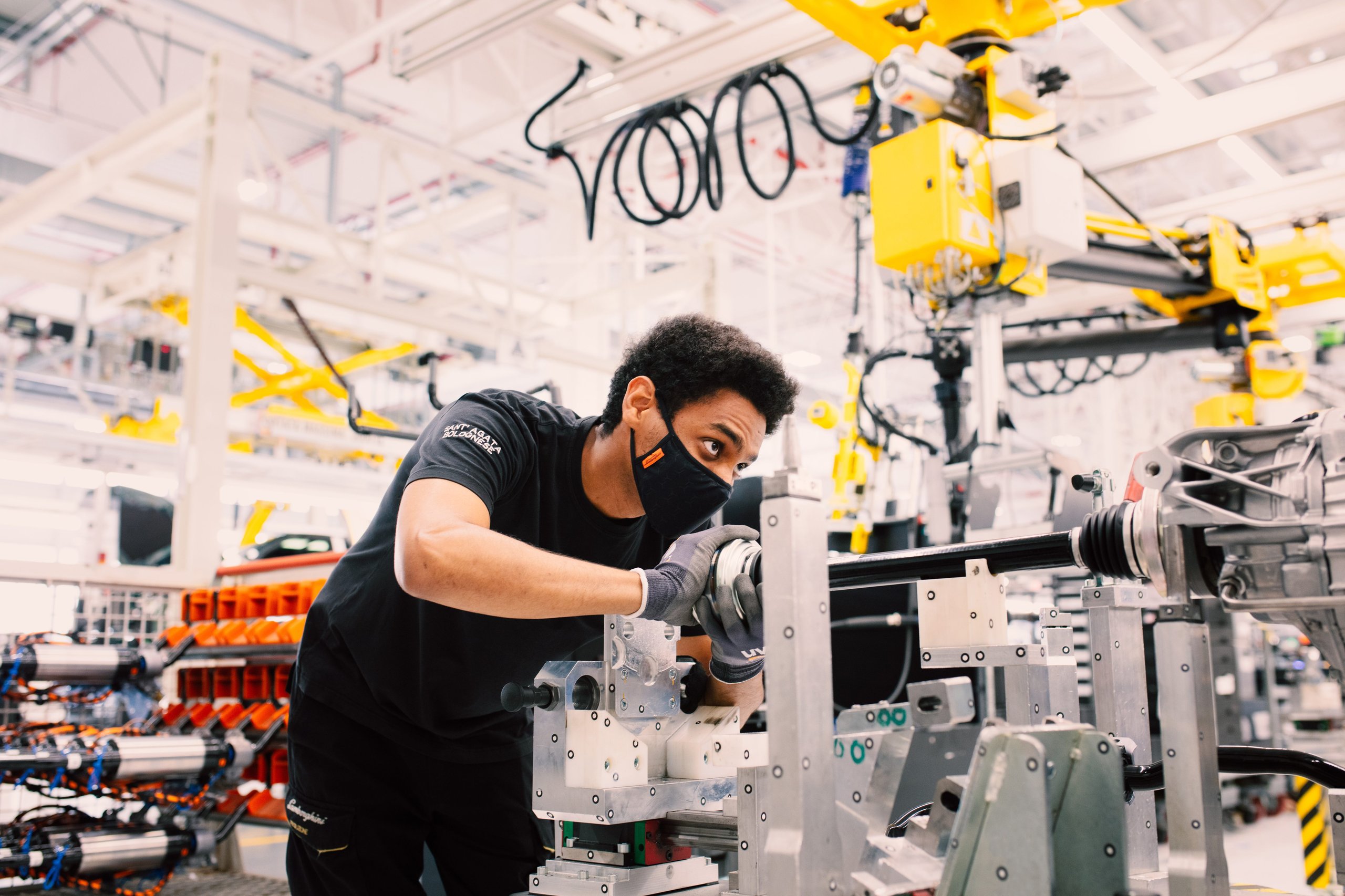
Lamborghini employees collaborate on the factory floor, demonstrating a commitment to quality and teamwork.
Dad Coaching and Parental Support: The Genuinely Unusual Part
Plenty of companies offer parental leave. Very few offer professional coaching sessions for new fathers during working hours, on a voluntary basis, with no strings attached to company performance goals. Lamborghini does.
The dad coaching program provides four to six one-hour sessions with a professional coach, designed to help new fathers navigate what the company describes as the emotional complexity of early parenthood. The focus is explicitly personal: exploring needs, identifying hidden emotions, and developing patience. It runs entirely during work hours and carries no obligation. Nicola Giganti, a Carbon Fibre, Moulds & Repair Foreman whose hands-on knowledge is essentially irreplaceable, participated in the program and described it as a genuine support system:
“In the Dad Coaching service, I found a great opportunity for support, and I’m gradually learning to better understand and interpret the needs and behaviors of my child and to be more patient.”
On the maternal side, Lamborghini enhanced its optional parental leave benefits beyond Italian statutory requirements. The company increased economic integration to 30% for the first six months of optional leave, rising to 40% if the other parent takes at least fifteen continuous days of the same leave. New mothers returning to work receive mum coaching, agreements with daycare centers, summer programs, and paid leave. The incentive structure is designed to encourage shared parenting, which in turn makes it easier for both parents to remain in the workforce. For a company that invests heavily in training specialized technicians, every retained employee represents avoided recruitment and knowledge-transfer costs, a reality that ties these personal benefits directly back to the quality of the cars.

A Lamborghini employee engages with a 'DAD COACHING' program on a laptop, reflecting work-life balance initiatives.
Bridging Generations: Reverse Mentoring and the Millennial Majority
More than 50% of Lamborghini’s workforce now consists of Millennials and Generation Z, a demographic reality that creates a specific management challenge: how do you transfer decades of artisanal manufacturing knowledge from senior craftspeople to younger employees who think in digital-native terms, while simultaneously absorbing the younger cohort’s fluency with software, simulation tools, and new materials science?
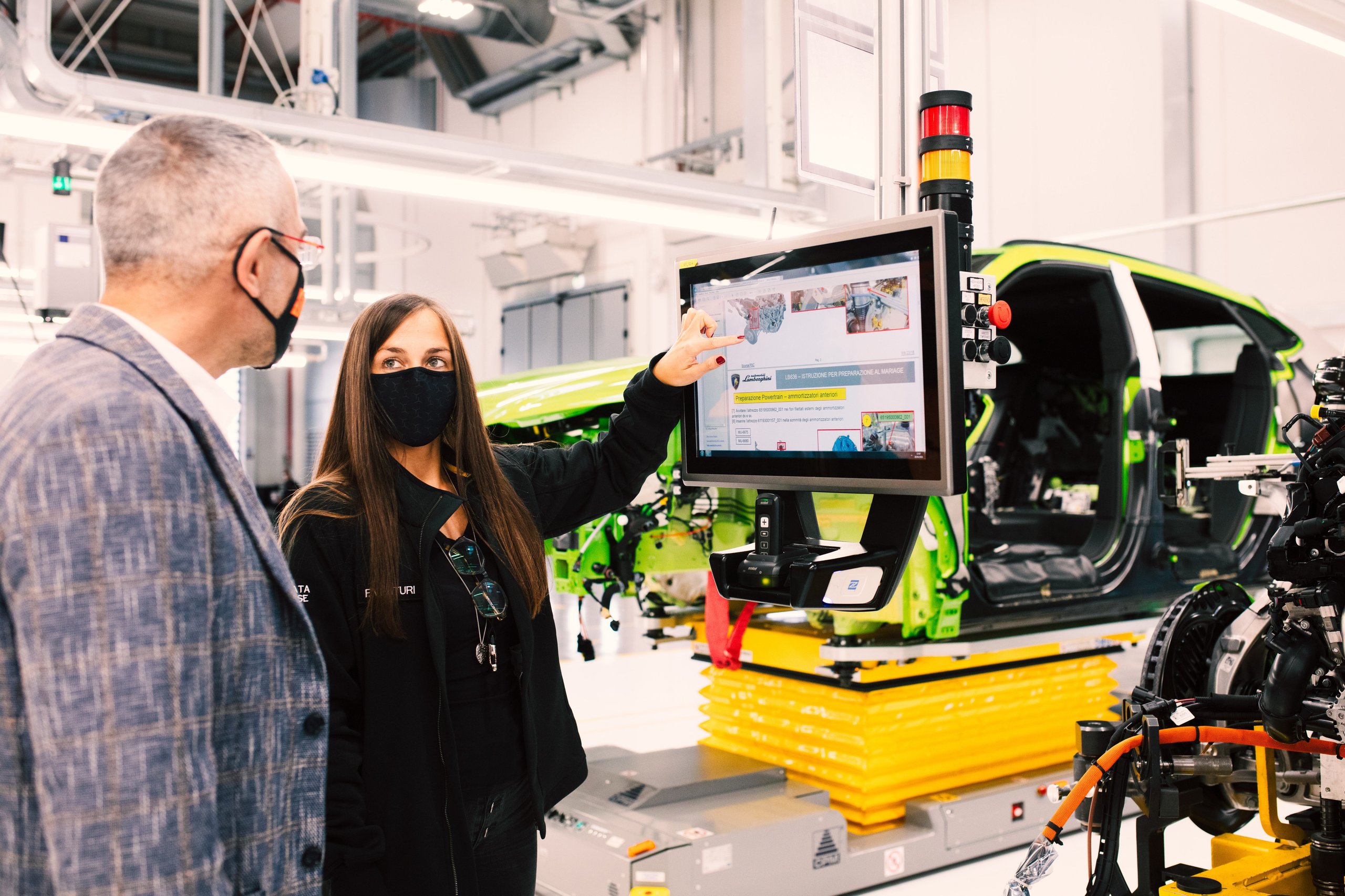
Lamborghini’s answer is a reverse mentoring program that pairs junior employees with senior professionals for bidirectional knowledge transfer. On a supercar production line, where a veteran’s ability to feel a carbon fiber panel’s resin cure by touch coexists with a junior engineer’s ability to optimize that same process through computational modeling, the concept takes on practical urgency. Antonio Aurucci, Head of the Urus Assembly Line, and his colleague Francesca Venturi, Urus Assembly Line Forewoman, serve as a working example. Aurucci described the exchange as combining traditional experience with digital innovation, while Venturi called reverse mentoring a fundamental tool for mutual development.
The company also signed a trade union agreement aimed at managing generational transitions: as employees approach retirement, the agreement provides for hiring an equal number of young workers with new skills, preserving institutional knowledge while refreshing the talent base. The shift from naturally aspirated powertrains to hybrid architectures demands exactly this kind of cross-generational skill blending. The senior technician who spent twenty years perfecting assembly brings irreplaceable knowledge of fit, finish, and quality feel. The recent graduate brings fluency in battery management systems and electric motor integration. Neither skillset alone builds a competitive hybrid supercar, and the programs Lamborghini describes exist to ensure both are present on the same factory floor.

Two masked individuals observe a partially assembled Lamborghini Urus on a bright yellow assembly line in a modern factory setting.
35 Nationalities, One Factory: Cultural Diversity at Sant’Agata
Lamborghini’s headquarters in Sant’Agata Bolognese hosts employees representing 35 nationalities from four continents. For a small town in Emilia-Romagna, that concentration of international talent is remarkable, and it reflects the company’s global customer base and supply chain.
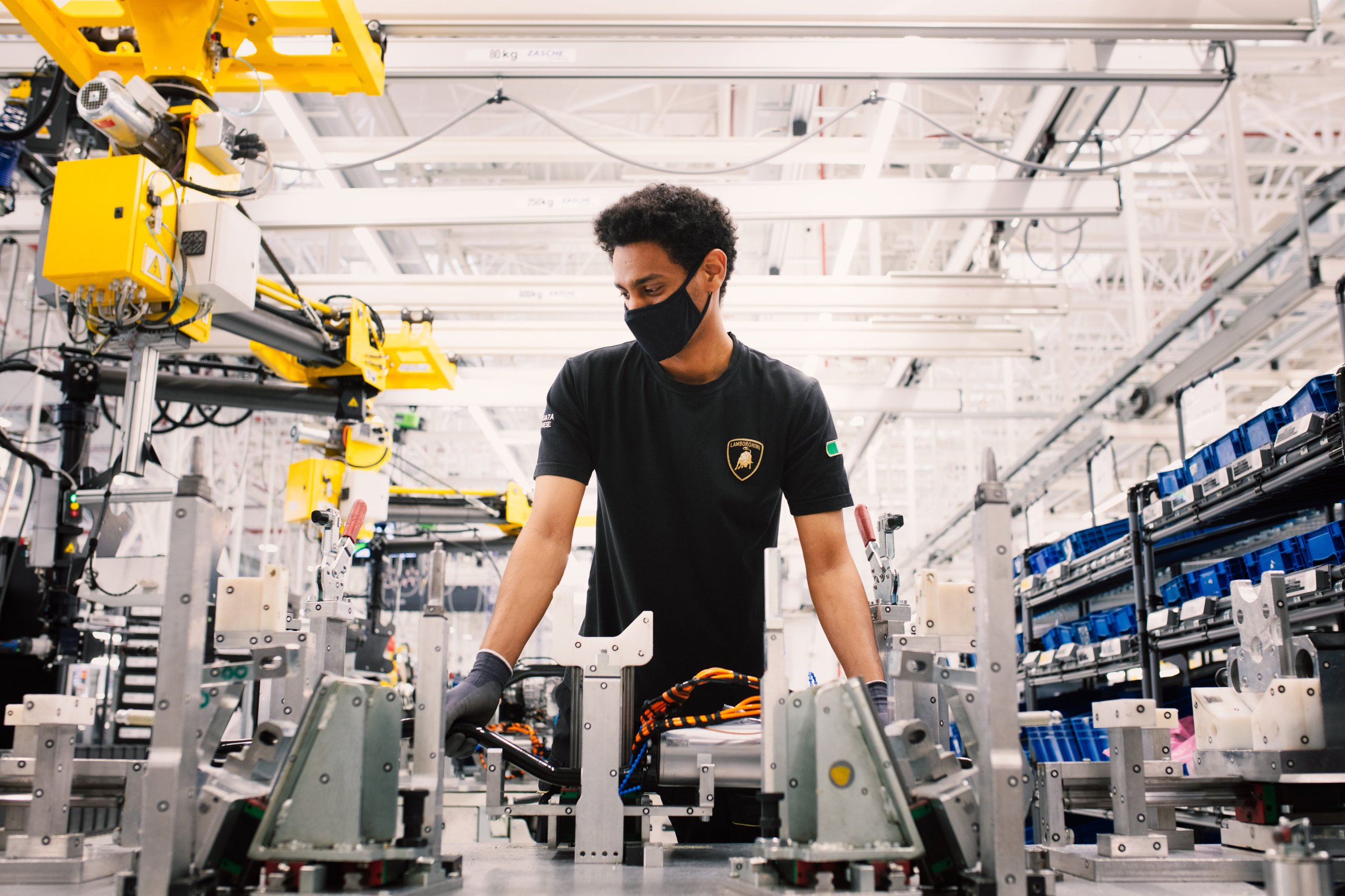
Two Urus line operators illustrate the point. Olena Achysova, who arrived in Italy from Eastern Europe as a teenager, described the disbelief her relatives expressed when she told them she worked at Lamborghini. Henok Abrahan Sium, a young man from Eritrea, called the job a daily dream and emphasized how colleagues learn from each other’s experiences regardless of background. Lamborghini also cooperates with service institutions for the inclusion of employees with disabilities or from disadvantaged backgrounds, and ensures a sign language interpreter is present at all company events and presentations. These are small details in the context of a global corporation, but they signal an operational commitment rather than a policy-document aspiration.

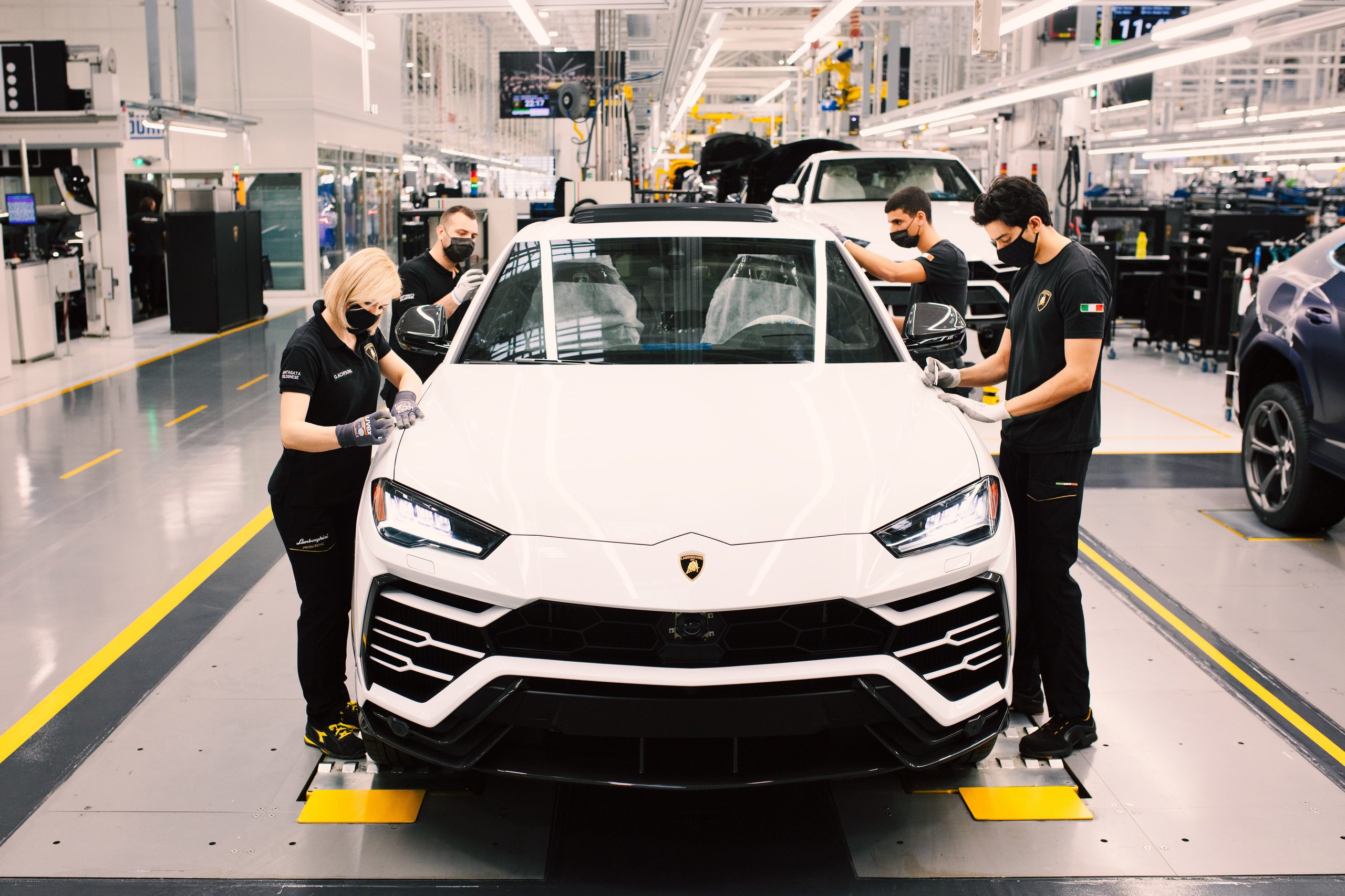
Lamborghini technicians perform final checks on a white Urus, ensuring every detail meets exacting standards.
What This Means for the Cars You Buy
Corporate culture stories rarely move the needle for enthusiasts who care about lap times and exhaust notes. But the connection between Lamborghini’s workforce investments and its product quality is less abstract than it appears. The Ad Personam customization program, which allows buyers to specify bespoke colors, materials, and trim combinations, depends entirely on skilled artisans who can execute those requests to a standard worthy of a six-figure (or seven-figure) purchase. Retaining those artisans, and attracting the next generation of them, requires exactly the kind of workplace environment Lamborghini is describing.
The announcement does leave questions unanswered. The company does not disclose specific metrics on employee retention rates, the percentage increase in women in STEM roles, or any direct measurement linking these programs to product innovation. Without those numbers, it remains impossible to quantify the return on investment. What the announcement does confirm is that Lamborghini treats its human capital strategy as a public-facing competitive argument, not a buried footnote in an annual report.
For prospective buyers, the practical takeaway is this: the people building your car are working in an environment that actively invests in their professional development, personal well-being, and cross-generational knowledge transfer. Whether that translates into a measurably better panel gap or a more refined hybrid calibration is unprovable from the outside. But in a segment where craftsmanship and attention to detail justify price premiums measured in hundreds of thousands of dollars, the quality of the workforce is not a peripheral concern. It is the product.
Gallery