Two New Roles, One Strategic Signal from Sant’Agata
Lamborghini confirmed two leadership changes that restructure how the company sells its cars and talks about them. Federico Foschini, a 22-year company veteran, takes the newly created title of Chief Marketing & Sales Officer, merging two departments that previously operated under separate leadership. Tim Bravo, who built Bugatti’s communications operation since 2018, arrives as Head of Communication with responsibility for media relations and social media. Both report directly to President and CEO Stephan Winkelmann.
The corporate org chart rarely quickens the pulse of someone shopping for a Revuelto allocation. Yet these two appointments reveal something concrete about where Lamborghini sees friction in its own machine, and what kind of commercial and storytelling apparatus it believes the brand needs as the entire lineup shifts to hybrid power. The through line is consolidation: fewer decision-makers between the product and the customer, and a tighter loop between the people who build desire and the people who fulfill it.

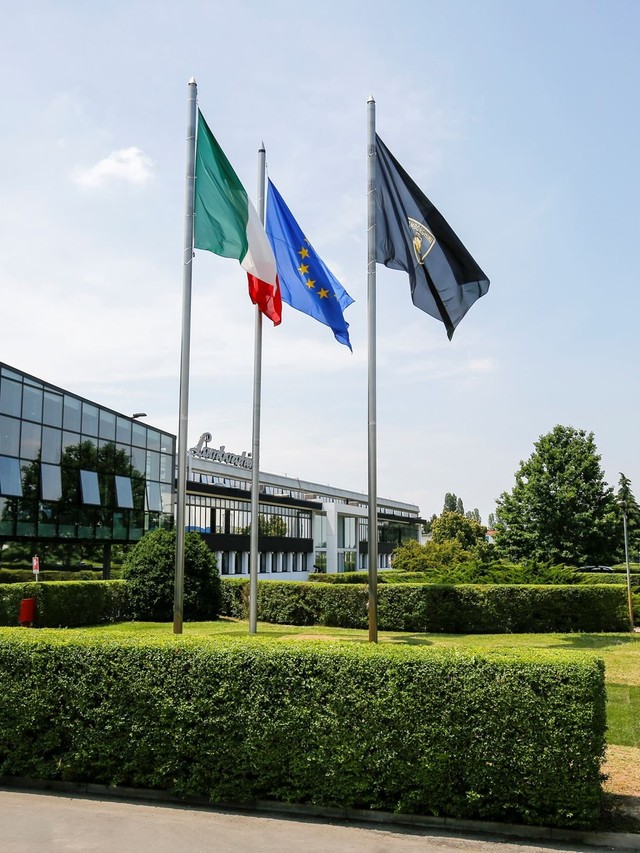
The Automobili Lamborghini headquarters proudly displays national and brand flags under a bright, sunny sky.
Foschini’s Return: The Man Who Watched the Urus Explode
Foschini is not a fresh hire parachuted in from another luxury group. Lamborghini says he previously ran marketing, sales, and after-sales from September 2015 through the end of 2019, a period that coincided with the Urus launch and the sales surge that transformed the company’s commercial profile. He then moved to Chief Procurement Officer in January 2020, overseeing the supply chain during semiconductor shortages and pandemic disruption. He retains that procurement role on an interim basis alongside his new title.
The detail worth pausing on is the merger itself. In most luxury automakers, marketing and sales answer to different chiefs with different incentives: marketing builds desire, sales fulfills it, and the two departments sometimes pull in opposite directions on allocation strategy, regional pricing, and how aggressively to court new demographics. Folding both under Foschini suggests Lamborghini wants a single, coherent commercial voice, particularly as it navigates the delicate work of selling hybrid supercars to a clientele that fell in love with naturally aspirated engines.
Foschini’s stated philosophy, based on available interviews, centers on maintaining demand above supply and prioritizing consistent growth over short-term volume spikes. For prospective buyers, that translates to continued allocation discipline. Do not expect the Temerario to suddenly appear on dealer lots without a wait. The consolidation of marketing and sales under one leader only reinforces that posture: every message about the car and every decision about who gets one will now flow through the same strategic filter.

A professional portrait of a man in a suit, smiling confidently in front of an elegant architectural backdrop.
Tim Bravo Brings Bugatti’s Playbook to Sant’Agata
Bravo’s appointment is the more outward-facing half of the same consolidation logic. German-born, with a degree in Communication from the University of Bonn, he started in broadcasting and digital media before joining the VW Group in 2011. His path ran through SEAT in Barcelona, then Porsche in Stuttgart (first as a product communications spokesperson, then as PR manager for Porsche Latin America in Miami), before landing at Bugatti in Molsheim in 2018. He keeps the Bugatti role alongside his new Lamborghini responsibilities.
That dual mandate is telling. Bugatti operates at the very top of the automotive luxury pyramid, where every communication touchpoint is curated with almost absurd precision. The question is whether Bravo imports that ultra-exclusive sensibility to a brand that thrives on a louder, more visceral form of aspiration. Lamborghini’s social media presence already punches well above its production volume; the brand consistently outperforms rivals in engagement metrics relative to units sold. Bravo’s job will be to sharpen that voice without losing the raw energy that makes a Lamborghini post feel different from a Bentley one. In practice, his appointment extends the same principle Foschini’s role embodies: one person, one coherent narrative, fewer seams between the brand’s internal functions and its public face.

A professional studio portrait of a man in a dark suit and patterned tie, with a direct gaze.
The Electrification Challenge Neither Can Avoid
Both appointments land at a moment when Lamborghini’s product story is more complex than it was five years ago. The Revuelto, a V12 HPEV producing 1,015 horsepower, sits at the top of the range. The Temerario arrives with a hybrid drivetrain built around a twin-turbo V8. The Urus SE adds plug-in hybrid capability to the SUV that accounts for the majority of the company’s volume. According to Road & Track, Lamborghini plans multiple new model debuts in 2026 and recorded record revenue despite tariff headwinds.
Selling electrified Lamborghinis to buyers who worship the Aventador’s atmospheric V12 requires a different kind of storytelling, and that is precisely why the consolidation matters. Foschini’s challenge is to make the commercial argument (allocation, pricing, regional strategy) reinforce the emotional one (these cars are faster, more capable, and still unmistakably Lamborghini). Bravo’s challenge is to make that emotional argument land in every market, across every platform, in a media landscape that moves faster than a Revuelto in Corsa mode.
Neither Ferrari nor McLaren currently combines marketing and sales under a single chief in quite this way. Ferrari separates its commercial and brand-building functions; McLaren restructured its own leadership repeatedly during its recent financial turbulence but kept marketing and sales distinct. Lamborghini’s integrated approach is a bet that a smaller, more unified commercial team can move more quickly, and that speed matters when you are asking loyal customers to embrace a technological pivot.

A vibrant fleet of Lamborghini supercars and Urus SUVs parked outside the 'Linea Urus' factory building.
What This Means If You Are Waiting for a Build Slot
For current owners and prospective buyers, the practical takeaway is continuity with tighter coordination. Foschini knows the dealer network, the allocation system, and the supply chain from the inside. He is unlikely to radically change how cars reach customers, but the merger of marketing and sales under one leader could mean a more consistent experience from the first configurator session to delivery day. If Lamborghini’s Ad Personam customization program expands further, or if regional special editions become more frequent, expect those decisions to flow through one commercial strategy rather than two.
Bravo’s arrival signals that Lamborghini wants its public voice to carry more polish without sacrificing energy. Enthusiasts who follow the brand’s social channels, event coverage, and media partnerships should watch for a shift in tone, potentially more curated storytelling and fewer generic product shots. Whether that resonates or feels overly managed will depend on execution.
Lamborghini confirmed the departures of Giovanni Perosino (Chief Commercial Officer), Katia Bassi (Chief Marketing & Communication Officer), and Gerald Kahlke (Head of Communication), thanking each for their contributions. The company did not announce specific strategic targets for the new leadership, and no timeline for measurable changes was provided. What the appointments do confirm is that Winkelmann wants fewer layers between the product and the customer, and a communications team that can speak fluently to both Molsheim and Sant’Agata audiences. The restructuring is not dramatic by the standards of the wider auto industry, but for a company that builds roughly 10,000 cars a year and guards its brand image with near-religious intensity, even a modest organizational tightening can change the way the cars are presented, sold, and remembered.

The Automobili Lamborghini headquarters stands illuminated at dusk, with flags waving under a beautiful sky.
Gallery


