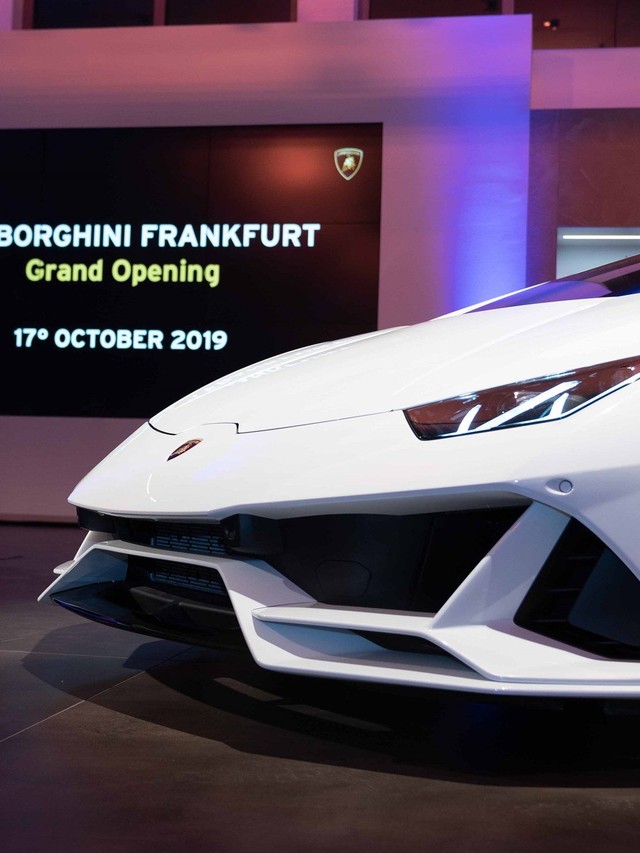
Lamborghini Frankfurt Moves Into Its Largest German Home
Six years after Automobili Lamborghini re-established its presence along the river Main, the brand’s Frankfurt outpost has outgrown its original quarters. The showroom relocated from Klassikstadt, a center known for classic cars, to the neighboring Cassellapark industrial park, and the difference is anything but subtle. The new facility spans nearly 1,300 square meters, a more than threefold expansion that makes it the largest Lamborghini showroom in Germany, built to the company’s new corporate design standards while retaining an architectural character unique to the site.
Approximately 300 guests joined owner Rainer Dörr and Andrea Baldi, CEO EMEA of Automobili Lamborghini, for the opening ceremony in Frankfurt’s Ostend district. Five models occupy the roughly 460-square-meter showroom floor, among them the Huracán EVO, carrying driving dynamics refined from the Performante, and the Urus, Lamborghini’s first super SUV. The remaining roughly 600 square meters house a modern workshop and warehouse space. Lamborghini says the building blends a historic brick structure with glass, flooding the interior with natural light.
A brand does not triple its retail footprint in a market unless the numbers justify it. In Lamborghini’s case, the numbers behind this move tell a story about a company whose customer base has changed so rapidly that its physical infrastructure had to follow.
How the Urus Rewrote Lamborghini’s Retail Math
Lamborghini delivered a record 5,750 vehicles worldwide in 2018, the year the Urus launched. By the first half of 2019, global deliveries surged 96 percent to 4,553 units, a pace that would roughly double the prior year’s total. EMEA sales climbed 67 percent to 1,826 units in that same period. Those are not incremental gains. They represent a fundamental shift in who buys a Lamborghini and how often they walk into a dealership.
Before the Urus, a Lamborghini showroom served a relatively narrow clientele: buyers who wanted a mid-engine V10 or a V12 flagship and could tolerate the compromises of a pure supercar. The Urus changed that equation. Rainer Dörr noted a growing interest in the brand, particularly among young entrepreneurs. When your customer base expands that rapidly, the old showroom, charming as it may be, stops working. You need more display space, more service bays, more room for the kind of consultative sales process that a buyer spending well into six figures expects.
The Frankfurt expansion is the physical evidence of what the Urus did to Lamborghini’s business model. Selling super SUVs alongside supercars requires a retail environment that can credibly present both, and a cramped classic-car venue was never going to accomplish that.
Germany’s Weight in the EMEA Equation
Germany stands as Lamborghini’s second-largest market within the EMEA region, a ranking that carries real strategic weight. The Rhine-Main area around Frankfurt is one of Europe’s wealthiest corridors, dense with the financial and entrepreneurial clientele that gravitates toward brands like Lamborghini. Automobili Lamborghini originally approached Dörr six years before this opening to re-establish the brand along the river Main, and the trajectory since then justified further investment. The Dörr Group was also entrusted with Lamborghini in Berlin as of July 2019, signaling that Sant’Agata Bolognese sees this partnership as a template for German market growth.
For prospective buyers in the region, the practical implication is straightforward: a larger facility staffed by a 13-person team that includes dedicated site and sales managers, an after-sales manager, and Evelyn Dörr, General Manager and member of the management board, personally available to clients. That depth of staffing, combined with an in-house detailing service and a workshop built to current factory standards, means Frankfurt owners no longer need to look elsewhere for the full ownership cycle. The showroom is not just bigger; it is built to serve a market that has grown too important for anything less.
Ad Personam and the Showroom as a Customization Studio
Lamborghini says the Frankfurt team offers the full Ad Personam program, the brand’s bespoke customization service that lets buyers specify paint, interior materials, stitching, and trim to personal taste. In a smaller facility, Ad Personam consultations often compete for space and attention with routine sales. A 460-square-meter showroom floor gives the process room to breathe, and that breathing room matters more than it might appear. Customization is where margin lives in the luxury car business, and it is increasingly where brands differentiate the ownership experience.
Expanding the Ad Personam footprint in a key German market is a direct competitive move. If a buyer can sit in Frankfurt and configure a Urus or Huracán EVO down to the last contrast stitch, the incentive to cross-shop diminishes. The car becomes theirs before it leaves Sant’Agata Bolognese.
Lamborghini’s corporate showroom design standards reinforce this sense of immersion. The brand’s retail identity draws on hexagonal and Y-shaped motifs that echo the cars themselves, using materials like cement-tone finishes and brass inserts to create an environment that feels deliberately curated rather than generically premium. The Frankfurt location, with its brick-and-glass architecture, adapts that template to a building with genuine industrial character, grounding the Lamborghini design language in something specific to the site rather than stamping out another identical showroom.
What This Showroom Signals for Lamborghini Buyers
For current and prospective Lamborghini owners in Germany, the Frankfurt facility represents a tangible upgrade in service access, personalization options, and after-sales support. Buyers who previously might have traveled to Munich or Stuttgart for a comparable luxury purchase experience now have a facility in the Rhine-Main corridor that matches or exceeds what rival brands offer in the region.
The broader signal is about trajectory. Lamborghini’s EMEA sales growth, the Urus’s continued demand, and investments like Frankfurt and Berlin point to a brand building infrastructure for a customer base that looks fundamentally different from the one it served a decade ago. Younger buyers, SUV buyers, and buyers who expect a retail experience on par with the product itself are reshaping what a Lamborghini dealership needs to be. Frankfurt is the clearest physical expression of that shift so far, and it is unlikely to be the last.
Gallery


