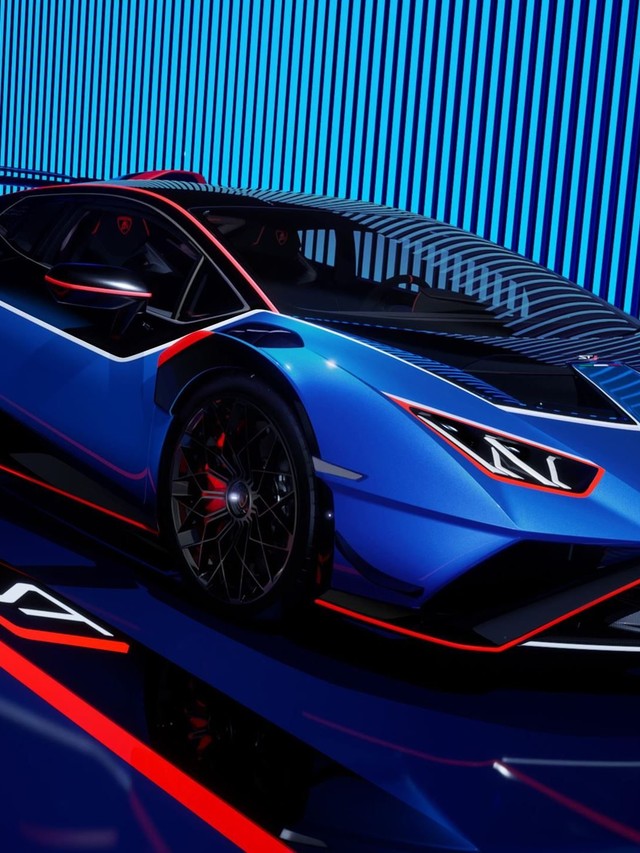
The V10’s Final Curtain Call, Limited to Ten
Lamborghini built the Huracán STJ for exactly ten people, and every one of them already owns one. All ten units reportedly sold before the car was even publicly announced, a fact that tells you everything about what the collector market thinks of a naturally aspirated V10 with an expiration date.
The STJ marks the final celebration of the Huracán line equipped with Lamborghini’s 5.2-liter V10 engine. Introduced in 2014, the Huracán family will be replaced by an all-new hybrid supercar by the end of the year, which means this car occupies a very specific place in history: the last time Sant’Agata Bolognese will send a pure, unassisted, screaming ten-cylinder engine out the factory door in its mid-engine sports car. No electric motors. No turbochargers. Just 640 CV at 8,000 rpm, a seven-speed dual-clutch gearbox, and rear-wheel drive.
For a brand that built its modern identity around the sound and fury of naturally aspirated power, that finality carries real weight. And the engineering choices Squadra Corse made for this farewell reveal a car designed not to be the most powerful Huracán, but the most focused, a track weapon refined through passive hardware rather than electronic intervention.
Why Ten Cars Create Instant Collector Gravity
Single-digit or low-double-digit production runs from Lamborghini tend to appreciate aggressively, and the STJ checks every box that drives collector demand. It pairs a “last of its kind” powertrain narrative with a production number so small that most Lamborghini dealers will never see one in person. Each car carries a numbered carbon fiber plate marked “1 of 10,” and customers can add a personalized plate on the passenger side.
Lamborghini has not announced pricing. The confirmed details reveal a car that sits at the absolute top of the Huracán hierarchy, built on the already track-focused STO platform with additional Squadra Corse engineering. For context, Car and Driver reports a $360,000 figure for the Huracán Super Trofeo Evo2 race car, which gives some sense of where Lamborghini prices its most extreme Huracán hardware. The STJ, as a road-legal collector piece, likely commands a significant premium over the standard STO, though the exact figure remains unconfirmed.
The practical takeaway for anyone watching the Huracán market: even standard STO values are likely to firm up now that the STJ formally closes the V10 chapter. When the flagship variant of a model line becomes a ten-unit farewell, the entire family benefits from reflected scarcity.
Super Trofeo Jota: What the Name Actually Means
Both halves of the “STJ” designation carry distinct meaning. Super Trofeo pays tribute to Lamborghini’s one-make championship, established in 2009, which remains one of the most competitive single-marque GT racing series in the world. “Jota” refers to Appendix J of the FIA Regulations for racing car specifications, and also to a lineage of track-focused Lamborghinis stretching from the Miura SVJ to the Aventador SVJ.
The original Miura Jota, built by test driver Bob Wallace in 1970, was a one-off experiment to see how close a road car could come to meeting FIA Appendix J homologation rules. It was destroyed in a crash, but the idea persisted across decades: a Jota badge signals a Lamborghini pushed to its regulatory and engineering limits for circuit use. The Aventador SVJ carried that torch with its Nürburgring lap record. The STJ now closes the tradition for the V10 era, though whether the Jota name resurfaces on hybrid-era models remains an open question Lamborghini has not addressed.
That lineage matters here because the STJ’s engineering philosophy mirrors Wallace’s original impulse: strip away comfort, prioritize the track, and let the driver sort out the rest.

The sharp lines and distinctive 'STJ' badging on the front of the Huracán STJ emphasize its unique and performance-oriented identity.
Passive Dampers Over Active, and Why That Matters
The STJ shares its 631 horsepower output and 565 Nm of torque with the STO. Lamborghini did not chase more power for this farewell. Squadra Corse technicians focused instead on how the car uses the power it already has, a more sophisticated engineering argument than simply turning up output.
The most significant mechanical change replaces the STO’s active suspension with four-way adjustable racing-derived shock absorbers. This is a counterintuitive move for a road car, since active systems generally offer broader compliance across different surfaces. For a car whose purpose is circuit performance above all else, though, passive adjustable dampers allow owners and their engineers to dial in rebound and compression at both high and low frequencies for specific track characteristics. Lamborghini says this setup allows for lower spring stiffness while maintaining optimal dynamic control and improving steering precision. The result is a car that can be softer where it needs compliance and stiffer where it needs control, tuned by hand rather than by algorithm.
New carbon fiber aerodynamic flicks on the cofango (Lamborghini’s term for the integrated hood and fender assembly) and a rear wing angle increased by 3 degrees deliver a 10% increase in aerodynamic load while maintaining balance. Specially developed Bridgestone Potenza Race tires with a high-grip compound, mounted on 20-inch single-nut rims, complete the package. The combined effect: more than one second faster around the Nardò Technical Center Handling Track compared to the STO. That gap, achieved without a single additional horsepower, is the clearest proof that the STJ’s Jota philosophy works.

The rear of the Lamborghini Huracán STJ features a massive wing and intricate diffuser, highlighting its track-focused aerodynamic prowess.
Two Liveries, No Ambiguity
Lamborghini Centro Stile designed two distinct livery configurations, and neither is subtle. One pairs Grigio Telesto (gray) bodywork with a Nero Noctis (black) roof and Rosso Mars (red) and Bianco Isi (white) accents, its interior finished in Nero Cosmus (black) Alcantara with leather details and contrasting Rosso Alala (red) stitching. The second wraps the car in Blu Eliadi (blue) with the same black roof and red-and-white detailing. Both speak the visual language of motorsport liveries rather than luxury paint schemes, reinforcing that the STJ exists to be driven hard, not parked at concours.
With only ten cars split across two color options, individual STJ units will be identifiable by their build number and livery choice for the rest of their existence. For collectors, that kind of traceability adds long-term provenance value and deepens the connection to a car that already carries the weight of being the V10’s final statement.

The intricate rear lighting and hexagonal exhaust details of the Huracán STJ underscore its aggressive and high-performance design.
What the STJ Signals for Lamborghini’s Hybrid Chapter
The STJ’s existence as a pure naturally aspirated farewell throws the upcoming Huracán successor into sharper relief. One source suggests the replacement will feature a high-revving twin-turbo plug-in hybrid V8 powertrain, and Road & Track reported that Lamborghini already selected a fighting-bull name for it. The contrast between the STJ’s analog purity and whatever comes next will define how enthusiasts process the transition.
Competitors like the Ferrari 296 GTB and McLaren Artura already sell hybrid mid-engine sports cars, and both prove that electrification can coexist with serious performance. But neither of those cars replaced a naturally aspirated legend with ten years of emotional equity behind it. Lamborghini’s challenge is different in kind: the Huracán’s V10 wail is arguably the single most recognizable sound in the modern supercar landscape, and no amount of hybrid torque-fill can replicate it.
The STJ does not pretend to solve that problem. It simply punctuates the sentence. Ten cars, one engine philosophy, no apologies. Whatever Lamborghini builds next will be measured against what these ten represent.
Gallery


