Fastest on Day One at Daytona
On December 6, 2023, Andrea Caldarelli put the Lamborghini SC63 at the top of the IMSA collective GTP test time sheets at Daytona International Speedway. His 1m35.027 was the quickest lap any manufacturer posted that day, and it came during the car’s very first appearance on American soil. For a brand that spent six decades avoiding factory-level prototype racing, the optics were extraordinary.
Lamborghini says the SC63 covered 1,150 km across the two-day test, with Romain Grosjean, Daniil Kvyat, and Mirko Bortolotti rotating through the cockpit on day two after Caldarelli’s solo opening stint. The car wore a revised livery for the American championship, its white central band replacing the Nero Noctis black of the WEC entry. Following private testing at Imola, Paul Ricard, Almería, and Jerez de la Frontera, the Daytona outing completed a European-to-American shakedown arc that looked, on paper, like a textbook program ramp.
Giorgio Sanna, Head of Lamborghini Motorsport, acknowledged that considerable work remained before the racing debut but expressed satisfaction with the technical progress and the Iron Lynx team’s efforts. The next stop was Circuit of the Americas in Austin, Texas, scheduled for December 12 to 13, before the SC63 would face its first green flag at the FIA WEC season opener in Qatar on March 2, followed by the IMSA opener at Sebring on March 16.
Why a Test-Day Fastest Lap Matters Less Than You Think
Topping the time sheets at a collective test makes a wonderful headline. In the context of LMDh and Hypercar racing, though, it is a deeply unreliable predictor of anything. Collective tests lack the Balance of Performance adjustments that govern actual race weekends, meaning manufacturers run different fuel loads, tire compounds, and engine maps without the regulatory equalization that compresses the field come race day. One car going quickest can reflect genuine pace, a lighter fuel load, a manufacturer pushing harder than its rivals chose to, or simply favorable track conditions during a particular run.
For Lamborghini, the Daytona number served a different, arguably more important purpose: it proved the SC63 could circulate at competitive speeds without drama. The program, brought to the track through Lamborghini’s partnership with Iron Lynx, reportedly selected Ligier for its chassis after exploring and ultimately not pursuing Audi’s cancelled LMDh platform due to cost. Reliability mattered as much as raw pace. The SC63’s bespoke 3.8-liter twin-turbo V8, developed with Autotecnica Motori according to one report, was still a young engine in a young car. Completing over 1,000 km without a significant mechanical failure was, quietly, the more meaningful result.
That distinction between a clean test and sustained race competitiveness is exactly where LMDh programs live or die, and the SC63’s story would prove the point with painful clarity.

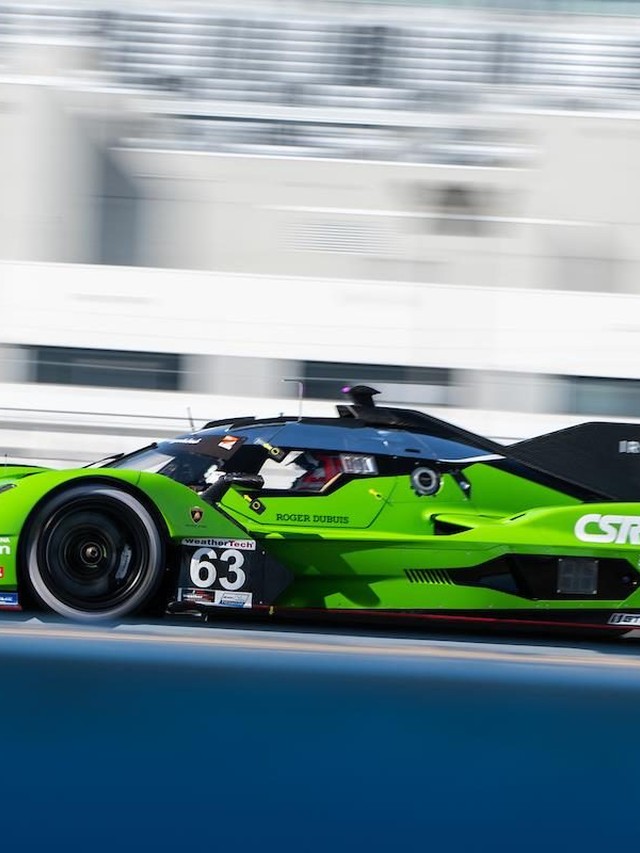
The Lamborghini SC63 LMDh race car showcases its aerodynamic profile at speed on the track.
The 2024 Season: Points, Pain, and a Steep Learning Curve
When the lights went green for real, the SC63’s debut season delivered a far more complicated story than Daytona’s stopwatch had promised. Lamborghini finished eighth in the FIA Endurance Hypercar Manufacturers Championship. Both SC63 entries completed the 24 Hours of Le Mans, finishing 10th and 13th overall, and the team earned championship points at Qatar, Imola, and Le Mans.
On the IMSA side, the SC63 finished seventh at the 12 Hours of Sebring, reportedly on the lead lap and just 20 seconds behind the winner. At Indianapolis in September, the team showed strong pace and led laps before contact damage forced a retirement. An Iron Lynx representative, Emmanuel, acknowledged both the positive performance aspects and the operational challenges that surfaced at that event.
Daniil Kvyat called 2024 a “challenging year” with results that fell short of expectations, though he pointed to encouraging performances. Teammate Edoardo Mortara emphasized the learning curve and the team’s focus on building a more competitive package. Commentators noted the SC63 faced specific issues: rear suspension behavior that affected mechanical grip and aero balance, difficulties with tire warm-up and wear, and suggestions the car may have been running above the minimum weight limit. These are the kinds of granular problems that separate a car capable of posting a fast lap from one that can race consistently at the front over six, twelve, or twenty-four hours. The chassis and hybrid powertrain appeared fundamentally sound, but race strategy, aerodynamics, and tire management all needed substantial development.

The Lamborghini SC63 LMDh race car takes a corner with precision during a test session.
The Complex Origins Behind Lamborghini’s LMDh Gamble
The SC63 represented a full factory effort, but its path to the grid was anything but straightforward. One report indicates Lamborghini explored using Audi’s LMDh car after Audi cancelled its own program in August 2022. That deal reportedly fell through due to the high cost. Lamborghini ultimately turned to Ligier for the SC63’s chassis, pairing it with the bespoke twin-turbo V8 from Autotecnica Motori.
One source suggests the project’s existence was contingent on external financial backing from Iron Lynx. Initial plans reportedly called for two cars in WEC and at least one in IMSA, but those targets were scaled back to a single entry per championship by February 2023. That reduction tells a story about budget realities colliding with competitive ambition. Running in both WEC and IMSA simultaneously, each with its own logistics chain and regulatory framework, is punishingly expensive even for manufacturers with decades of prototype experience. A testing accident reportedly cost months of track time, compounding the challenge of homologating an underdeveloped car.
Forum discussion among Lamborghini enthusiasts reflected genuine excitement, particularly around the car’s aesthetics and the novelty of seeing the brand compete at Le Mans. Opinions were mixed on the depth of commitment, however. Some fans on Reddit’s r/wec and r/IMSARacing communities questioned whether the program was fully resourced, with recurring observations that the car appeared to enter competition before its development was complete.

The Lamborghini SC63 LMDh race car rests in the pit lane surrounded by its dedicated team.
Ferrari Won Le Mans While Lamborghini Was Still Learning to Walk
The uncomfortable competitive context for the SC63 program is Ferrari. The 499P won Le Mans outright in its debut year, 2023, then defended that victory in 2024. Ferrari arrived with the full weight of a factory Hypercar (LMH) program, years of simulator development, and a deep bench of experienced endurance drivers. Porsche’s 963 LMDh, while enduring its own reliability struggles in early races, brought decades of institutional prototype knowledge and multiple customer team entries to spread the development burden.
Lamborghini entered with none of that infrastructure. The SC63 was the company’s first factory prototype since the 1960s. The partnership model with Iron Lynx, while operationally capable from GT racing, was being stress-tested at a level of complexity and cost that dwarfs anything in the Super Trofeo or GT3 paddock. Comparing the SC63’s trajectory to Ferrari’s 499P is instructive but somewhat unfair: Ferrari’s endurance racing pedigree is arguably the deepest in the sport, and the 499P benefited from LMH regulations that allow more bespoke engineering than the cost-controlled LMDh formula Lamborghini chose.
The more useful comparison may be to other LMDh newcomers who found the regulations’ promise of cost efficiency did not automatically translate to competitiveness. The SC63’s eighth-place manufacturers’ championship finish tells a familiar story for first-year programs: the platform lowers the barrier to entry, but closing the gap to established front-runners still demands time, money, and institutional knowledge that cannot be shortcut.
What the SC63’s Arc Means for Lamborghini Fans
According to Road & Track, Lamborghini paused the SC63 IMSA and Le Mans program for 2026, with Squadra Corse citing a strategic decision to refocus its efforts. By mid-2025, The Race described the program as “troubled” with an “uncertain” future. The SC63 had not achieved significant results since its 2024 racing debut, according to multiple reports.
The practical takeaway is sobering but not catastrophic. The SC63 proved that Lamborghini could build a prototype that circulates reliably at the highest level of endurance racing, earns points at Le Mans, and occasionally shows genuine front-running pace. What it did not prove is that the company can sustain a factory prototype effort against manufacturers who treat this category as a core strategic priority.
The technology and experience from the program are unlikely to disappear entirely. Lamborghini’s hybrid architecture is central to its road car future, with the Revuelto and Temerario both running electrified powertrains. Lessons learned about hybrid energy management, thermal management under sustained load, and aerodynamic optimization at prototype speeds feed back into Squadra Corse’s broader portfolio, including the upcoming Temerario GT3 program where Lamborghini competes on more familiar ground.
Looking back at that December 2023 Daytona test, the fastest lap was real. So was the ambition behind it. The question Lamborghini now faces is whether the SC63’s pause becomes a permanent exit or a regrouping before a more competitive return. The company’s official material frames it as strategic refocusing. The competitive landscape will not wait for the answer.
Gallery


