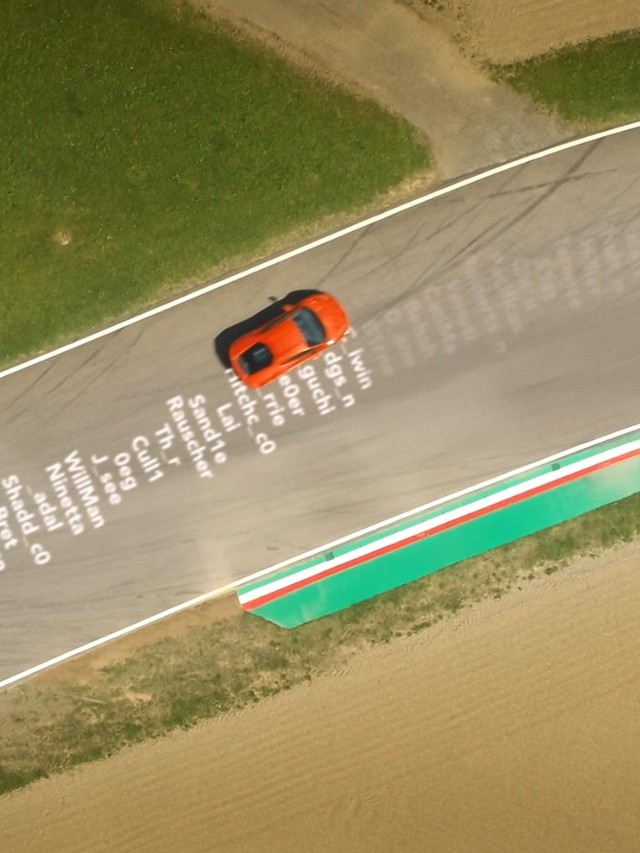
A Million Names on the Asphalt
Most automakers would celebrate a YouTube milestone with a press release and a social media graphic. Automobili Lamborghini projected the names of its one million subscribers onto racetrack tarmac and sent a Huracán EVO screaming past them. The resulting video, titled “One million times thank you,” earned the company YouTube’s Gold Creator Award, and it revealed something about Sant’Agata’s digital instincts that the raw subscriber count alone cannot: this is a brand that treats its online audience as participants in its physical world, not passive spectators watching from behind a screen.
The image is worth lingering on. An orange Huracán EVO, shot from above, tears across asphalt dense with white text, each line a real subscriber name. Green-and-white curbing frames the edges. It looks like a race broadcast overlay brought to life, collapsing the distance between a follower tapping a subscribe button in São Paulo or Shanghai and the tarmac at a circuit in Emilia-Romagna.
Lamborghini says its YouTube channel now counts nearly 1.1 million subscribers, with that figure and Instagram both growing by 50 percent over the preceding 12 months. Across all platforms, the company claims a combined audience exceeding 38 million, a significant portion of which skews young. Instagram leads at 22.5 million followers, with Facebook accounting for 12.7 million. Those numbers matter less as vanity metrics than as evidence of a deliberate strategy: Sant’Agata is building a media ecosystem around its cars, and the Gold Creator Award is simply the first visible proof that the approach is working at scale.
The Strategy Behind the Subscribers
A million YouTube subscribers does not materialize from occasional uploads. One analysis of Lamborghini’s digital approach noted that the brand publishes new content to Instagram and Facebook almost daily and maintains a near-daily upload schedule on YouTube as well, a frequency that dwarfs what many luxury manufacturers manage. Most post once a week, if that.
The content follows a recognizable formula: high-production track footage, factory walkthroughs, behind-the-scenes glimpses of Squadra Corse operations, and lifestyle-adjacent material that connects the cars to aspiration rather than spec sheets alone. Lamborghini also maintains a presence on Chinese platforms like Weibo, acknowledging that its growth markets extend well beyond traditional European and North American bases.
What lifts this output above a generic corporate feed is the willingness to let the cars speak for themselves. Scroll through the YouTube library and you find that the naturally aspirated V10 and V12 engines do most of the talking. A flat-plane V10 screaming to redline on a Vallelunga straight requires no narration, and Sant’Agata seems to understand that better than any rival. By late 2024, Lamborghini extended this logic further, launching its own smart TV streaming app, Lamborghini TV, as Road & Track reported. The move signaled that the company views content distribution not as a marketing afterthought but as a dedicated channel worth owning outright. Taken together with the subscriber-name projection, a pattern emerges: every piece of content is designed to pull the audience closer to the physical experience of the cars, whether that means hearing an exhaust note through headphones or seeing your own name on the asphalt beneath one.
Beyond the Numbers: What a Young Audience Means for Sant’Agata
Lamborghini’s acknowledgment that “many” of its 38 million followers are very young deserves a closer read than the company probably intended. The overwhelming majority of those followers will never configure a Revuelto. They know that. Lamborghini knows that. And yet Sant’Agata invests in them anyway, because the supercar business runs on a peculiar economic engine: desire built decades before the purchase.
A 16-year-old who pins a Huracán poster to a bedroom wall in 2019 becomes the 35-year-old entrepreneur who walks into a dealership in 2038. The pipeline from aspiration to allocation is long, and brands that neglect it pay the price in cultural relevance. Lamborghini’s digital investment functions as a futures contract on brand loyalty, one that costs far less than traditional advertising and reaches a far broader demographic.
For current owners and enthusiasts, the practical takeaway is straightforward: Lamborghini’s digital visibility keeps residual values healthy. A brand that millions of young people actively follow and engage with maintains the cultural cachet that underpins collector-car pricing. When a Countach or a Murciélago appears in a YouTube compilation watched by ten million people, that visibility reinforces the desirability of the car sitting in your garage. The subscriber-name projection stunt works on this level too. It tells every one of those million followers that they belong to the Lamborghini story, and belonging is the first step toward buying. Digital relevance and real-world value are more connected than many collectors want to admit.
The Competitive Playbook: Where Lamborghini Stands Against Rivals
Ferrari’s social presence leans heavily on its Formula 1 operation, which provides a built-in content engine that no marketing budget can replicate. Every Grand Prix weekend delivers hours of footage, driver interviews, and real-time drama. Lamborghini lacks that F1 megaphone, which makes its YouTube and Instagram growth all the more striking: it reached a million subscribers on the strength of road cars, customer racing, and factory storytelling alone.
Porsche, meanwhile, commands an enormous digital following buoyed by a model range that spans from the Macan to the 911 GT3 RS. That breadth gives Porsche more content hooks, from overlanding a Cayenne to chasing lap records at the Nürburgring. Lamborghini’s narrower portfolio forces a tighter editorial focus, which paradoxically works in its favor on platforms that reward visual intensity over variety. A Revuelto launch control video does not need a lifestyle preamble. It grabs attention in the first second.
The subscriber-name projection illustrates a gap that neither Ferrari nor Porsche has attempted to close in quite the same way. Both brands celebrate their communities through track days, owner events, and heritage programs, but physically inscribing digital fans onto a circuit surface collapses the boundary between online follower and real-world participant in a manner unique to Sant’Agata. Whether that gesture translates to measurable loyalty remains impossible to quantify, but as a piece of community theater that reinforces the broader content strategy, it lands.
Content as Currency: What Actually Works on Lamborghini’s Channel
Browse the Lamborghini YouTube channel and a pattern emerges quickly. The videos that rack up the highest view counts almost always feature raw engine sound, dramatic camera angles, and minimal corporate narration. Factory tour content performs well too, tapping into the same curiosity that drives millions of views for “how it’s made” videos across YouTube. The Accademia and Squadra Corse programs provide a steady stream of on-track footage that doubles as both brand content and genuine motorsport documentation.
Owner-generated content amplifies the official channel’s reach in ways Lamborghini cannot fully control but clearly benefits from. On forums like Lamborghini-Talk, owners regularly share their own YouTube videos, from POV night drives in a Huracán Tecnica to full delivery-day walkthroughs of a new Revuelto. This grassroots layer creates a flywheel: the official channel draws viewers in, owner channels keep them engaged, and the combined ecosystem reinforces the brand’s presence across the platform.
Lamborghini’s willingness to let enthusiast creators orbit around its brand, rather than policing every piece of user-generated content, reflects a maturity in digital strategy that some luxury houses still struggle with. The instinct to protect exclusivity by limiting visibility is strong in this segment. Sant’Agata appears to have concluded that visibility and exclusivity can coexist, provided the product itself remains genuinely special.
For LamboCars readers who follow the brand closely, the Gold Creator Award is a small data point in a larger trajectory. The subscriber-name projection, the near-daily upload cadence, the streaming app launch: all of it points toward a company building permanent media infrastructure around its cars, treating content as a lasting asset rather than a disposable campaign. The direction is clear. Sant’Agata wants to own the screen as confidently as it owns the road, and a million names glowing on the tarmac suggest it is well on its way.
Gallery


