Lamborghini Handed Its Flagship to a Rock Photographer. The Results Look Nothing Like a Car Ad.
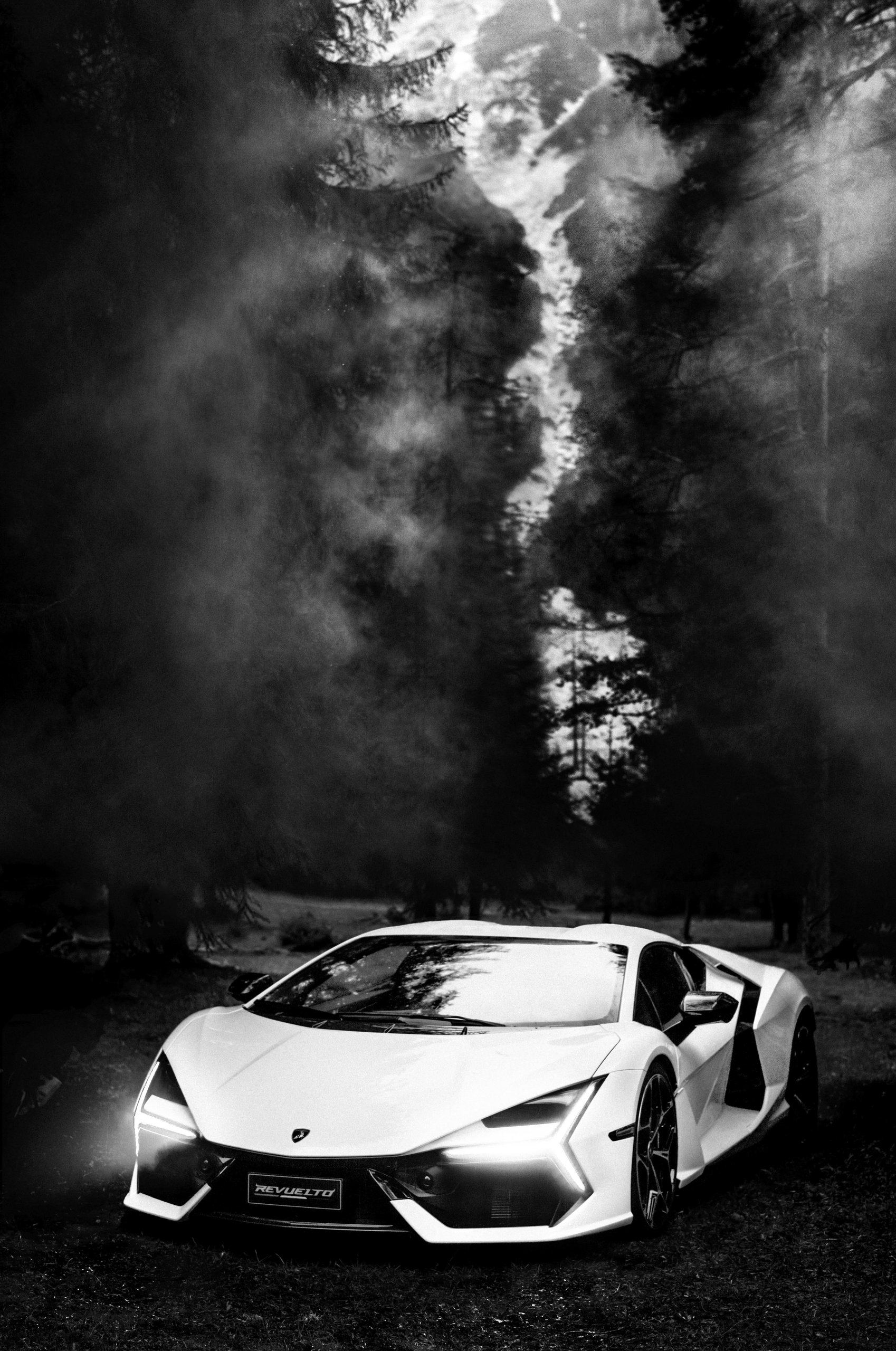
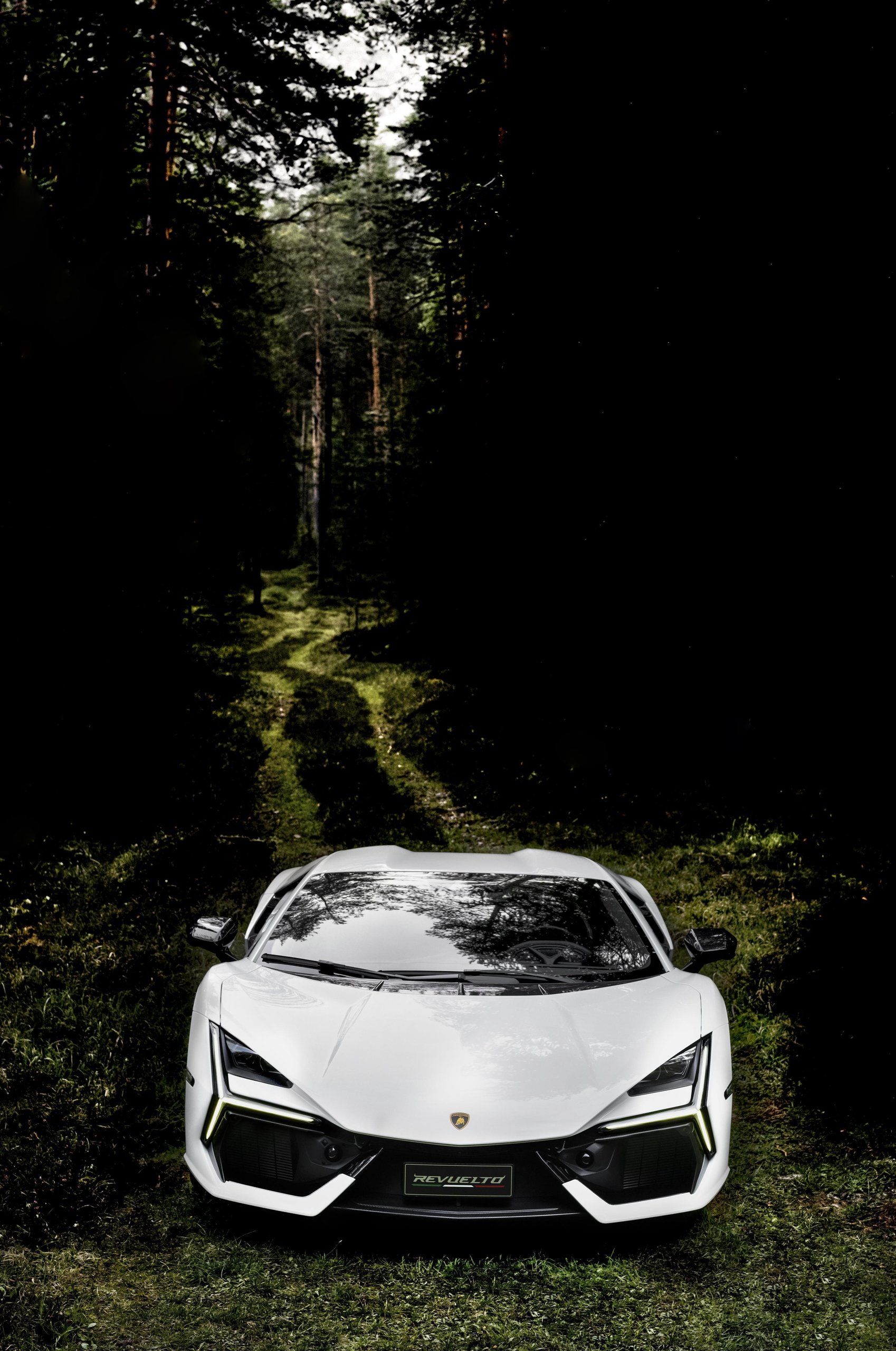
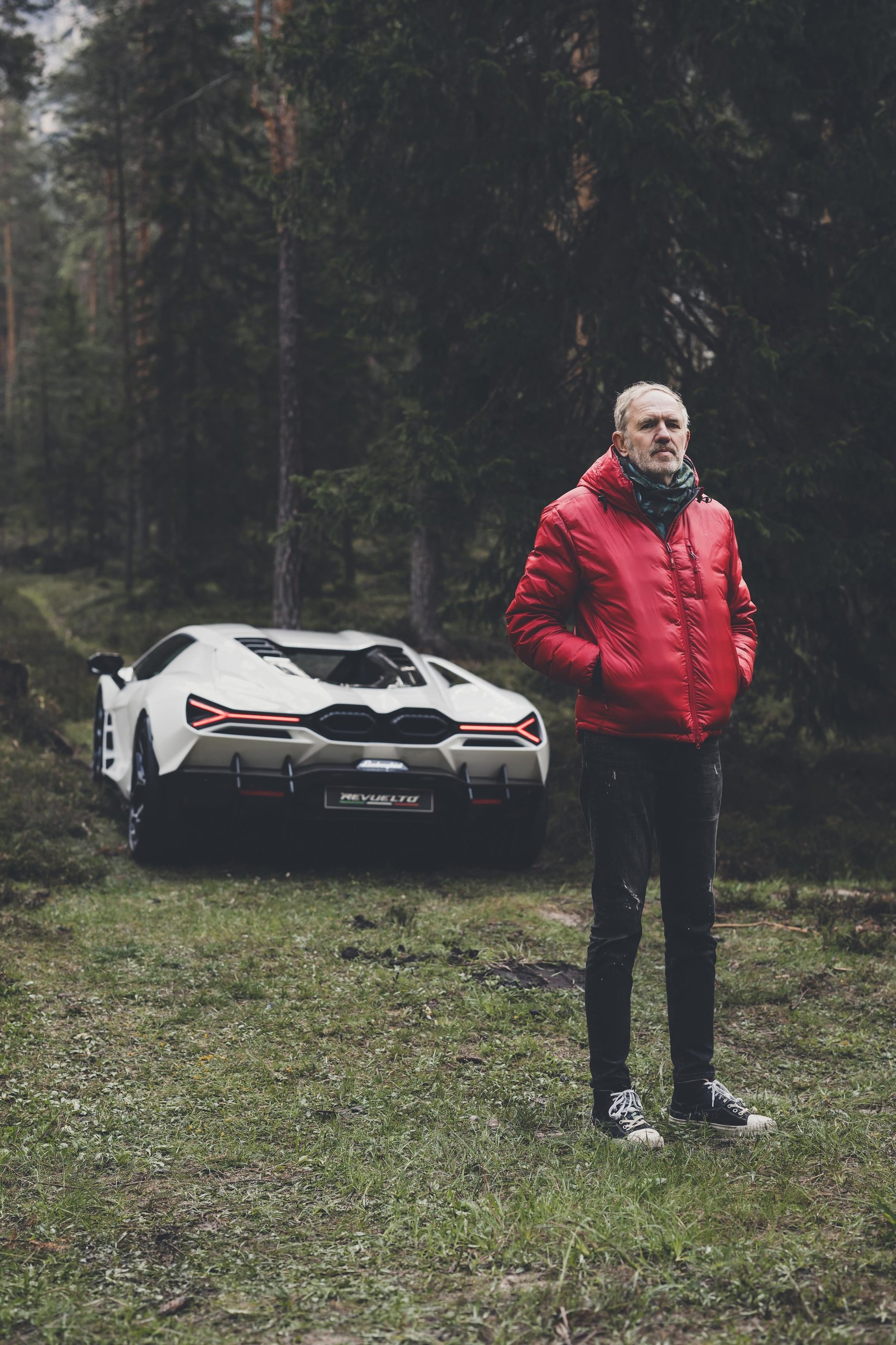
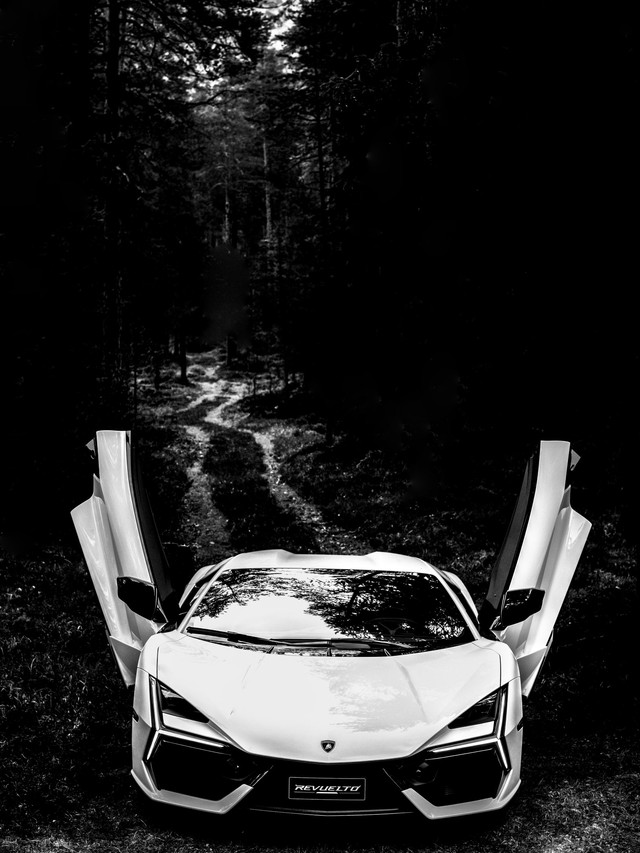
Lamborghini commissioned Anton Corbijn, the Dutch photographer and filmmaker whose lens defined the visual identities of U2, Depeche Mode, and David Bowie, to spend two days with the Revuelto in the Italian Dolomites. The resulting images look less like a luxury car campaign and more like album artwork: a white Revuelto emerging from forest mist in stark black and white, its scissor doors thrown open on a mossy path, its Y-shaped taillights glowing against a wall of dark pines. No circuit. No blur of speed. No driver in a helmet.
The collaboration is a deliberate choice by Sant’Agata to position its hybrid V12 flagship as something beyond a performance machine. Corbijn’s portfolio spans five decades of cultural image-making, from The Joshua Tree and Achtung Baby album covers to films like Control and The American starring George Clooney. He is, by any reasonable measure, one of the most influential visual artists alive. Giving him the Revuelto and a forest, then stepping back, tells you exactly what Lamborghini wants this car to mean in the broader culture.

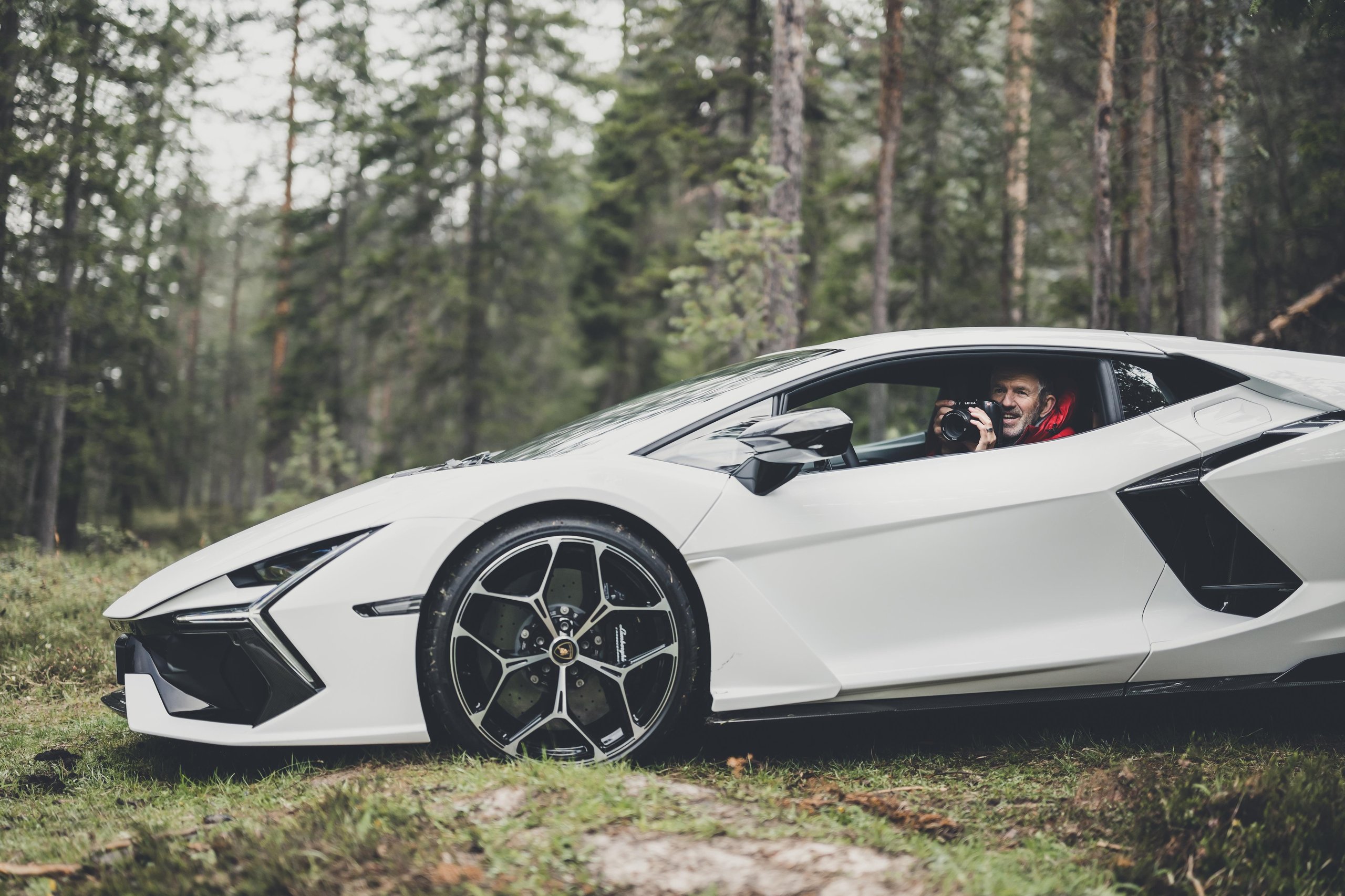
A white Lamborghini Revuelto is photographed in a natural setting with a forest and cliff backdrop. Image: Automobili Lamborghini.
Why Corbijn? Building Icon Status Before the First Oil Change
Lamborghini could have hired any number of accomplished automotive photographers. Going outside the car world entirely reveals the strategy: Corbijn built his reputation by turning musicians into myths. His early black-and-white portraits of Joy Division’s Ian Curtis, shot on cheap film because that was all he could afford, became inseparable from the band’s legacy. He later shaped how the world saw Bowie, Miles Davis, Bruce Springsteen, and Tom Waits. For U2, he created not just album covers but an entire visual language that persisted across decades.
His creative philosophy runs counter to everything a typical supercar photoshoot represents. Corbijn believes his style is “defined by your inability to do it any other way.” He credits Brian Eno for teaching him to “minimise your choices and then become very inventive with the little things you have left.” He started shooting in black and white because it was the only medium he could develop himself, then discovered it carried more expressive force than color. Two lenses and a camera, he says, will always be enough.
Where the standard supercar shoot places the car on a polished studio floor or captures it screaming past at 150 mph, Corbijn strips away the noise. Placing the Revuelto in a quiet alpine forest, alone, surrounded by mist and moss, he forces the viewer to look at the car the way he looks at a musician: as a subject with presence and personality, not just technical capability. The Revuelto already proved its engineering credentials. Corbijn’s job was to give it a soul that transcends spec sheets, to create images people will associate with the car long after the first service interval.

The Dolomites as Stage: Corbijn’s Visual Language Applied to a Supercar
Corbijn explained his choice of location in characteristically spare terms. He wanted the car to feel “like a foreign body in the forest, like an animal raring to go.” Nature, he acknowledged, is difficult to work in because its beauty tends to overwhelm the subject. The Revuelto, he found, balanced the equation: the visual power of the car matched the grandeur of the landscape without either one swallowing the other.
The images bear this out. In the black-and-white shots, the Revuelto sits low on a forest floor while smoke or mist curls around its flanks, its angular lines and Y-shaped running lights cutting through the organic chaos of tree trunks and undergrowth. The color images are warmer but no less deliberate: the car’s white paint reads almost luminous against dark green foliage, its scissor doors open like wings. A close-up isolates a single wheel, brake disc and caliper rendered in Corbijn’s signature monochrome, turning an engineering component into an abstract composition.
Corbijn, a Taurus, noted his appreciation for the roots of the Revuelto’s name, which follows Lamborghini’s tradition of naming cars after fighting bulls. He described Lamborghini as representing “sophistication in cars,” calling it “a beautiful, sophisticated and chic name for any product.” Whether or not you find that observation persuasive, it reveals something about how he approached the assignment: not as a commercial job but as a creative interpretation of a subject he genuinely found compelling.

The Lamborghini Revuelto reveals its iconic scissor doors in a striking black and white forest setting. Image: Automobili Lamborghini.
The Competitive Canvas: How Rivals Launch Their Halo Cars
Lamborghini’s decision to commission a fine-art photographer looks even more pointed when you consider how its competitors typically introduce flagship hybrids. Ferrari tends to lean on motorsport heritage and lap times. McLaren favors wind-tunnel data and aerodynamic storytelling. Both approaches are effective, but they keep the conversation firmly inside the performance envelope, where arguments eventually reduce to tenths of a second and downforce figures.
By associating the Revuelto with an artist whose work hangs in museums and whose album covers shaped popular culture, Lamborghini is arguing that the car belongs in a cultural conversation, not just a horsepower war. The Revuelto does not need Corbijn’s images to prove it can accelerate or corner. It needs them to prove it can endure as an object of fascination the way a great record cover endures.
This approach aligns with other recent Lamborghini moves. The Revuelto Opera Unica program, which offers fully bespoke one-off specifications, and the broader Ad Personam customization platform both emphasize the car as a canvas for personal expression. Corbijn’s images function as the brand-level version of that same idea: the Revuelto as art, not appliance. Owners who spec these cars through Ad Personam tend to think of their vehicles as reflections of personal taste. Corbijn’s campaign validates that instinct at the highest possible cultural register.
No other supercar manufacturer, at the time of this collaboration, paired its flagship launch with a photographer of Corbijn’s stature and gave him this much creative latitude. That distinction matters for collectors and enthusiasts who care about a car’s cultural footprint, not just its lap time.

The Lamborghini Revuelto's distinctive rear design and glowing taillights command attention in a moody forest setting. Image: Automobili Lamborghini.
The Engineering That Made It Worth Shooting
None of this cultural positioning would work if the Revuelto were merely pretty. Its 6.5-liter naturally aspirated V12, supplemented by three electric motors for a combined output of 1,015 CV (1,001 horsepower), provides the substance behind the style. Built around a carbon fibre monofuselage, the car represents Lamborghini’s bridge between its naturally aspirated heritage and the hybrid era, retaining the high-revving V12 that purists demanded while adding electrified torque and the ability to creep through a neighborhood silently in electric mode.
Lamborghini positioned the Revuelto as the apex of its engineering as the company celebrated its 60th anniversary. The car is widely recognized as the flagship successor to the Aventador, a model that itself became a cultural fixture over more than a decade of production. According to CarBuzz, the Revuelto proved itself the quickest Lamborghini ever in independent drag testing, crossing the quarter-mile in under 9.5 seconds.
Multiple owners on enthusiast forums describe the dual-clutch transmission as a transformative improvement over the Aventador’s single-clutch unit, making the car considerably more livable day to day. That practical dimension matters because a car people actually drive accumulates stories. Stories build legend. And legend is precisely what Corbijn specializes in creating.

The advanced digital cockpit of the Lamborghini Revuelto offers a clear view of performance data and driving modes. Image: Automobili Lamborghini.
What This Collaboration Signals for Buyers and Collectors
For prospective Revuelto owners, the Corbijn campaign is worth paying attention to for a reason that goes beyond aesthetics. Lamborghini is building the car’s cultural narrative from the outset, and that narrative directly influences long-term collectibility. The Aventador’s residual values stayed remarkably strong across its production run partly because the car became a cultural object, referenced in music, film, and social media far more than its competitors. Lamborghini appears to be accelerating that process with the Revuelto, investing in high-profile artistic collaborations rather than waiting for organic cultural adoption.
The practical takeaway for anyone on the waiting list or considering a Revuelto: the car is being positioned not just as a performance benchmark but as a cultural artifact. That positioning tends to support resale values, particularly for early production examples and bespoke Ad Personam specifications. Lamborghini confirmed a Japan-exclusive Ad Personam Revuelto with a custom gradient design, and the company recently teased a limited “few-off” special model ahead of Monterey Car Week. Both moves reinforce the exclusivity strategy.
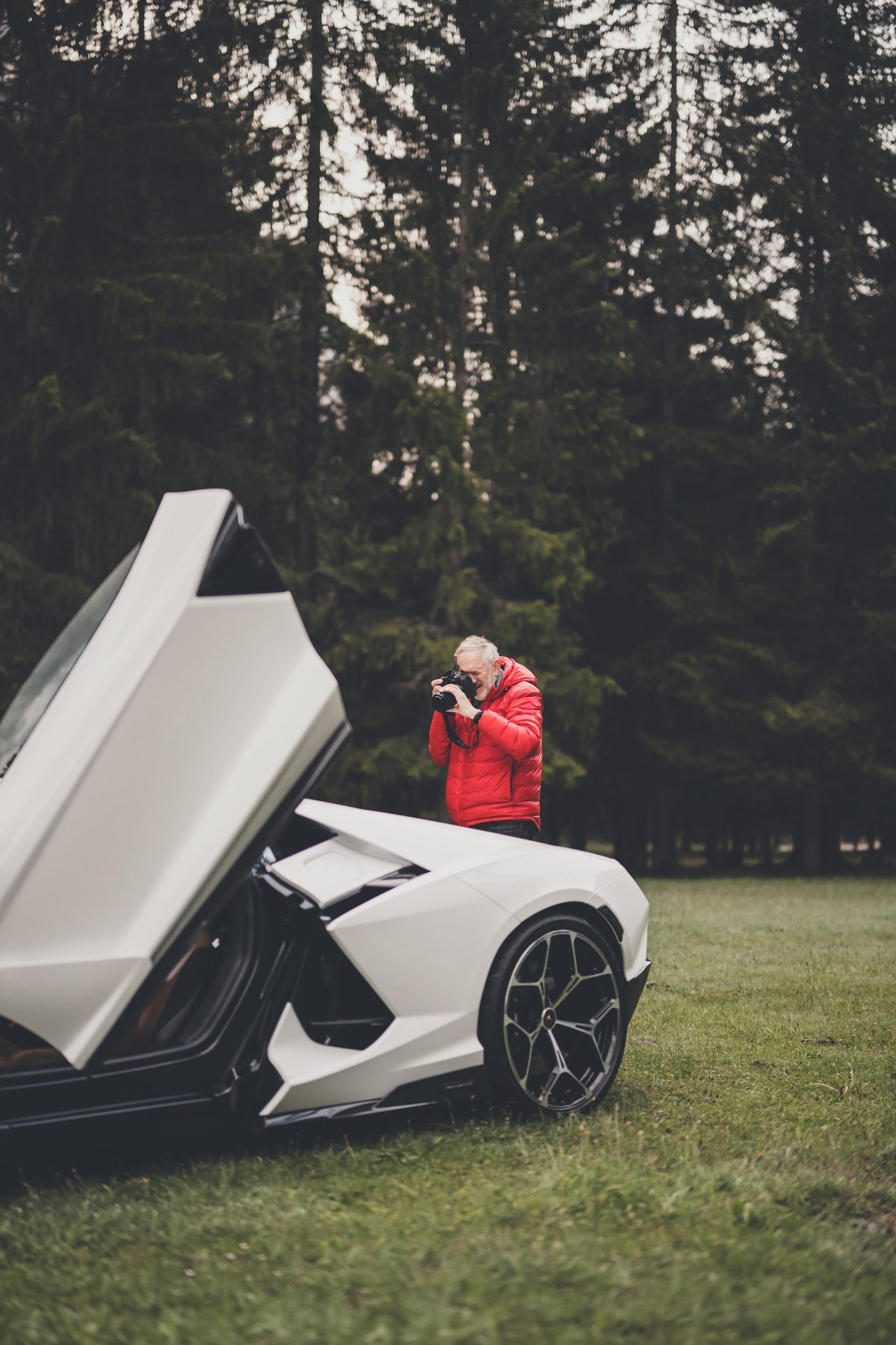
Corbijn himself seemed to understand the weight of the assignment. He spoke about authenticity and bravery, values he sees reflected in Lamborghini’s own ethos. “I shoot fast, in a kind of documentary approach,” he said. “My work in the beginning was very brave because nobody really liked it. You have to believe in yourself and keep doing it.”
That sentiment could describe Lamborghini’s entire history, from Ferruccio’s original act of defiance against Ferrari to the decision to keep a naturally aspirated V12 alive in an era of downsized turbos. Corbijn did not photograph the Revuelto because it was fast. He photographed it because, in his estimation, it was worth looking at. For a car company navigating the transition to electrification while trying to preserve its identity, that endorsement from outside the automotive world carries real weight.

A man in a red jacket stands in a scenic field with a white Lamborghini and its iconic scissor door open in the background. Image: Automobili Lamborghini.
Gallery