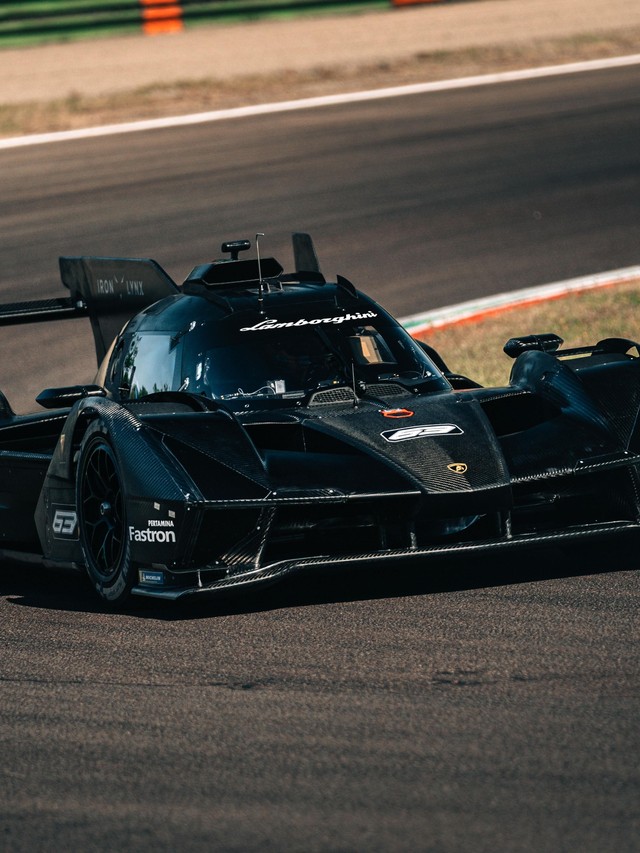
1,500 Kilometers at Imola: The SC63’s Ambitious Opening Act
Over two days in August 2023, Lamborghini’s SC63 LMDh prototype completed its first proper track test at Imola. Factory drivers Mirko Bortolotti, Andrea Caldarelli, and Daniil Kvyat accumulated 1,500km of running, building on an initial shakedown at Vallelunga earlier that month. Imola was where the real work began: calibration of the engine, gearbox, traction control, speed limiter, brake migration, cooling systems, and aerodynamics. Two more European tests at Paul Ricard and Spa-Francorchamps were scheduled before the month was out.
The engine drew the most attention. It was the first bespoke racing engine developed entirely in-house by Squadra Corse, a milestone that carried enormous symbolic weight. Lamborghini’s motorsport efforts had long relied on production-derived powertrains, the Huracán GT3’s naturally aspirated V10 being the most successful example. Building a purpose-built racing engine from scratch signaled a fundamentally different level of commitment. Gearshift calibration on the standardized Xtrac gearbox, which LMDh regulations mandate across all entrants but allow manufacturers to customize for gear ratios and mechanical differential slip, rounded out the technical agenda.
The mood was unmistakably optimistic. Lamborghini was preparing to contest both the FIA World Endurance Championship and the IMSA WeatherTech Sports Car Championship for 2024, placing the brand on the same grid as Porsche, Ferrari, Toyota, and Cadillac at the top tier of global endurance racing for the first time. For enthusiasts who followed the announcement, it felt like Lamborghini was finally playing in the arena its road cars had always implied it belonged in. Looking back, those 1,500 kilometers at Imola marked the high-water mark of uncomplicated ambition for a program whose trajectory would prove far more turbulent than anyone anticipated.
Why the SC63 Program Mattered Beyond the Stopwatch
The SC63 was never just a race car. It was Lamborghini’s statement of engineering independence at the highest level of motorsport, arriving at a moment when the brand’s identity was undergoing a broader transformation. The Revuelto had introduced hybrid technology to the V12 flagship. The Temerario was on its way with a twin-turbo V8. The SC63’s hybrid powertrain, combining that bespoke Squadra Corse engine with standardized LMDh hybrid components, represented the racing parallel to these road car shifts.
For a company Lamborghini’s size, entering LMDh was a calculated gamble. The regulations were designed to lower costs relative to the old LMP1 era through standardized chassis (Ligier, in Lamborghini’s case), a common hybrid system from Bosch, and a single gearbox supplier. In theory, this made the class accessible to manufacturers lacking the budgets of Toyota or Porsche’s dedicated prototype programs. In practice, costs and complexity escalated faster than anyone expected.
The partnership with Iron Lynx, Lamborghini’s factory-supported team for both WEC and IMSA competition, added professional racing infrastructure that Squadra Corse needed. Iron Lynx brought experience in endurance formats, pit strategy, and the operational demands of multi-driver events spanning six, twelve, and twenty-four hours. On paper, the collaboration looked like sound architecture for a first-time prototype program. Yet the gap between sound architecture and sustained competitiveness at this level would prove wider than the Imola test suggested.

The Lamborghini SC63 LMDh prototype car makes its debut on the track, showcasing its aggressive aerodynamic design.
What Went Wrong: The Strategic Pause and Its Causes
The SC63 did race. It debuted in competition in 2024 across both WEC and IMSA, and the results were, charitably, part of the learning curve. According to Road & Track, the car retired from its first 24 Hours of Daytona in 2025 after just an hour of running due to an apparent powertrain problem. Reliability and pace remained inconsistent throughout the program’s competitive life.
Lamborghini had already withdrawn the SC63 from the World Endurance Championship Hypercar class ahead of the 2025 season. For 2025, the car was scheduled to compete solely in IMSA’s five-race Michelin Endurance Cup (Daytona, Sebring, Watkins Glen, Indianapolis, and Road Atlanta), a significantly reduced commitment from the dual-championship ambitions that accompanied that first Imola test.
Then came the full pause. Lamborghini confirmed it would not race the SC63 in the 2026 season, describing the decision as a “strategic realignment of its motorsport activities.” Chairman and CEO Stephan Winkelmann and Head of Motorsport Maurizio Leschuitta attributed the decision primarily to external factors. Winkelmann was specific: “The rules changed, technology was moving faster and more expensive than expected, and also the commitment.”
CTO Rouven Mohr acknowledged weaknesses in the car’s rear suspension kinematics and stiffness. The team deployed what the regulations call an “evo joker,” a limited allowance for homologation updates, to address the suspension, and drivers Romain Grosjean and Edoardo Mortara reportedly responded positively. The car showed improved practice pace, with Grosjean placing fourth in one GTP practice session, 0.767 seconds off the fastest time, and qualifying within 0.601 seconds of pole. During the race, the No. 63 Lamborghini ran in podium contention before an additional energy stop dropped it to tenth. The potential was visible. The resources to fully realize it were not.
A recurring theme in enthusiast discussions was that a testing accident in August 2023, which destroyed a chassis and caused significant development delays, put the program on the back foot from which it never fully recovered. Others pointed to the difficulty of running a competitive two-championship effort with a single car. Both observations trace back to the same underlying tension: the ambition announced at Imola outpaced the scale of investment required to sustain it.

The Lamborghini SC63 prototype demonstrates its rear aerodynamic efficiency while navigating a challenging turn on the circuit.
The Temerario GT3: Where Lamborghini’s Motorsport Investment Goes Now
With the SC63 paused, Lamborghini’s motorsport focus shifts to the Temerario GT3, which launched in July 2025 ahead of customer deliveries in 2026, with a Super Trofeo one-make version expected in 2027. This is not a retreat so much as a return to the territory where Lamborghini’s racing programs generate the most tangible value for the company and its customers.
The Huracán GT3 and its Super Trofeo variants built one of the most commercially successful customer racing ecosystems in the supercar world. Over 30 Huracán Super Trofeo EVO2 cars regularly appeared on grids for the 2025 North American season alone. For Lamborghini owners who want to race, the Super Trofeo series offers a structured, well-supported path from track days to competitive endurance events. The Temerario GT3 is designed to continue and expand that pipeline.
Anyone considering a Lamborghini purchase with an eye toward eventual track use should pay attention to this shift. The Temerario GT3 represents where Lamborghini will concentrate its engineering talent, development budget, and factory support for the foreseeable future. That concentration of resources, freed from the enormous demands of a prototype program, should translate into a more refined and competitive customer car. Lessons from the SC63’s bespoke engine development and hybrid system calibration will almost certainly inform the Temerario platform, even if the specific technologies differ.
Mohr indicated that with the SC63’s mechanical suspension issues addressed, the next planned improvement areas were aerodynamics and weight saving. Whether those learnings migrate into the GT3 program in some form remains an open question, but Squadra Corse’s engineering staff now works on one program instead of splitting attention between two very different racing disciplines.
The Bigger Picture: What the SC63 Means for Lamborghini’s Future
Winkelmann and Leschuitta described a potential return of the SC63 program as “hypothetical.” One web report indicates Lamborghini would be open to resuming the project in 2027 if a suitable factory partner is found. That phrasing is telling. Running a single-car LMDh effort against multi-car factory teams from Porsche, Toyota, Ferrari, BMW, and Cadillac was always going to be an uphill fight, and the financial and logistical demands of the class grew beyond what Lamborghini could justify while simultaneously launching the Temerario GT3 program.
The honest assessment is that Lamborghini entered LMDh with genuine ambition and underestimated the escalation. That first test at Imola in August 2023 captured the optimism of the moment: a new bespoke engine, three factory drivers logging serious mileage, a full calendar of development tests planned. The car that emerged from that program showed flashes of genuine pace. It also exposed the reality that competing at the top of endurance racing requires either the budget of a major OEM prototype program or the patience to develop over multiple seasons, something the rapidly shifting regulatory landscape and cost trajectory made difficult to sustain.
Road & Track reported the pause in August 2025, framing it as a decision made less than two years after the brand’s factory debut at the top level of sports car racing. That timeline underscores how quickly the calculus changed.
For Lamborghini enthusiasts, the SC63 chapter is worth remembering not as a failure but as a calibration. The brand proved it could design and build a bespoke racing powertrain. It proved it could compete on the world’s most demanding circuits against the sport’s established powers. What it could not do, at this scale and at this moment, was sustain the investment required to close the gap. The Temerario GT3 represents a more measured bet: a program where Lamborghini’s track record is strong, the customer base is real, and the path to competitive results is shorter. Whether the SC63 ever returns to a starting grid depends on factors Lamborghini cannot fully control. What the brand does control is where it puts its engineering talent next, and that answer, for now, is clear.

The Lamborghini SC63 prototype showcases its powerful rear design as it accelerates down the straightaway.
Gallery


