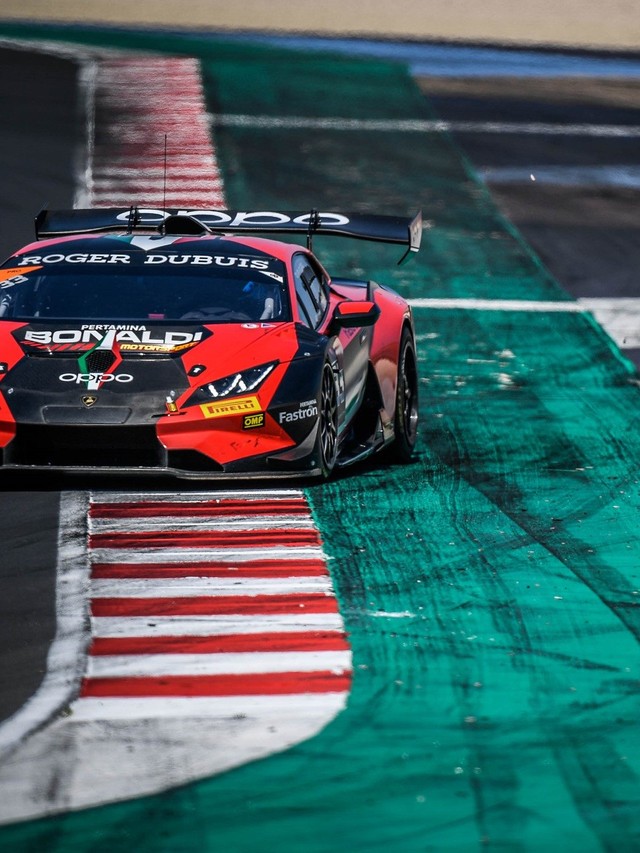
Stoneman’s Misano Masterclass: Chasing Down the Leader Under Brutal Heat
Dean Stoneman spent most of the second Lamborghini Super Trofeo Europe race at Misano Adriatico running behind other people’s cars. By the time the checkered flag fell on August 9, 2020, the Bonaldi Motorsport driver was the one everyone else was chasing.
Karol Basz put the #16 VS Racing Huracán Super Trofeo Evo on pole and controlled the opening stint, holding off Loris Spinelli through the first corner and pulling away from a pack led by Kikko Galbiati and Stoneman, who ran third and fourth respectively. Ambient and track temperatures climbed well above Saturday’s evening race, turning the already slippery Misano surface into a challenge that caught several drivers out. Olli Kangas, sharing with the experienced Edoardo Liberati, suffered a front-right puncture at the final corner that spun the Finnish driver off and out of the race. Franz Konrad, Martin Lechman, and Takis Spiliopoulos all spun independently.
The pit window reshaped the order. Andrzej Lewandowski took over from Basz and held the lead, while Vito Postiglione inherited Galbiati’s car and immediately began closing the gap, dispatching Gerard van der Horst and pulling nearly four seconds out of Lewandowski. Then a loose wheel approaching the high-speed Turn 11 kink sent the #44 Imperiale machine into the gravel. For a veteran of the series, it was a brutal way to lose a podium.
That retirement cleared Stoneman’s path. He latched onto Lewandowski’s gearbox and made the decisive pass at Turn 4 with just under ten minutes remaining. Lewandowski held on for second, also claiming Pro-Am honors, while the Race 1 winning pair of Raul Guzman and Miloš Pavlović finished third to extend their championship points lead. Jonathan Cecotto brought the GSM Racing entry home fourth on the Monaco-based team’s debut weekend. Massimo Mantovani dominated the Am class, and Hans Fabri won the Lamborghini Cup.
The Strategic Crucible: Why Super Trofeo Matters More Than Its Grid Size Suggests
Single-make racing series rarely generate the headlines of a Le Mans campaign or a GT3 factory program, but they serve a purpose those higher-profile efforts cannot replicate. Every car on the Lamborghini Super Trofeo grid runs the same Huracán Super Trofeo Evo, powered by a 5.2-liter naturally aspirated V10 producing 620 CV and managed by a standardized MoTeC control unit. The hybrid carbon and aluminum frame carries a dry weight of 1,270 kg. When the hardware is identical, the differentiators become driver skill, team preparation, and pit-stop execution, precisely the kind of data Lamborghini Squadra Corse needs to evaluate talent and refine its motorsport pipeline.
The series operates across three continental championships (Europe, North America, and Asia) and feeds directly into Lamborghini’s broader motorsport ladder. Drivers who prove themselves in Super Trofeo gain the credibility and seat time to move toward GT3 programs. Stoneman himself went on to win the 2020 Super Trofeo Europe championship, a result that underscored the depth of competition in a series sometimes dismissed as a gentleman-driver exercise. His career context adds weight to that achievement: widely reported accounts note that Stoneman was diagnosed with testicular cancer in January 2011, a diagnosis that derailed early Formula 1 ambitions and makes his single-make championship title a more layered story than a simple race result.
For Lamborghini, the engineering feedback loop matters just as much. Running hundreds of identical cars across global circuits under race conditions generates reliability data and component stress information that no amount of factory testing can replicate. Every puncture, every loose wheel, every grip complaint from a driver struggling in 35-degree heat at Misano becomes a data point that shapes the next generation of competition machinery.
From Huracán to Temerario: The Racing Platform Handover
The road-going Huracán gave way to the plug-in hybrid Temerario, and the competition side of the house is following a parallel trajectory. The Temerario GT3, which debuted at the 2025 Goodwood Festival of Speed, marks Lamborghini’s first competition car to be fully designed, developed, and built in-house, according to Autoblog. Previous GT3 programs relied on external partners for significant portions of the development work. Bringing that capability inside Squadra Corse represents a structural shift in how Lamborghini approaches motorsport.
The Super Trofeo series played a direct role in making that shift possible. A decade of running the Huracán platform in one-make competition built institutional knowledge about race-car engineering, team support logistics, and the operational rhythms of a global racing series. When Squadra Corse sat down to design the Temerario GT3 from a blank sheet, they carried that accumulated experience with them. Stoneman’s Misano victory and the hundreds of races like it across three continents are the foundation on which that in-house capability was built.
For teams and drivers who shaped their programs around the Huracán’s characteristics, the transition will eventually mean adapting to an entirely different powerband, different weight distribution, and the complexities of a turbocharged hybrid architecture in wheel-to-wheel racing. Lamborghini has not confirmed a timeline for a Temerario-based Super Trofeo car, but the logic of the platform ladder suggests one is inevitable. The current Huracán Super Trofeo Evo, meanwhile, continues to attract collector interest even off the track: Autoblog recently reported a 2020 example with just 84 miles listed for sale, a sign of how desirable these naturally aspirated V10 race cars are becoming as the platform reaches the end of its competitive life.
Super Trofeo Against the Competition: A Different Value Proposition
Lamborghini is not the only manufacturer running a customer racing series. Ferrari operates the Challenge series, and Porsche fields the Carrera Cup, both serving similar functions: brand engagement, driver development, and a controlled competitive environment for owners and semi-professional racers. What separates the Super Trofeo is the specificity of the car itself. The Huracán Super Trofeo Evo is a purebred, non-street-legal race car, not a modified road car with a roll cage bolted in. That distinction matters because the engineering was optimized solely for circuit performance, with no compromises for road-legal noise limits, ride comfort, or emissions compliance.
The series structure reinforces the proving-ground thesis. Am and Lamborghini Cup classes serve less experienced drivers, Pro-Am accommodates mixed-skill pairings, and the Pro class produces genuinely sharp racing. The Misano results illustrate that range clearly. Stoneman, a former Formula Renault 3.5 champion, won the overall race, while Mantovani and Fabri took their respective class victories in what amounted to entirely different competitions running on the same track at the same time.
Lamborghini has not published official season costs for Super Trofeo competitors, and the company does not publicly detail its privateer support packages. But the grid at Misano included professional-caliber drivers, experienced GT racers, and well-funded privateers, all pushing identical machinery to its limits. The entry barrier is high, and the competitive credibility is real.
What Misano Told Us About the 2020 Season and Beyond
Guzman and Pavlović left Misano with an extended championship lead, a strong position given that only four rounds remained on the compressed 2020 calendar. The next scheduled round at the Nürburgring on September 4-5 would test both car and driver in a very different environment: cooler temperatures, longer straights, and elevation changes that Misano’s flat, technical layout does not replicate. The full 2020 calendar ran through Barcelona, Spa-Francorchamps, and Circuit Paul Ricard before the season concluded.
Stoneman’s Misano victory proved to be a turning point rather than an isolated result, as he ultimately won the overall 2020 Super Trofeo Europe championship. That trajectory, from mid-pack in the opening stint to race winner to series champion, is exactly the kind of story the Super Trofeo is designed to produce. The series operates under the surface of Lamborghini’s public motorsport narrative, but it is the mechanism that identifies talent, stress-tests hardware, and builds the institutional knowledge Squadra Corse now uses to develop competition cars entirely in-house.
The 2020 season operated under the shadow of a global pandemic that compressed schedules and limited paddock access, yet the quality of racing at Misano suggested the series lost none of its competitive intensity. The race report is the surface. The pipeline underneath it is the point.
Gallery


