Five Rounds, One New Country, and a World Final at a Circuit Lamborghini Has Never Used
Lamborghini Squadra Corse confirmed the complete 2020 Super Trofeo North America calendar alongside two announcements that carry real competitive weight: the World Final moves to Misano World Circuit Marco Simoncelli for the first time in the series’ history, and the Pro category will permit a single driver per car, eliminating the mandatory two-driver crew requirement that defined the class since its inception. Together, these changes signal that Squadra Corse is actively reshaping the series’ competitive character, not merely rotating venues and reprinting entry forms.
The North American schedule spans five weekends from April through September, opening at Barber Motorsports Park in Alabama (April 3-5) and closing at WeatherTech Raceway Laguna Seca in California (September 11-13). Between those bookends, the series returns to Watkins Glen International in late June, visits VIRginia International Raceway in August (a fixture on the calendar since 2013), and makes its first trip to Canada for the Streets of Toronto weekend in July. That Canadian debut marks the first time the North American series crosses a national border, adding a street circuit to a calendar otherwise composed entirely of permanent road courses.
The eighth campaign of the North American series then converges with the European and Asian championships at Misano on October 29 through November 1, with the World Final itself occupying the final two days of that window.
Why Misano Matters More Than a Pin on the Map
Since 2013, every Super Trofeo season worldwide has concluded with a World Final that gathers champions from all three continental championships for a pair of 50-minute sprint races at a single venue. The host circuit rotates, and previous editions landed at tracks like Vallelunga, Imola, and Jerez. Misano World Circuit Marco Simoncelli, located near the Adriatic coast town of Misano Adriatico, breaks new ground for the series.
Best known as a MotoGP venue and named after the late Marco Simoncelli, Misano sits roughly 200 kilometers southeast of Lamborghini’s Sant’Agata Bolognese headquarters. For a brand that runs its entire motorsport operation through Squadra Corse in Sant’Agata, hosting the global championship decider within easy reach of the factory carries obvious logistical and symbolic advantages. Engineering and management staff can attend without the overhead of international travel, and the proximity to Emilia-Romagna’s “Motor Valley” gives the event a distinctly Italian flavor that competitors like Ferrari’s Challenge series and Porsche’s Carrera Cup achieve when they race on home soil.
The circuit’s 4.2-kilometer layout, with its mix of tight chicanes and medium-speed corners, also presents a different challenge from the high-speed sweeps of Jerez or the long straights of Monza. For teams that spent the season tuning their Huracán Super Trofeo setups for the specific demands of North American tracks, adapting to Misano’s character in a compressed practice window adds a genuine competitive variable. Choosing Misano, in other words, is not just a scheduling decision; it tilts the playing field in ways that reward adaptability over familiarity.
Toronto and the North American Calendar in Context
The five-round North American schedule balances variety well. Barber Motorsports Park offers a technical, elevation-rich layout that rewards chassis balance. Watkins Glen brings old-school commitment corners and one of the fastest sections on any North American road course. VIR is a driver’s track, narrow and punishing, where car placement matters more than outright power. Laguna Seca, with its iconic Corkscrew, needs no introduction.
Toronto is the wild card. Street circuits are rare in one-make supercar series because the consequences of contact are expensive and the surface quality is unpredictable. For the Super Trofeo, which fields a mix of professional and gentleman drivers across its four categories, a street course introduces risk that a permanent facility does not. Barriers are closer. Runoff is minimal. The margin for error shrinks, and that tends to separate drivers who can manage their aggression from those who cannot.
This is where the calendar’s design reinforces the same competitive philosophy behind the Misano selection and the solo-driver rule. For aspiring professionals in the Pro and Pro-Am classes, Toronto offers a proving ground that more closely resembles the street-circuit rounds found in higher-tier GT racing. Learning to race with carbon bodywork inches from concrete walls is the kind of experience that builds a resume for a step up to GT3 or GT World Challenge competition. Lamborghini’s broader motorsport ladder depends on producing drivers who can handle exactly that pressure.
The Single-Driver Pro Rule Changes the Competitive Equation
Of all the 2020 changes, the decision to allow a single driver in the Pro category is the most strategically significant. In previous seasons, every Pro entry required a two-driver crew, meaning each 50-minute race included a mandatory pit stop and driver change. That format rewarded teamwork, pit crew efficiency, and the ability of two drivers to extract similar pace from the same car. It also meant that a fast driver paired with a slower co-driver could lose a race in the pits.
Removing the mandatory co-driver requirement accomplishes several things at once. It lowers the barrier to entry for individual professional drivers who want to race the series but lack a suitable co-driver or the budget to fund a two-driver program. It places a heavier physical and mental load on the solo driver, who must manage tire degradation, fuel strategy, and concentration across the full race distance without relief. And it creates an asymmetry within the Pro class itself, because two-driver crews will still be permitted. A team running a single driver gains consistency but loses the advantage of fresh legs in the second stint; a two-driver crew retains that advantage but must execute a clean driver swap under time pressure.
The broader implication connects directly to Lamborghini’s driver development pipeline. The Super Trofeo series began in 2009 and evolved into a three-continent championship managed entirely by Squadra Corse. It functions as the first rung on a motorsport ladder that leads to GT3 and, eventually, factory-supported programs. Allowing solo Pro entries gives Lamborghini a clearer view of individual driver talent, unfiltered by the variable of a co-driver’s performance. For scouts evaluating who deserves a seat in a GT3 Huracán, that clarity is valuable.
The race format otherwise stays unchanged: two 50-minute races per weekend, rolling starts, mandatory pit stops, and four categories (Pro, Pro-Am, Am, and Lamborghini Cup). The consistency of that format across all three continental championships is one of the series’ strengths, because it allows direct performance comparisons when the World Final brings all regions together at Misano.
Super Trofeo’s Place in Lamborghini’s Motorsport Architecture
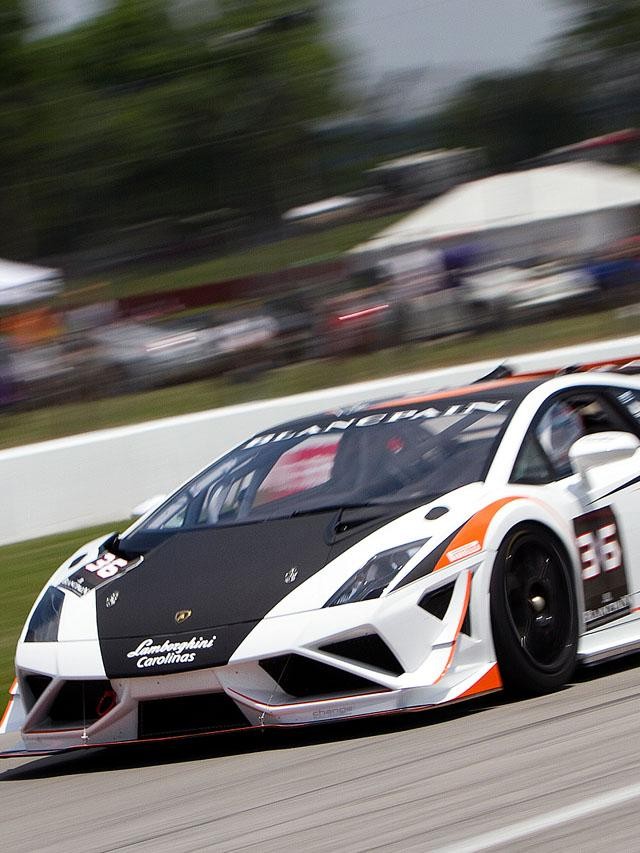
Customer racing programs are not charity. Ferrari, Porsche, and McLaren all operate one-make series or customer GT programs because they generate revenue, build brand loyalty among wealthy enthusiasts, and create a controlled environment to develop racing technology. Lamborghini’s Super Trofeo occupies a specific niche: it uses a single car platform (the Huracán Super Trofeo, which succeeded the Gallardo Super Trofeo), equalizes competition through identical machinery, and structures its categories to accommodate everyone from weekend hobbyists in the Lamborghini Cup class to aspiring professionals in the Pro division.
Squadra Corse, the same division responsible for Lamborghini’s GT3 program and the SC63 hypercar prototype, manages the series. That organizational link matters. Lessons learned from running hundreds of customer race cars across three continents feed directly into the engineering decisions behind Lamborghini’s higher-tier competition efforts. When Squadra Corse evaluates brake wear patterns, aerodynamic efficiency in traffic, or gearbox reliability under race stress, the Super Trofeo provides a massive data set that no amount of factory testing can replicate.
Viewed through that lens, the 2020 changes are not isolated tweaks. Moving the World Final to Misano puts the championship decider under the factory’s nose. Opening the Pro class to solo drivers sharpens the talent identification process. Adding Toronto tests competitors in an environment that mirrors the demands they will face if they graduate to international GT racing. Each decision tightens the connection between the Super Trofeo and the broader Squadra Corse mission.
What to Watch in the 2020 Season
The 2020 Super Trofeo North America season, as originally announced, laid out a calendar designed to test versatility: permanent circuits, a street course, and a World Final at a venue nobody in the series had raced before. The single-driver Pro rule adds a layer of strategic intrigue that the series lacked in previous years, and the Toronto debut gives North American fans a chance to see these cars in an environment that amplifies their visual and audible drama.
| Round | Venue | Date |
|---|---|---|
| 1 | Barber Motorsports Park, Alabama | April 3-5 |
| 2 | Watkins Glen International, New York | June 26-28 |
| 3 | Streets of Toronto, Canada | July 10-12 |
| 4 | VIRginia International Raceway, Virginia | August 21-23 |
| 5 | WeatherTech Raceway Laguna Seca, California | September 11-13 |
| World Final | Misano World Circuit, Italy | October 31, November 1 |
One practical note for anyone planning to follow the season: the 2020 schedule was later revised due to the global disruption caused by COVID-19. The original calendar published here reflects Lamborghini’s announced intentions as of October 2019. Revised rounds ultimately included Road America, Michelin Raceway Road Atlanta, and a condensed season that looked quite different from the plan outlined above. For historical accuracy, the original schedule represents what Squadra Corse designed before circumstances intervened.
The larger takeaway is structural. Lamborghini continues to invest in a customer racing ecosystem that spans three continents, rotates its showcase event to new venues, and refines its competitive rules to sharpen the quality of racing and the development of talent. Whether the next chapter plays out in Huracán Super Trofeo EVO machinery or transitions to a platform built around the Temerario, the infrastructure Squadra Corse built over more than a decade of Super Trofeo competition is the foundation everything else rests on.
Gallery


