A Lamborghini 1-2 Rewrites the Championship Math
Phil Keen and Adam Balon delivered the first double victory of the 2020 British GT Championship season at Snetterton, and the way they did it reveals why the Lamborghini Huracán GT3 Evo remained such a formidable customer racing weapon. The #72 Barwell Motorsport car won Race 2 outright, with the WPI Motorsport Huracán of Michael Igoe and Lamborghini Factory Driver Andrea Caldarelli finishing second. A Lamborghini lockout of the top two positions, heading into the season finale at Silverstone, fundamentally changed the championship picture.
Before Snetterton, Keen and Balon were contenders but not favorites. Now they carried genuine momentum and, crucially, would avoid a success time penalty in the next round’s opening race. That penalty system, a fixture of British GT designed to equalize front-runners, punishes recent winners with additional stationary time during pit stops. Having served no penalty in Race 2 at Snetterton because their previous best result was seventh, the pairing exploited the clean stop to devastating effect. The implication for Silverstone was clear: if they won again, they would carry a penalty into the following race, but by then the championship could already be decided.
Wet Weather Chaos and the Art of Staying on the Black Stuff
Snetterton’s weekend played out in two acts, and the contrast between them tells the real story of how the Huracán GT3 Evo‘s characteristics suited a team willing to play the long game.
Race 1 started on a damp surface. Balon, gridded ninth, spun at Palmer in the slippery conditions. That could have ended the weekend’s ambitions entirely, but the #72 crew recovered. Keen, taking over after the mandatory driver change, clawed back to seventh. It was damage limitation rather than glory, yet it kept the championship alive and, just as importantly, kept the success penalty light for Race 2.
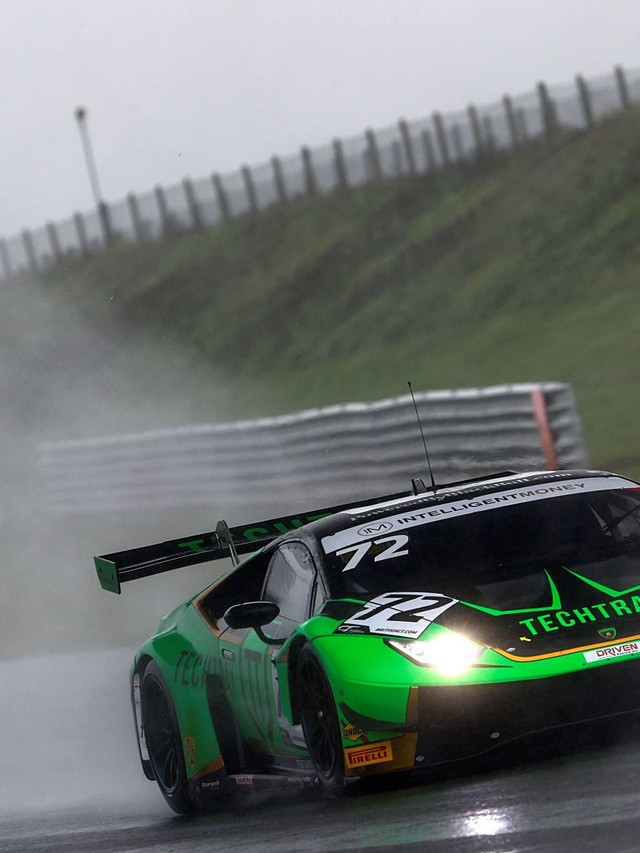
The second race was a different proposition altogether. Keen started second, on the outside of the front row alongside Barwell teammate Sandy Mitchell in the sister #78 car. The outside line at Riches offered more grip than the dirty inside, and Keen exploited it perfectly, sweeping around Mitchell into the lead on the opening lap. From that point, the race was about control rather than heroics. Keen built a gap in the first stint, handed a comfortable lead to Balon, and the gentleman driver brought it home with a six-second margin over the WPI Huracán.
“I was sort of lucky in a way being on the outside, you get a lot more grip. [Sandy] braked a little bit earlier because he didn’t have the grip on the inside. Then I just got my head down and pushed as hard as I could to try and build a lead.”
Keen’s candor about the start is telling. In GT racing, track position at Turn 1 often decides the race, and knowing which side of the grid offers better grip in mixed conditions is the kind of detail that separates experienced professionals from the rest of the field. It also speaks to the Huracán GT3 Evo’s predictability: a car that communicates grip levels clearly gives its driver the confidence to commit on a damp opening lap.

The number 72 Lamborghini Huracán GT3 Evo races through a wet track, its headlights cutting through the spray.
Three Huracáns, Three Different Weekends
Lamborghini fielded three Huracán GT3 Evos at Snetterton, and each crew experienced a wildly different weekend. That spread of outcomes illustrates both the depth of the brand’s British GT presence and the fine margins that define any championship built around Pro-Am pairings.
The #72 of Keen and Balon delivered the headline result. The WPI Motorsport #18 of Igoe and Caldarelli ran a strong, consistent weekend, finishing second in Race 2 to complete the 1-2. Caldarelli’s presence as a Lamborghini Factory Driver adds a layer of works support that benefits the entire customer racing ecosystem; when a factory driver partners with a gentleman racer, the data and feedback loop accelerates development for every Huracán on the grid.
The #78 Barwell car of Sandy Mitchell and Rob Collard endured the most frustrating weekend. Mitchell produced a breathtaking second stint in Race 1, beating the McLaren of Ollie Wilkinson to second place by just 0.081 seconds in a drag race to the finish line. That margin, roughly the length of a front splitter, is the kind of finish that makes British GT one of the most compelling national championships in the world. But the success time penalty earned from that second place, combined with a pit stop issue involving seat belts in Race 2, dropped the #78 to fifth. In a championship decided by consistency, those lost points could prove decisive at Silverstone. Balon’s own assessment of Race 2 was refreshingly honest:
“I had the much easier job after Phil pulled out a nice lead. I made a mistake in the first race and I was really conscious about not making the same mistake in this one. I’m really pleased to have stayed on the black stuff and bring it home.”
That self-awareness captures the discipline of Pro-Am GT racing. The gentleman driver’s job is often defined by what they avoid rather than what they achieve. Keeping the car clean, maintaining tire temperature, and protecting a lead built by a professional co-driver is a discipline unto itself, and the Huracán GT3 Evo’s forgiving balance made that task more manageable than it might have been in a less predictable car.
Why the Huracán GT3 Evo Kept Winning
The Huracán GT3 Evo built its reputation on naturally aspirated throttle response, predictable handling at the limit, and a reliability record that made it a favorite among customer teams worldwide. The 5.2-liter V10, developed by Lamborghini Squadra Corse in conjunction with Dallara for the aerodynamic package, gave drivers a linear power delivery that proved especially valuable in mixed conditions like those at Snetterton. When grip levels change corner by corner on a drying or dampening surface, a naturally aspirated engine’s instant throttle correlation becomes a genuine competitive advantage, exactly the kind of edge Keen leveraged on that opening lap at Riches.
Barwell Motorsport’s relationship with Lamborghini Squadra Corse stretches back years, and the team’s ability to extract consistent performance from the Huracán platform reflects that institutional knowledge. Running multiple cars in the same championship generates a data advantage: setups, tire strategies, and driver feedback from three entries feed into a shared pool that benefits every crew. The Snetterton 1-2 was not an accident of circumstance but the product of a team and manufacturer operating at a high level of coordination.
The 2020 season proved to be a landmark year for the Huracán GT3 Evo globally. Beyond British GT, one report indicates the car secured a clean sweep of the IMSA WeatherTech SportsCar Championship driver and team titles in both full-season and endurance standings with Paul Miller Racing, alongside a class victory at the 24 Hours of Spa. That breadth of success across different continents, regulations, and conditions speaks to the fundamental soundness of the platform and explains why customer teams like Barwell continued to trust it at the sharp end of their own championships.
The Bigger Picture: From Huracán to Temerario on the Grid
For Lamborghini enthusiasts watching the racing program evolve, the Snetterton result sits in a broader narrative arc. The Huracán GT3 platform, in its various iterations, defined Lamborghini’s customer racing identity for nearly a decade. Its successor, the Huracán GT3 EVO2, continued that legacy before the eventual transition to the Temerario GT3, which Car and Driver reports is the first race car entirely designed and developed at Lamborghini’s Sant’Agata Bolognese facility. That car swaps the naturally aspirated V10 for a twin-turbocharged V8, marking a fundamental shift in Lamborghini’s racing philosophy.
The move from natural aspiration to forced induction on the track mirrors the road car transition. For teams and drivers who built their programs around the Huracán’s characteristics, the shift means adapting to an entirely new powerband, different weight distribution, and the complexities of turbo management in wheel-to-wheel racing. Results like Snetterton 2020 represent the high-water mark of the naturally aspirated era in Lamborghini’s GT3 program, a period when the V10’s linear delivery and the Dallara-developed aero package combined to create one of the most successful customer racing platforms in the GT3 category.
Lamborghini also commemorated the racing Huracán’s success with limited road car editions. One report notes the Huracán EVO GT Celebration, limited to 36 units for the American market, was created to honor the GT3 Evo’s victories at the 2019 24 Hours of Daytona and 12 Hours of Sebring. That cross-pollination between the racing program and the road car lineup is something Lamborghini does particularly well, giving collectors a tangible connection to specific on-track achievements like the ones Barwell delivered at Snetterton.
What Remained at Stake Heading to Silverstone
Lamborghini’s official account of the Snetterton weekend confirmed the championship standings were reshuffled but did not publish specific points totals. What the results make clear is that Keen and Balon entered the Silverstone finale as genuine title contenders, having scored the season’s only double victory and benefiting from the success penalty system that would burden their rivals.
British GT occupies a particular niche in the motorsport landscape. It combines professional drivers with gentleman racers, rewards consistency over outright pace, and produces some of the closest racing in any GT series. For Lamborghini, sustained success in that environment validated the customer racing model that Squadra Corse built around the Huracán platform.
The Snetterton weekend also underscored a less obvious point about Lamborghini’s racing ecosystem. With three Huracáns on the grid from two different teams, and a factory driver embedded in one of the customer entries, the infrastructure supporting these cars extended well beyond a single team’s garage. That depth of commitment separates manufacturers who dabble in GT racing from those who treat it as a core part of their brand identity. The Huracán GT3 Evo was never just a race car. It was the vehicle through which an entire generation of customers, teams, and drivers experienced Lamborghini at its competitive edge, and Snetterton 2020 showed exactly why.


