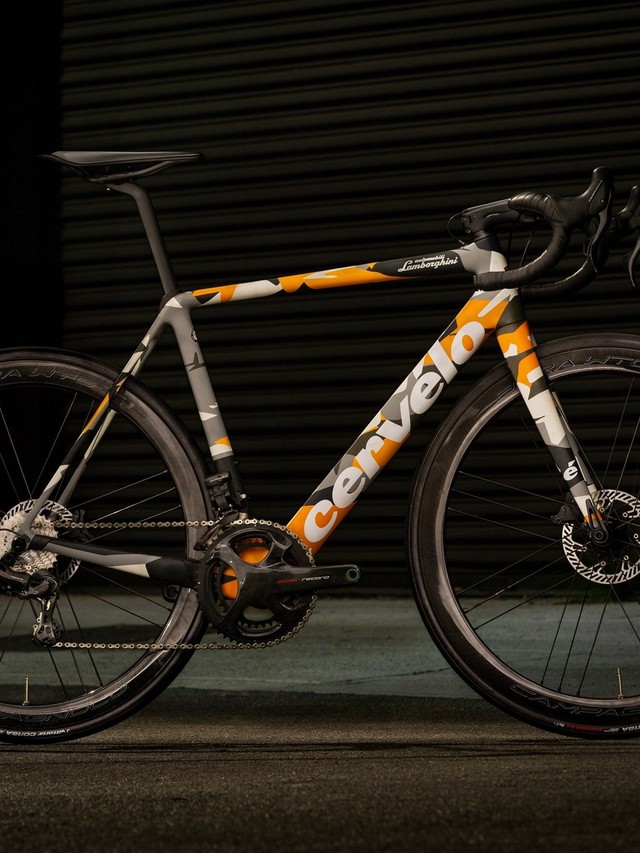
A Two-Wheeled Statement at $18,000 and 63 Units
Lamborghini and Cervélo Cycles collaborated on the Cervélo R5 Automobili Lamborghini Edition, a carbon fiber road bicycle limited to just 63 units worldwide and priced at $18,000. The number is deliberate: 63 for the year Ferruccio Lamborghini founded his company in Sant’Agata Bolognese. The bike wears a camouflage livery pulled directly from the Aventador SVJ, is fitted exclusively with Italian-made components, and is available through official Cervélo resellers and dealers.
A luxury automaker putting its badge on a bicycle could easily read as lifestyle merchandise. But the Cervélo R5 is a respected platform in serious road cycling, and the component spec here reads like a wishlist for Italian cycling purists. The real question is whether this collaboration amounts to a genuine extension of Lamborghini’s performance identity or an expensive piece of wall art for the garage. Everything about the project, from the scarcity model to the supply chain, suggests Lamborghini is betting on the former.
One report notes that the standard Cervélo R5 starts at $10,500, placing the Lamborghini Edition’s premium at roughly $7,500 for its exclusivity, bespoke livery, and curated component package. For context, that premium alone would buy a very capable mid-range road bike from most manufacturers.
Why Lamborghini Wants to Sell You a Bicycle
Supercar manufacturers branching into lifestyle products is nothing new, but the execution varies enormously. Ferrari licenses its name across clothing lines, watches, and even theme parks. Porsche sells everything from luggage to sunglasses. The typical playbook is volume licensing: keep the badge visible in affluent daily life without diluting the core automotive identity.
Lamborghini’s approach with the Cervélo R5 is far more targeted. Rather than a mass-market licensing deal, this is a scarcity play: 63 units, a single partner with genuine performance credentials, and a component list that speaks to people who actually ride rather than just collect. Lamborghini owners tend to be active, fitness-oriented, and drawn to equipment that performs as well as it looks. A limited-run bicycle built on a proven racing chassis, dressed in the livery of the company’s most celebrated Nürburgring record-holder, fits neatly into that lifestyle without cheapening the brand.
The risk is that any product outside the core lineup invites scrutiny. A poorly specified or mass-produced bicycle would undermine the very exclusivity Lamborghini trades on. The 63-unit cap and the all-Italian component strategy suggest the company understands that danger and has designed the project to avoid it.
The Aventador SVJ Connection: More Than a Paint Scheme
The Aventador SVJ famously set a Nürburgring Nordschleife production car lap record of 6:44.97 in 2018, a benchmark that cemented the car’s reputation as the most extreme road-legal Aventador ever built. Lamborghini chose that specific car’s livery for the R5, and the connection runs deeper than graphics.
Lamborghini says the bicycle’s essence is inspired by the SVJ: fast from every perspective, but distinguished by easy handling. In cycling terms, that translates to a frame designed to climb aggressively while remaining stable on descents. According to Lamborghini, the R5 Automobili Lamborghini Edition is engineered to excel on the steep uphill and downhill tracks of the Italian Dolomite Alps, about as demanding a proving ground as road cycling offers.
The camouflage pattern visible on the bike directly echoes the geometric disruption liveries Lamborghini used on pre-production SVJ prototypes during Nürburgring testing, a knowing nod to enthusiasts who followed the SVJ’s development closely. The Lamborghini crest sits prominently on the frame, yet the overall design avoids the garish branding that plagues many automotive crossover products. Grey, orange, and white tones integrate into the carbon fiber in a way that looks purposeful rather than applied as an afterthought.
Italian Components, Dissected
The “all Italian-made” claim is the detail that separates this collaboration from a simple rebadge. Every major component on the R5 Automobili Lamborghini Edition comes from an Italian manufacturer with deep roots in professional cycling:
| Component | Supplier | Role |
|---|---|---|
| Groupset | Campagnolo Super Record EPS | Electronic shifting, top-tier mechanical assembly |
| Wheels | Campagnolo Bora One | Carbon clincher, race-proven aero profile |
| Stem | Deda Elementi | Lightweight Italian alloy/carbon |
| Tires | Vittoria Corsa Pro | Handmade graphene compound, race standard |
| Saddle | Fizik Aliante | Endurance geometry, Italian design |
For cyclists, this is a genuinely compelling build. The Campagnolo Super Record EPS groupset is the company’s flagship electronic shifting system, and the Bora One wheels are a staple of professional road racing. Vittoria Corsa Pro tires are handmade and widely considered among the best-performing road rubber available. Fizik saddles are standard issue at the WorldTour level.
Lamborghini describes the bike as a tribute to the Italian flag and to Italian luxury. The component list backs that up with substance rather than sentiment. Each of these brands operates at the pinnacle of its respective category, and all are headquartered in Italy. For a Lamborghini enthusiast who also rides seriously, the provenance is genuine, reinforcing the thesis that this collaboration was built around credibility rather than mere badge appeal.
How Lamborghini’s Cycling Play Compares to the Competition
Ferrari, Porsche, and several other luxury automotive brands pursue lifestyle extensions, but their approaches differ in revealing ways. Ferrari’s brand licensing operation is vast, spanning apparel, accessories, and even a branded theme park in Abu Dhabi. The breadth is impressive, though critics argue that ubiquity can erode the sense of exclusivity that makes a supercar brand aspirational in the first place.
Porsche takes a more curated route with its Porsche Design subsidiary, producing watches, electronics, and luggage that emphasize industrial design and understated branding. McLaren, meanwhile, collaborated with Specialized on a limited-edition Tarmac SL7 bicycle that followed a similar playbook to the Cervélo R5: small production run, high-end components, livery inspired by the automotive brand’s racing heritage.
Lamborghini’s 63-unit ceiling is more restrictive than most of these efforts. The production number ties directly to brand heritage rather than market demand, positioning the R5 Automobili Lamborghini Edition closer to a collectible than a product line. If the goal were revenue, 63 units at $18,000 would be a rounding error. But if the goal is reinforcing the idea that Lamborghini’s performance ethos extends beyond four wheels, the scarcity and component quality make the argument more convincingly than a thousand branded polo shirts ever could.
For buyers already on the Lamborghini waiting list or deep in the ownership ecosystem, this bicycle functions as a membership signal. It says you understand the brand well enough to appreciate the SVJ connection, the founding-year numerology, and the Italian supply chain. That kind of insider signaling is exactly what luxury brands prize.
Does It Embody the Raging Bull Spirit?
The honest answer is: partially. The Cervélo R5 is a serious performance platform, and the Italian component spec would satisfy any discerning cyclist. The SVJ livery is tastefully executed, and the 63-unit limitation gives the product genuine rarity. On paper, Lamborghini and Cervélo checked every box that a credible brand extension requires.
What the bicycle cannot replicate is the visceral, sensory assault that defines a Lamborghini. No bicycle will pin you to a saddle with 770 horsepower or announce its arrival with the naturally aspirated scream of a 6.5-liter V12. The SVJ set its Nürburgring record through brute aerodynamic force and mechanical grip at speeds no cyclist will ever approach. Translating that essence into a 15-pound carbon frame is, by definition, an exercise in metaphor.
The practical takeaway is this: if you are a Lamborghini owner who rides seriously, the Cervélo R5 Automobili Lamborghini Edition is one of the more thoughtful automotive brand collaborations on the market. The components alone justify a significant portion of the price, and the exclusivity is real rather than manufactured through artificial marketing scarcity. If you are a cyclist with no particular attachment to Lamborghini, the standard Cervélo R5 delivers the same frame and can be built with equivalent components for less money.
Lamborghini’s broader message is clear enough. The company wants its brand to occupy space in the lives of its customers beyond the garage, and it chose to do so with a product that demands actual performance rather than passive display. Whether 63 people will pay $18,000 for that proposition is not really in doubt. The more interesting question is what comes next, and whether Lamborghini will resist the temptation to expand these collaborations into territory where exclusivity begins to erode.
Gallery


