The Man Who Preserved Lamborghini’s Past Now Controls Its Future Supply Chain
Paolo Gabrielli, the executive who founded Lamborghini Polo Storico and spent years tracking down unobtainable parts for vintage Miuras and Countachs, now oversees every supplier relationship that will define the brand’s hybrid and electric future. Automobili Lamborghini confirmed Gabrielli as its new Chief Procurement Officer, placing him at the center of the company’s Direzione Cor Tauri decarbonization strategy at a moment when what goes into a Lamborghini matters as much as what comes out of its exhaust.
Lamborghini could have recruited a supply chain specialist from the broader VW Group or poached a procurement executive from a battery supplier. Instead, the company promoted someone whose defining professional achievement involved certifying the authenticity of classic Lamborghinis and reconstructing discontinued spare parts to original specifications. That choice reveals how Sant’Agata Bolognese intends to approach electrification: not as a pure cost optimization exercise, but as a quality and identity problem.
Gabrielli takes over the role from Federico Foschini, who moved to Chief Marketing & Sales Officer in March 2021.
Direzione Cor Tauri: Why Procurement Became a Strategic Role
For most of Lamborghini’s history, procurement meant sourcing leather, aluminum, carbon fiber, and naturally aspirated engine components from a relatively stable network of Italian and European suppliers. Direzione Cor Tauri changes that equation fundamentally. Lamborghini now builds the Revuelto with a hybrid V12 powertrain incorporating three electric motors and a supercapacitor system. The Urus SE pairs a twin-turbo V8 with plug-in hybrid architecture. A fully electric model, though its timeline remains uncertain, sits somewhere in the brand’s forward planning.
Each of those vehicles demands battery cells, power electronics, electric motor components, and thermal management systems that Lamborghini never needed before. Sourcing those parts at the quality level a six-figure supercar demands, in the relatively small volumes Lamborghini produces, creates procurement challenges that look nothing like what a mass-market automaker faces. You cannot simply phone up a commodity battery supplier and expect the kind of bespoke attention that a company building roughly 10,000 cars a year requires.
One report indicates Lamborghini’s strategy targets a 40% reduction in CO2 emissions per car across the entire value chain by 2030, compared to 2021 levels. If accurate, that goal extends well beyond what happens on the assembly line in Sant’Agata Bolognese. It reaches upstream into raw materials, logistics, and supplier manufacturing processes, all of which fall under the CPO’s authority.

The Automobili Lamborghini headquarters building stands proudly under a clear sky, with national and corporate flags waving.
From Polo Storico to the Supply Chain: A Career Built on Obsessive Sourcing
Gabrielli’s path to CPO reads like a deliberate education in how components define a car’s character. Born in Mantua in 1976, he earned a Mechanical Engineering degree from Milan Polytechnic and an MBA from SDA Bocconi before starting his career at the Fiat Research and Development Center in 2000. He moved through the VW Group and served as technical support manager at Porsche Italy, gaining exposure to German engineering standards and the Group’s centralized procurement infrastructure.
When he joined Lamborghini in 2011 as Head of After Sales, he encountered a problem that most automakers consider secondary: keeping decades-old supercars alive. His solution, launched in 2014, was Polo Storico. The department certifies the authenticity of classic Lamborghinis, restores them to factory specification, reconstructs spare parts that no longer exist in any warehouse, and manages the company’s historical archives.
That work sounds romantic, and it is. But it also requires a very specific procurement skill: finding or fabricating components to exacting standards when the original supply chain disappeared decades ago. Polo Storico routinely sources or remanufactures parts for cars like the Miura, the Espada, and the original Countach, working with specialty suppliers who can match period-correct materials and tolerances. The discipline of that process, verifying authenticity, demanding precision from small-batch suppliers, refusing to compromise on specification even when a cheaper alternative exists, maps surprisingly well onto the challenge of sourcing high-performance EV components at low volumes.

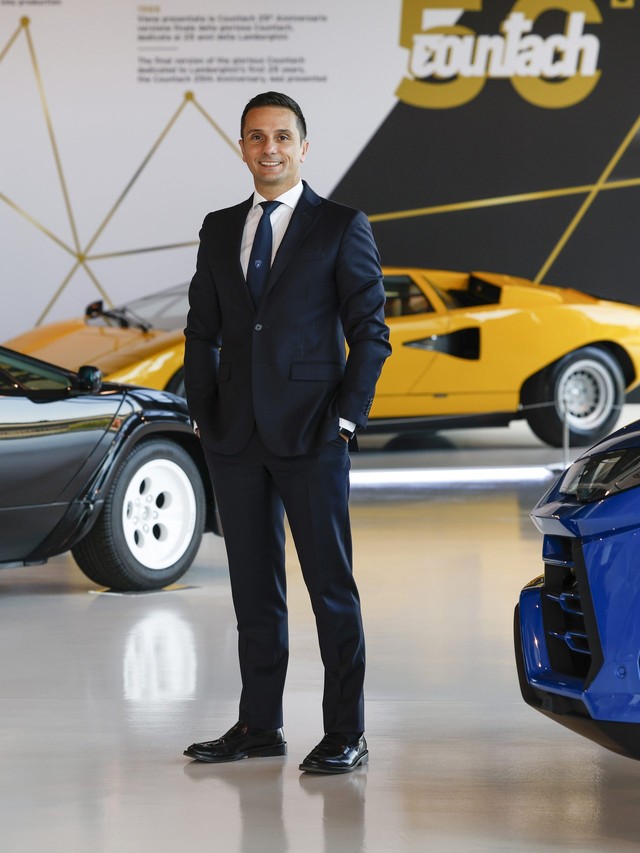
Paolo Gabrielli stands among iconic Lamborghini models, including the Countach and Urus, showcasing the brand's rich history.
Keeping the Soul: What Heritage-Informed Procurement Actually Means
The real question this appointment raises is whether a heritage mindset can translate into better decisions about battery chemistry, power electronics suppliers, and sustainable materials. The optimistic read is that Gabrielli’s instinct will be to evaluate components not just on cost and availability, but on whether they contribute to a car that feels distinctly like a Lamborghini. That distinction matters enormously as electrification threatens to homogenize the supercar segment.
Consider the tactile experience of a Lamborghini interior: the weight of a switchgear toggle, the grain of the leather, the way carbon fiber panels catch light. Those details result from procurement decisions as much as design decisions. As Lamborghini introduces more electrified models, the CPO’s supplier choices will determine whether hybrid and electric components feel integrated into the car’s character or bolted on as compliance hardware. Battery packaging, motor calibration tuning, even the acoustic profile of electric drive modes all trace back to what gets specified and sourced.
Lamborghini’s relatively small production volumes give the CPO leverage that a mass-market buyer would not enjoy. Specialty suppliers are often more willing to customize components for a prestigious, low-volume client. Gabrielli’s Polo Storico experience working with exactly those kinds of suppliers, artisans and specialists who prioritize craft over scale, could prove genuinely useful in building a supplier network for electrified Lamborghinis that prioritizes distinctiveness over commodity pricing.
How Rivals Approach the Same Problem
Lamborghini is not the only supercar manufacturer wrestling with electrified procurement. Ferrari launched its SF90 Stradale hybrid and continues developing its electric powertrain strategy, reportedly investing heavily in in-house battery and motor development to maintain control over the driving experience. Porsche, Lamborghini’s sibling within the VW Group, built an entire factory for the Taycan and established deep partnerships with battery cell suppliers. McLaren pursued a lighter hybrid approach with the Artura, sourcing a compact battery and axial-flux motor to minimize weight penalties.
What separates Lamborghini’s approach is the explicit decision to place heritage expertise at the top of the procurement hierarchy. Ferrari and Porsche tend to frame their electrification procurement around performance metrics and manufacturing efficiency. Lamborghini, by choosing Gabrielli, signals that it views the supply chain as an identity question first. Whether that philosophy produces tangibly different cars remains to be seen, but the intent is clear.
For buyers on waiting lists for the Revuelto or considering the Urus SE, this appointment offers a small but meaningful reassurance. The person selecting and managing suppliers for future Lamborghini models spent years ensuring that a 1967 Miura’s replacement part met the same standard as the original. That obsessive quality threshold, applied to hybrid and electric components, is exactly what owners of six-figure supercars expect.
What Remains Unanswered
Lamborghini confirmed the appointment and Gabrielli’s background but offered no specifics about procurement strategy changes, new supplier partnerships, or how the CPO role will interact with the company’s broader electrification timeline. The fully electric model that was once part of the Direzione Cor Tauri roadmap remains in flux; enthusiast discussion online reflects genuine uncertainty about whether Lamborghini will pursue a battery-electric vehicle at all, or pivot toward extended hybrid strategies that preserve internal combustion character.
Gabrielli inherits those open questions along with his new title. The practical answer for LamboCars readers is that this appointment matters more for what it signals than for any immediate product change. Lamborghini chose to staff its supply chain leadership with someone who understands, at a molecular level, what makes a Lamborghini feel authentic. In an era when every supercar manufacturer risks building vehicles that share the same battery modules and motor architectures, that instinct for distinctiveness could prove to be the most valuable procurement tool of all.
Gallery


