
A New V12 When Everyone Expected None
Lamborghini could have killed the V12. Every regulatory signal, every competitor’s pivot toward turbocharging or full electrification, pointed toward retirement.
The combined output of the system is reported at 1,015 CV (around 1,001 horsepower), drawn from the V12 and three electric motors working together. The electric motors and the combustion engine operate as a unified powertrain, each contributing to the total figure. That integration runs through every engineering decision in the car and separates it from anything else on sale today. McLaren’s Artura runs a turbocharged V6 hybrid.
Three Motors, One Powertrain Philosophy
The front motors also provide electric torque vectoring, independently adjusting power delivery to each front wheel to sharpen turn-in and stabilize corner exits.
The gearbox itself marks a generational leap. In fully electric mode, all four wheels can drive the car, letting owners creep through residential neighborhoods without waking anyone.
The lithium-ion battery pack carries a reported capacity of 3.8 kWh, a deliberately small number. The sprint from 0 to 100 km/h takes a reported 2.5 seconds. The sprint to 200 km/h takes less than seven seconds. Top speed exceeds 350 km/h (around 217 mph).
Carbon Bones and Sharper Lines
Claimed torsional stiffness is 40,000 Nm per degree, a figure that matters because a stiffer chassis gives engineers more freedom to tune suspension behavior without the structure flexing and muddying feedback. Weight distribution lands at a reported 44 percent front and 56 percent rear, preserving the rear bias that keeps the car planted in Lamborghini tradition.
Lamborghini reports improvements in both front and rear aerodynamic load compared to the Ultimae, though exact percentages vary across sources.

For buyers who want to move beyond the standard palette, the Revuelto is also available through Ad Personam, Lamborghini’s bespoke personalization program. The design work behind the car flows from Centro Stile Lamborghini, the brand’s in-house studio, under the direction of Mitja Borkert. Even standing still, the Revuelto reads as a car designed around a powertrain that demanded a new structure, not a reskin of the car it replaced.

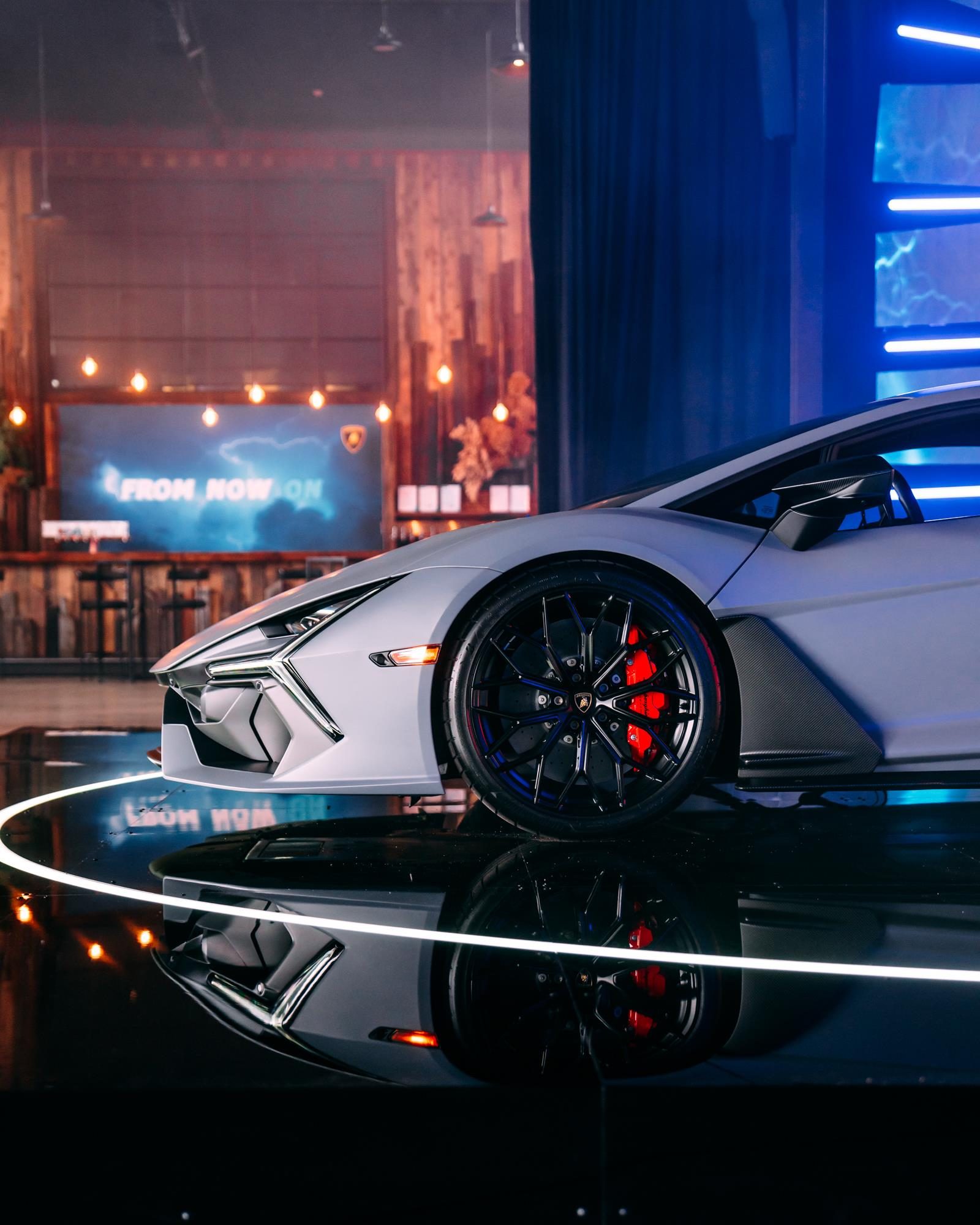
A close-up shot of the front headlight and fender of a white Lamborghini Revuelto, highlighting the intricate Y-shaped DRL design and sharp body lines.
Four Modes, Four Different Cars
The Revuelto’s driving modes do not merely adjust throttle mapping. They fundamentally reconfigure how much of the powertrain is active. Strada blends combustion and electric power for a reported 886 CV. Sport raises the combined output to around 907 CV. Only in Corsa Performance mode does the full 1,015 CV become available, with all three electric motors and the V12 working at maximum effort simultaneously. The gap between 180 CV in Citta and 1,015 CV in Corsa is a ratio of nearly six to one, making the Revuelto a meaningfully different car depending on the mode selected.

A close-up of the interior of a Lamborghini Revuelto, focusing on the steering wheel with carbon fiber accents, digital instrument cluster, and orange leather dashboard.
The V12’s Next Decade
Two distinct power characters in a single throttle application. Lamborghini’s order book filled quickly after launch, with demand reportedly covering more than two years of production. Developed at Sant’Agata Bolognese, the Revuelto represents Lamborghini’s clearest statement yet that the naturally aspirated V12 has a future, not just a past.

A close-up shot of the rear of a white Lamborghini Revuelto, focusing on the distinctive Y-shaped taillights, exhaust outlets, and aggressive diffuser.
