Lamborghini’s Podcast Pulls Back the Curtain on Supercar Sound Strategy
The third episode of Beyond: A Lamborghini Podcast pairs two people who spend their careers obsessing over what machines sound like: Lamborghini Chief Technical Officer Rouven Mohr and Charles Deneen, a composer and audio director whose credits include shaping the automotive soundtrack for The Fast and the Furious franchise. Hosted by Lamborghini Director of Communications Tim Bravo and broadcaster Giulia Salvi, the conversation zeroes in on a question every enthusiast already feels in their gut: what happens to the Lamborghini roar when the V12 shares its stage with electric motors, or eventually disappears altogether?
The episode is available on Spotify, Apple Podcasts, YouTube, and Lamborghini’s dedicated podcast hub, with new installments arriving monthly. The real value, though, lies in what Mohr says on the record. His comments amount to the clearest public statement yet of Lamborghini’s philosophy on sound authenticity during the hybrid and electric transition, and some of his conclusions are genuinely surprising.
Why Lamborghini’s Sound DNA Becomes a Strategic Problem Right Now
Every supercar brand faces the same physics: electrification mutes the mechanical drama that built decades of emotional loyalty. The stakes for Lamborghini are arguably higher than for anyone else in Sant’Agata’s competitive set. Ferrari leans on racing heritage and turbocharging expertise refined over Formula 1 generations. McLaren built its identity around lightweight engineering and aerodynamic efficiency. Lamborghini’s brand equity, by contrast, is welded to visceral, unapologetic sensory assault, and sound sits at the center of that contract with buyers.
Mohr frames the challenge bluntly. Lamborghini says transitioning from naturally aspirated to turbocharged engines, then to hybrid powertrains, and eventually to fully electric cars, all without losing the brand’s sound DNA, represents a major engineering discipline in its own right. The Revuelto is the first car that forces the company to solve this problem at the flagship level, because its V12 reaches a 9,500 rpm redline in one mode and operates in complete electric silence in another. That range, from full-blooded twelve-cylinder scream to zero mechanical noise, is wider than anything the Aventador ever asked its engineers to manage.

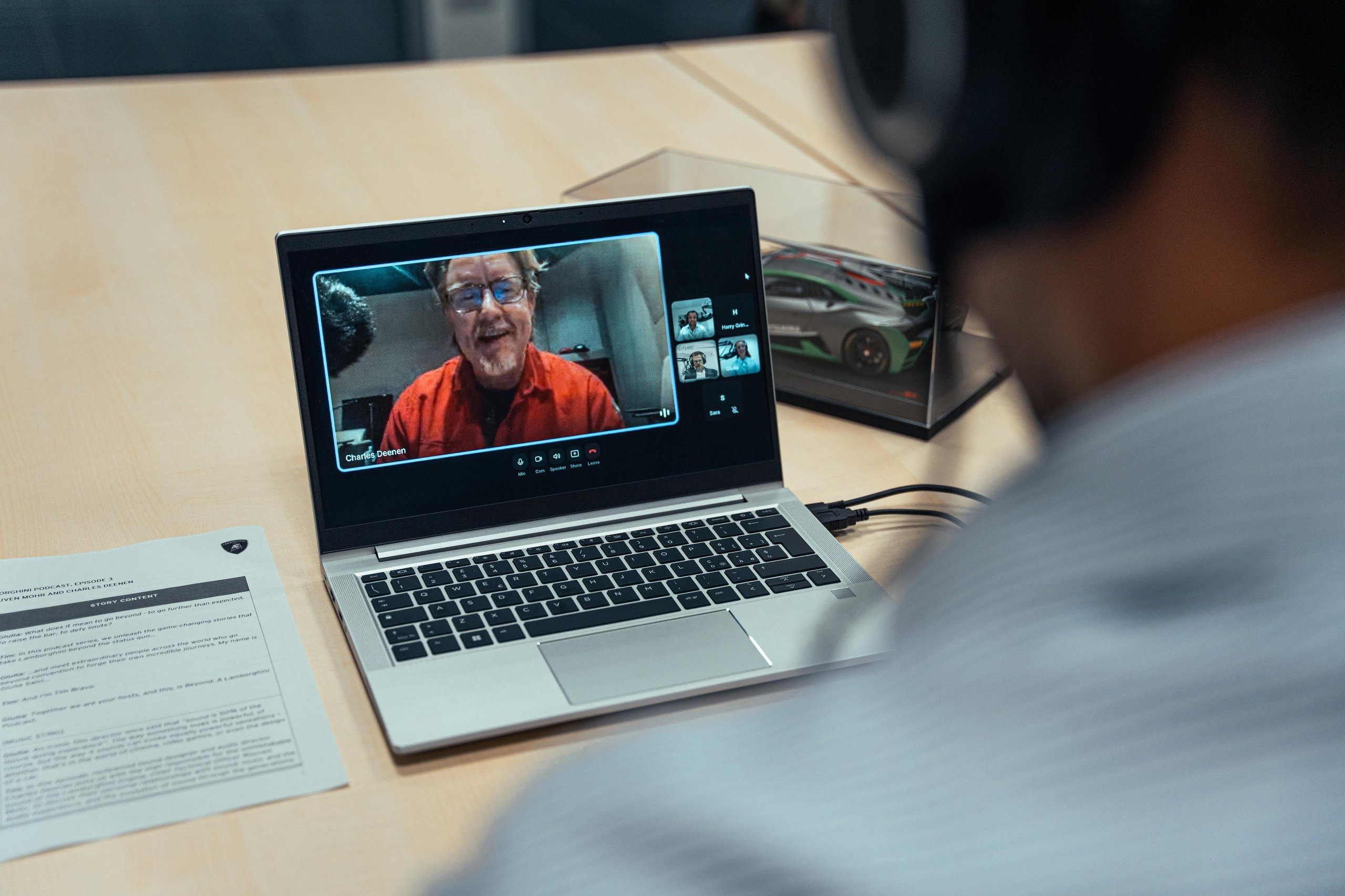
An expert shares insights during a recording session for the 'Beyond: A Lamborghini Podcast' series. Image: Automobili Lamborghini.
The Case Against Artificial Sound, Straight from Lamborghini’s CTO
Mohr’s most striking argument is his flat rejection of synthesized engine noise as a long-term solution. Lamborghini says artificial sounds decouple the auditory impression from the car’s actual physical reaction, creating a mismatch between what the driver hears and what the chassis is doing. The reactiveness of the car stops matching what the ears report. For a brand that sells the feeling of being plugged directly into a machine, that disconnect is fatal.
This position rules out the easiest path. Several manufacturers already pipe augmented or entirely fabricated engine notes through cabin speakers. It works well enough for a commuter crossover. For a car whose buyers pay seven figures partly because the experience feels raw and unmediated, Mohr argues it would be a betrayal. Lamborghini says authenticity remains a core principle, and that means sound design must embrace imperfections rather than smooth them away digitally.
“If you try to do something artificial, the sound impression is decoupled from the real physical reaction of the car.”
Deneen, approaching from the entertainment side, echoes the philosophy. His job replicating engine sounds for film and games requires capturing every reverberation, every startup quirk, every shutdown rattle, then balancing those details so they remain compelling over hours of exposure. The parallel to Lamborghini’s engineering problem is direct: a sound that thrills for ten seconds but fatigues over ten minutes is a failure in both a game and a supercar.
The Revuelto’s Sonic Signature: V12 Thunder Meets Electric Silence
Lamborghini describes the Revuelto’s V12 soundtrack as “more pulsating than ever,” which is marketing language, but it points to a real engineering decision. Rather than softening the combustion engine to blend more gracefully with the electric powertrain, Lamborghini chose to amplify the contrast. The V12 mode is uncompromising. The electric mode is genuinely silent. The car does not try to split the difference.
For prospective buyers, this matters more than it might seem on paper. Car and Driver reports that Lamborghini keeps hearing from its customers that engine sound ranks among the most important attributes of the ownership experience. The Revuelto’s approach, preserving the full-fat V12 experience while offering a discrete electric alternative, reads as a direct response to that feedback. It also explains why aftermarket exhaust developers are already working on systems designed to further liberate the V12’s voice, suggesting owners want even more acoustic drama than the factory delivers.

Diverse voices converge to discuss the latest innovations and stories from the world of Lamborghini. Image: Automobili Lamborghini.
Beyond the Engine: Defining a Lamborghini Without Sound
Perhaps the most fascinating revelation from Mohr is that his team conducted physiological research on what makes a car feel like a Lamborghini when the sound is stripped away entirely. Using noise cancellation, they measured driver responses to isolate non-auditory cues. Lamborghini says the brand’s driving DNA extends well beyond engine noise to include the shape of acceleration, the vibrations transmitted through the steering wheel, and the responsiveness of the front axle to steering inputs.
The implication for the brand’s electric future is significant. Mohr states that a Lamborghini can still be perceived as a Lamborghini even with the sound of today eliminated. If that research holds up in production vehicles, it gives the company a credible path toward a fully electric model (the Lanzador concept previews that direction) without abandoning the core emotional contract. No other supercar manufacturer, to date, has publicly described this kind of systematic, physiological approach to defining brand identity independent of powertrain noise.
Deneen adds a speculative but intriguing layer: AI could eventually tailor in-cabin music intensity to a driver’s style, building tempo with acceleration and pulling back to a simple beat during deceleration. Whether that idea ever reaches production is unknowable today, but it signals the kind of creative thinking Lamborghini is at least entertaining as the acoustic landscape changes.
Where Lamborghini Stands Against Rivals on Sound Strategy
Ferrari and McLaren face the same electrification transition, but neither company has been as explicit about its acoustic philosophy. Ferrari’s SF90 Stradale pairs a twin-turbo V8 with electric motors, a fundamentally different engine architecture that produces a different harmonic character than a naturally aspirated V12. McLaren’s Artura uses a twin-turbo V6 hybrid setup. Both cars are accomplished, but neither brand has publicly framed sound design as a standalone engineering discipline the way Mohr describes it, or published research isolating non-auditory brand cues.
Lamborghini’s advantage, at least for now, is that it still builds a naturally aspirated V12 for its flagship. Natural aspiration produces a mechanical sound that is almost impossible to fake convincingly because the frequency response tracks directly with throttle input and engine speed. Turbocharged engines muffle some of that directness by design. Mohr’s insistence on authenticity over artificiality is easier to deliver when the engine itself cooperates. The harder test comes when the V12 eventually exits the lineup.
For buyers weighing a Revuelto against a Ferrari 296 GTB or SF90, the practical takeaway is this: Lamborghini is betting that emotional authenticity in the driving experience will matter more than peak hybrid efficiency or lap-time optimization. Whether that bet pays off depends on whether the next generation of supercar buyers values sensation over specification. Based on what Lamborghini says its current customers report, the answer is yes.
What Comes After the V12: The Open Questions
Mohr’s skepticism about synthetic “spaceship” sounds raises an obvious follow-up that the podcast does not answer: if artificial noise is off the table, and the V12 eventually gives way to a fully electric powertrain, what exactly fills the acoustic void? The multi-sensory research Lamborghini describes, covering acceleration feel, steering vibration, and chassis responsiveness, offers a partial answer. Sound remains the most emotionally immediate sense in a car, though, and no amount of steering-wheel feedback fully replaces a 9,500 rpm V12 crescendo.
Lamborghini released a vinyl record in 2024 compiling V12 recordings from the Miura through the Revuelto, as Car and Driver reported. That gesture acknowledged the V12’s irreplaceability even as the company builds toward a future without it. The honest read is that Lamborghini does not yet have a complete answer for the electric era’s sound problem. What it does have is a clear set of principles: no faking, no decoupling sound from physics, and a research program that tries to define brand identity through every sense, not just hearing. Whether those principles produce a convincing electric Lamborghini remains the most consequential open question in Sant’Agata.
Gallery