A Seventh Straight Year at the Top, and What It Actually Signals
In January 2020, Automobili Lamborghini earned the “Top Employer Italia” certification for the seventh consecutive year, awarded by the Top Employers Institute, a global body that audits corporate HR practices against rigorous benchmarks. Seven years is not a publicity stunt. It reflects a sustained, externally verified commitment to how the company recruits, develops, and retains the people who design, engineer, and hand-assemble its cars.
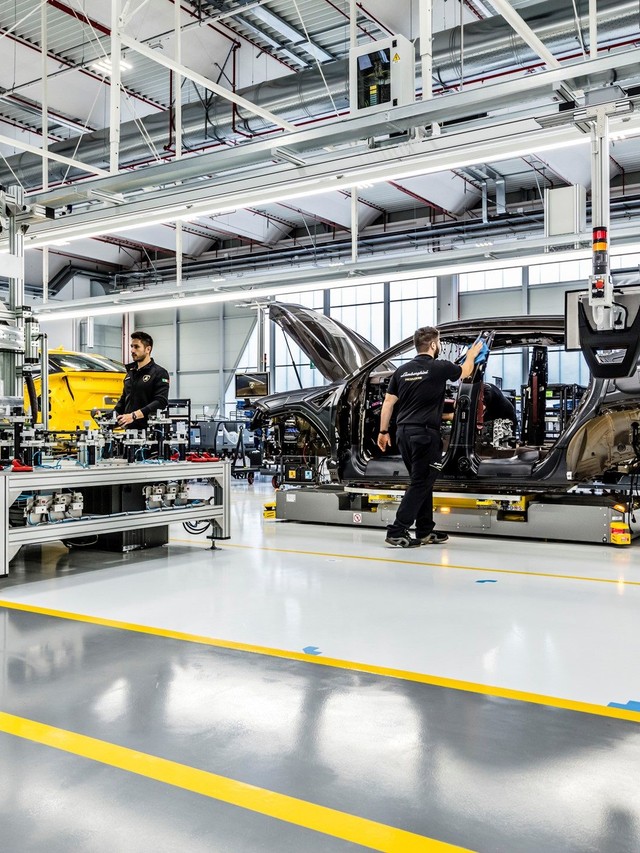
For enthusiasts, this kind of corporate story can feel distant from the roar of a V12 or the snap of a dual-clutch gearbox. The connection, though, is more direct than it appears. Lamborghini says its workforce exceeded 1,800 employees by the end of 2019, a 62% increase over five years, with an average age under 39. That growth, and the internal culture that supports it, directly shapes the quality and innovation of every vehicle that rolls out of Sant’Agata Bolognese.

The Automobili Lamborghini headquarters stands proudly under a clear sky, adorned with national and corporate flags.
The Urus Effect: Growth That Demanded a New Kind of Workforce
Lamborghini says the Urus Super SUV was the catalyst behind its corporate expansion, and the numbers bear that out. The company doubled in volumes, turnover, and physical space occupied. Over 100 new hires joined in 2019 alone, split between administrative and production roles.
Scaling a supercar company is a peculiar challenge. Unlike a volume manufacturer adding a shift at an existing plant, Lamborghini needed specialists: composite engineers, paint technicians capable of working with bespoke finishes, calibration experts for increasingly complex powertrains. Bringing those people in quickly while preserving the craftsmanship culture that defines a hand-built car requires more than competitive salaries. It requires a workplace that skilled people actively choose over the competition.
Anyone who follows Italian automotive manufacturing understands the geography at play. Ferrari, Ducati, Pagani, Dallara, and Maserati all operate within a short drive of Sant’Agata Bolognese. The talent pool for roles like CNC machinists and composite specialists is finite, and every one of those brands recruits from it. Lamborghini’s employer certification is, in practical terms, a recruiting weapon in Motor Valley’s quiet talent war.
Reverse Mentoring, Equal Pay, and the Italian Constitution
The specific programs behind the 2020 certification reveal a company thinking beyond standard corporate benefits. Lamborghini launched a pilot reverse mentoring project, pairing junior employees with senior professionals. Sixty percent of the workforce fell between ages 21 and 39, so the exchange runs both ways: younger staff bring digital fluency and fresh perspective while veterans contribute institutional knowledge and craft expertise. For a company navigating the transition to hybrid powertrains and advanced electronics, that two-way knowledge transfer is not optional.
Lamborghini also confirmed a policy of equal pay for male and female employees holding equivalent qualifications and responsibilities, and introduced enhanced parental leave benefits, including an increased supplementary allowance for new mothers during optional maternity leave. In a region where specialized talent can walk to a competitor’s front door, family support and pay equity become genuine retention tools rather than decorative policies.
Among the more unusual initiatives was a professional development program, described as unique in Italy, that provides training sessions on the Italian Constitution. The aim is to ground employees in the civic principles underpinning the company’s social responsibility framework. Paired with sustainability campaigns like a plastic-free company restaurant, collaborations with the Climate Reality Project, and volunteer work with the humanitarian NGO EMERGENCY, the picture is of a company investing in its employees as citizens, not just as production assets.
From 2020 to Direzione Cor Tauri: A Strategy That Kept Evolving
What makes the 2020 certification more than a historical footnote is the trajectory it established. Lamborghini went on to earn the same recognition every year since. Automotive World reported that by 2024, the company achieved its eleventh consecutive Top Employer Italia certification, a streak now extending to thirteen years by 2026.
Later milestones built directly on the 2020 foundation. The Lamborghini Feelosophy program, introduced in 2021, expanded employee well-being through its “Body, Mind, and Purpose” framework, eventually adding on-site psychological support sessions. The supplementary labor contract was updated to raise the economic supplement for optional parental leave from 70% to 80% of pay for the first six months when both parents take leave, with 100% coverage for single parents or children with disabilities.
Most significantly, the 2024 certification coincided with institutional approvals for Lamborghini’s Direzione Cor Tauri program, its largest-ever investment in research and development. That program includes a plan to hire at least 500 new employees by 2026. The workforce strategy seeded in 2020, when the Urus was still reshaping the company’s identity, now underpins Lamborghini’s entire electrification and decarbonization roadmap.
According to the Randstad Employer Brand 2022 award, Lamborghini ranked among Italy’s top three employers overall and first in the country’s automotive sector. For a company of its size, competing against far larger industrial groups, that ranking speaks to the disproportionate pull of the brand and its workplace culture.

A smiling executive poses for a professional portrait, exuding confidence and approachability. Image: Automobili Lamborghini.
Why Enthusiasts Should Care About HR Awards
Supercar enthusiasts tend to measure a company’s health in horsepower figures, lap times, and order backlog length. Those metrics matter. But the people assembling carbon fiber monocoques, calibrating hybrid powertrain software, and stitching Alcantara interiors are the ones who determine whether a car meets the standard its badge promises. A company that struggles to attract or retain that talent produces inconsistent cars. One that invests in its workforce, year after year, builds the institutional knowledge that separates a truly great car from a merely fast one.
Lamborghini’s approach also contrasts with the broader supercar industry’s tendency to treat labor as a cost center rather than a competitive advantage. Ferrari, operating just down the road, competes fiercely for the same pool of engineers and craftspeople. Lamborghini’s consistent, externally validated employer strategy represents a form of competitive positioning that never shows up on a spec sheet but shapes every car that does.
The practical takeaway is straightforward: a stable, well-supported workforce is one of the strongest indicators that build quality and innovation will remain high through the company’s ambitious electrification transition. The people building these cars chose to be there, and the company is working to keep it that way.
Gallery


