Nineteen Cars, Zero Remaining: Lamborghini’s Open-Top Hybrid V12 Arrives Pre-Sold
Every one of the 19 Lamborghini Sián Roadsters found a buyer before the car officially existed in public. That detail alone reveals the kind of object this is: a limited-edition, open-top V12 hybrid functioning simultaneously as a collector’s trophy, a technology demonstrator, and a philosophical argument about how Lamborghini intended to electrify its most sacred engine.
Positioned as the roofless counterpart to the Sián FKP 37 coupé, the Sián Roadster was, at the time of its debut, the most powerful Lamborghini ever produced. Combined thermal and electric output reaches 819 hp (602 kW), good for a sprint to 100 km/h in under 2.9 seconds and a top speed exceeding 350 km/h, with a weight-to-power ratio of just 2.0 kg/hp. Those figures matter, but they are not the real story. The real story is what sits between the cockpit and the engine: a supercapacitor, not a lithium-ion battery, storing and releasing energy in a way no production car had attempted before. From the moment Lamborghini chose that component, the Sián became less about peak numbers and more about a conviction that electrification should protect the V12’s character rather than compromise it.
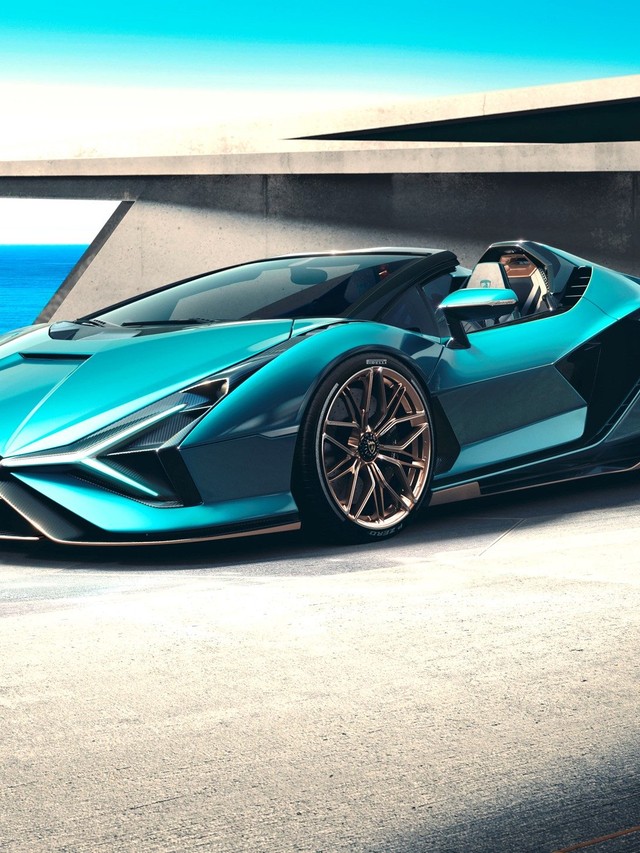
Lamborghini says the debut color, Blu Uranus, was specially selected by Centro Stile, though each of the 19 buyers could personalize their car entirely through the Ad Personam department. In practice, no two Sián Roadsters look alike, which is precisely the point for a car pitched at collectors who measure exclusivity in single digits.
A Supercapacitor Instead of a Battery: Lamborghini’s Deliberate Detour
Most manufacturers reaching for hybridization in the hypercar segment grabbed the obvious tool: a lithium-ion battery pack paired with one or more electric motors. Lamborghini looked at the same problem and chose a fundamentally different component.
A supercapacitor stores energy electrostatically rather than through chemical reactions. The practical result is that it charges and discharges at the same rate, fully replenishing every time the driver brakes. Lamborghini says its supercapacitor stores ten times the power of a lithium-ion battery of equivalent size. The entire electric system, comprising the supercapacitor and a 48-volt e-motor delivering 34 hp, weighs just 34 kg, yielding a weight-to-power ratio of 1.0 kg/hp for the electric components alone.
The trade-off is energy density. A supercapacitor cannot store enough energy for meaningful electric-only range, which is why the Sián never pretended to be a plug-in hybrid. The e-motor operates up to 130 km/h before automatically disconnecting, and its primary role is filling the torque gap during upshifts and boosting traction force in lower gears. Lamborghini claims this makes the car more than 10% faster in elasticity maneuvers than an equivalent vehicle without the system, with traction force improved by up to 10% in third gear. The e-motor also handles low-speed duties like reversing and parking under electric power alone.
This was a deliberate philosophical choice. A heavy battery pack and multiple motors would have changed the car’s weight distribution, its center of gravity, and arguably its identity. The supercapacitor, located in the bulkhead between cockpit and engine, preserved the mass centralization that a mid-engine V12 demands. Lamborghini wanted the lightest possible hybrid solution that would sharpen the V12’s responses rather than muffle them.
The V12 Unfiltered: What the Open Top Changes
Strip the roof from any V12 Lamborghini and the acoustic experience transforms completely. The Sián Roadster‘s 6.5-liter naturally aspirated engine, uprated to 785 hp at 8,500 rpm with titanium intake valves, breathes directly into the cabin with nothing between the driver’s ears and the intake trumpets but open sky. That unfiltered connection to the powertrain is exactly where the supercapacitor philosophy pays its greatest dividend: the hybrid system exists to enhance the V12’s delivery, not to overlay it with a second, competing soundtrack.
Lamborghini engineered the roadster conversion to maintain aerodynamic efficiency, routing airflow through front splitters, over the bonnet, through side intakes, and across the integrated rear spoiler. The company claims no loss of aerodynamic performance compared to the coupé, though the open cabin naturally changes the pressure dynamics at speed. The rear wing sits flush within the body profile and deploys only during driving, keeping the silhouette clean at rest.
The hybrid system’s torque-fill function during gear changes deserves particular attention in this context. In a traditional single-clutch automated manual (which the Aventador platform used), upshifts produce a momentary dip in thrust as the clutch disengages and re-engages. The Sián’s e-motor fills that gap with electric torque, smoothing the transition. Lamborghini describes this as eliminating the deceleration and missing torque felt during conventional gear changes. In an open-top car where every mechanical sensation is amplified, that refinement matters more than the spec sheet suggests. It is a genuinely clever application of mild hybridization, one that serves the driving experience rather than a regulatory checkbox.

The Lamborghini Sián Roadster, finished in a striking teal, stands poised against a backdrop of modern architecture and the serene ocean.
Design Language: Countach Echoes and Smart Materials
Viewed from above, the Sián Roadster’s proportions recall the periscopio line of the original Countach, a diagonal spine running from the cockpit rearward and terminating in aerodynamic airstreamers behind each headrest. Lamborghini says this connection was intentional, linking the brand’s most radical design moment of the 1970s to its hybrid future.
The front end sits extremely low, with an integrated carbon fiber splitter feeding air beneath the car and Y-shape headlights that became a recurring motif across the lineup. At the rear, six hexagonal taillights reference the Countach again, surrounded by active cooling vanes that use a patented smart-material technology. These vanes react to exhaust system temperature: as heat rises, shape-memory elements cause the vanes to rotate open, providing cooling without electric actuators, wiring, or added weight. It is an elegant piece of engineering that embodies the same unconventional thinking behind the supercapacitor choice: solve the problem with the lightest, simplest mechanism available, then move on.
Inside, the debut car paired a white interior with Blu Glauco detailing and Oro Electrum aluminum accents. The 3D-printed air vents, which can be customized with each client’s initials, were among the first production applications of additive manufacturing for a visible interior component at Lamborghini. For buyers spending at this level, that kind of bespoke detail separates a car from a commodity, even when the commodity in question costs seven figures.
From Sián to Revuelto: The Blueprint That Scaled
Nineteen cars cannot sustain a business model, but they can prove a concept. The concept Lamborghini proved with the Sián Roadster was that a naturally aspirated V12 could coexist with electrification without surrendering its essential character.
When the Revuelto arrived as Lamborghini’s first series-production V12 hybrid, it took a markedly different path: three electric motors, a lithium-ion battery capable of short electric-only driving, and a new dual-clutch gearbox replacing the Aventador’s single-clutch unit. The Revuelto’s system is more comprehensive, more powerful in total output, and more aligned with regulatory demands for plug-in capability. But the philosophical seed, using electrification to sharpen the V12 experience rather than apologize for it, was planted in the Sián.
The supercapacitor itself did not carry forward into the Revuelto. Its limitations in energy storage made it unsuitable for a car that needed to offer an electric driving mode for urban zones and emissions compliance. What did carry forward was the principle of torque fill, the idea that electric motors should make gear changes seamless rather than simply add range. The Revuelto’s rear-mounted e-motor performs a similar function, smoothing the transition that even a dual-clutch gearbox cannot entirely eliminate.
For collectors, the Sián Roadster occupies a peculiar and potentially very valuable position. It represents a technological dead end in one sense, since the supercapacitor approach was not repeated, and a foundational moment in another, as the first electrified V12 Lamborghini. Lamborghini confirmed no pricing at launch, and the secondary market for these cars remains almost entirely private. The confirmed details establish a 19-unit production run with full Ad Personam individualization, placing the Sián Roadster in the same rarefied air as the Veneno and Centenario in terms of collectibility.
Whether the supercapacitor returns in a future Lamborghini application remains an open question. The technology’s strengths, instant power delivery, negligible weight, and infinite charge cycles without degradation, align well with performance applications where range is irrelevant. For now, the Sián Roadster stands as proof that Lamborghini’s first instinct when confronting electrification was to protect the V12’s soul, even if it meant choosing a technology the rest of the industry ignored.


